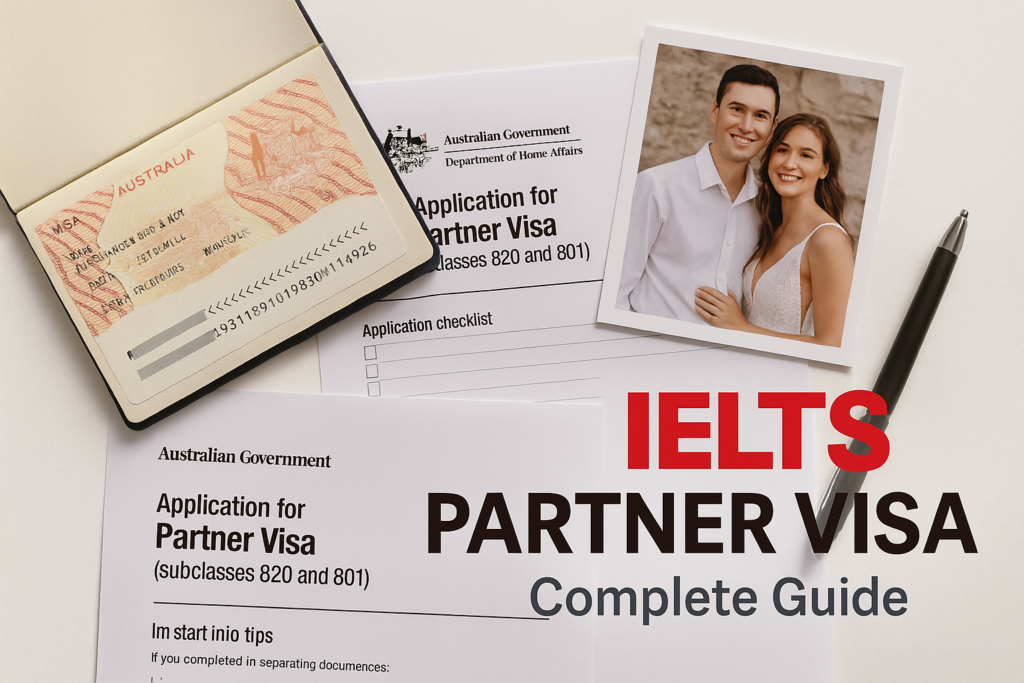
Applying for a partner visa in Australia involves careful preparation — and for many applicants, meeting the IELTS English language requirement is one of the most important steps. Whether you are sponsoring your partner or being sponsored, understanding exactly what IELTS score you need and how to achieve it can make or break your visa outcome.
This complete guide walks you through every aspect of IELTS for a partner visa: score requirements, which visa subclasses apply, how to prepare effectively, and what to do if you have already attempted the test without success. If you are not sure where your English level currently sits, the IELTS Express Pre-Test gives you a fast, affordable band prediction for just $4.99 — so you can plan your preparation before booking a real test date.
Does a Partner Visa Require IELTS?
Not every partner visa applicant needs to sit IELTS, but many do. The English language requirement depends on your nationality, where you are applying from, and the specific visa subclass involved.
For the Partner Visa (subclass 309/100 and 820/801), the primary applicant — the person being sponsored — generally must demonstrate a functional level of English to qualify for most forms of welfare and public services in Australia. While the Department of Home Affairs does not always require a formal IELTS test for grant, it often becomes necessary at various stages of the process or when applying for further visas (such as citizenship or permanent residency) down the line.
Additionally, if you are applying for Australian citizenship after holding a partner visa, you will need to demonstrate English competency, and IELTS is the most commonly accepted evidence.
Certain exemptions apply if you are a citizen of the UK, USA, Canada, New Zealand, or Ireland — countries where English is the primary language. Check the Department of Home Affairs website or consult a registered migration agent to confirm your specific requirement.
What IELTS Score Do You Need for a Partner Visa?
For most Australian visa and migration purposes, the benchmark score is IELTS band 6.0 overall, with no individual section below 5.0. However, the exact requirement varies:
- Functional English (for general visa grant): Often demonstrated by an IELTS overall score of 4.5 or a score of at least 4 in each component
- Vocational English (required for some skilled and professional visas): IELTS 5.0 in each component
- Competent English (commonly required for citizenship, PR, and some occupations): IELTS 6.0 in each of the four components
- Proficient English (required for some professional registration bodies): IELTS 7.0 in each component
- Superior English: IELTS 8.0 in each component (rare, required by some healthcare boards)
If your partner visa pathway will eventually lead to permanent residency or citizenship, planning for a minimum of IELTS 6.0 in all four sections from the start is the safest approach. It avoids the need to resit the test later.
IELTS General Training vs IELTS Academic: Which One for a Partner Visa?
For most partner visa and migration purposes, you need to sit IELTS General Training, not IELTS Academic.
IELTS Academic is designed for people entering university or professional registration pathways. It tests academic reading and writing skills, and is typically required for university admission or professional body registration (such as doctors, nurses, and engineers).
IELTS General Training assesses practical everyday English — the type used in workplaces, social settings, and general communication — which is more appropriate for migration and residency applications.
Both versions assess the same four skills (Listening, Reading, Writing, Speaking) and use the same band score scale. The key difference is in the Reading and Writing tasks, where IELTS General Training uses non-academic material.
Always confirm with your migration agent or the Department of Home Affairs which version your specific pathway requires, but for partner visas the answer is almost always IELTS General Training.
How to Prepare for IELTS for a Partner Visa
Preparing for IELTS with a visa deadline in mind requires a different mindset than general exam preparation. You are not just trying to improve — you are trying to hit a fixed score by a fixed date, with real consequences if you do not.
Here is a practical approach that works well for partner visa applicants:
Step 1: Know Your Starting Point
Before building a study plan, find out your current band score across all four sections. Many applicants overestimate their listening but underestimate the writing component, or vice versa. A diagnostic test removes the guesswork. The Unlimited IELTS Mock Tests platform lets you run timed, realistic practice tests across all four skills so you can identify exactly where your gap is before investing in months of preparation.
Step 2: Set a Realistic Timeline
The time you need depends entirely on how far you are from your target score. As a general guide:
- 0.5 band score improvement: 4–6 weeks of focused daily study
- 1.0 band score improvement: 8–12 weeks minimum
- 1.5+ band score improvement: 3–6 months with structured support
Do not book your test date before you have confirmed your baseline. Sitting the real test before you are ready wastes money and adds stress — and if your application has a deadline, a premature attempt can cause serious delays.
Step 3: Focus on Your Weakest Section First
Since visa requirements often specify a minimum in each component, a single weak section can disqualify your result even if your overall average looks fine. A score of 7, 7, 7, 4 does not meet the “6.0 in each section” requirement — focus your time disproportionately on lifting your lowest band.
Step 4: Use Official Practice Materials
The official Cambridge IELTS practice books remain the gold standard for preparation. Use them alongside timed mock tests to build the pace and stamina the real exam demands. For Writing in particular, getting actual feedback on your responses is critical — self-marking only gets you so far.
Band Score Breakdown by Section for Partner Visa Applicants
Here is what each section requires at the Competent English level (IELTS 6.0 overall, 6.0 in each section), which is the target most partner visa applicants should work toward:
- Listening: Answer approximately 30 out of 40 questions correctly. Practice with a range of accent types — Australian, British, American — since real tests include all of them.
- Reading (General Training): At band 6, you need to answer around 23–26 of 40 questions correctly. General Training reading includes texts from notices, advertisements, workplace policies, and general interest articles.
- Writing: Task 1 (letter writing) and Task 2 (essay) are each scored separately, then averaged. Task 2 is worth double the weight. A clear structure, relevant vocabulary, and grammatically accurate sentences are the key markers at band 6.
- Speaking: At band 6, examiners expect clear communication with some errors that do not impede understanding. Fluency, vocabulary range, and grammar accuracy are assessed across three parts of a face-to-face interview.
For detailed section strategies, the IELTS General Training Migration Guide covers score targets, section tips, and preparation timelines specifically for migration applicants.
Common Mistakes Partner Visa Applicants Make With IELTS
After helping thousands of IELTS students prepare for migration-related tests, these are the most frequent errors we see from partner visa applicants:
- Sitting the Academic test instead of General Training: This is a disqualifying error. Make sure you book the correct version.
- Booking too early without a diagnostic: Spending test fees before knowing your starting point is avoidable. Always test yourself first.
- Ignoring the Writing section: Speaking and Listening feel more natural, so applicants often under-prepare Writing. Writing band scores are the most common reason for a failed result.
- Not understanding the section minimum rule: An overall score of 6.5 with a 5.0 in Writing does not meet most requirements. Every section must meet the threshold.
- Using outdated practice materials: IELTS test formats and task types have evolved. Practice with current materials (Cambridge IELTS 17–20) rather than older books.
- Not factoring in result processing time: Test results take up to 13 days for paper-based and up to 3–5 days for computer-based. Factor this into your visa timeline.
Ready to find out your IELTS band score?
Take the IELTS Express Pre-Test for just $4.99 and get your personalised band prediction with a 14-day improvement plan.
Frequently Asked Questions
Is IELTS mandatory for a partner visa in Australia?
Not always at the initial grant stage, but English language requirements do apply in many partner visa pathways — particularly when transitioning to permanent residency or citizenship. Many applicants are required to sit IELTS to demonstrate Functional, Vocational, or Competent English. Check the specific requirements for your visa subclass with the Department of Home Affairs or a registered migration agent.
What IELTS score is needed for a partner visa?
For Functional English (often required at the partner visa stage), a minimum IELTS score of around 4.5 overall is typical. For permanent residency and citizenship pathways that follow a partner visa, Competent English at band 6.0 in all four components is the standard benchmark. Check your specific requirements before setting your target score.
Which IELTS test should I take for a partner visa?
IELTS General Training is the correct version for partner visa and migration purposes. IELTS Academic is for university admission and professional registration. Booking the wrong version means your result will not be accepted, so confirm before registering.
How long is an IELTS result valid for a partner visa?
IELTS test results are valid for two years from the test date. If your result expires before your visa is granted or finalised, you may need to resit. Plan your test timing carefully, especially if there are known processing delays on your visa subclass.
Can I resit IELTS if I do not get the required score?
Yes. You can sit IELTS as many times as needed. There is no limit on attempts. If you narrowly miss one section’s requirement, you may also be able to apply for an IELTS One Skill Retake — a newer option that lets you resit a single section rather than the entire test, saving both time and money.
How do I prepare for IELTS General Training for a partner visa?
Start with a diagnostic to establish your baseline band score across all four sections. Then target your weakest section first, since every component must meet the minimum — not just the overall average. Use official Cambridge practice tests, run timed mock exams, and seek feedback on your Writing responses. For step-by-step preparation advice, see the full IELTS Preparation Complete Guide.