If your IELTS Writing Task 2 score has been sitting at Band 6 and you need a 7, you are closer than you think. The gap between these two bands is not about writing longer essays or using more complex vocabulary. It is about precision — knowing exactly what the examiner is looking for and consistently delivering it. This guide breaks down the four marking criteria, the specific weaknesses that keep writers at Band 6, and the concrete actions that push you to Band 7.
Before diving in, it helps to know where you currently stand. The IELTS Express Pre-Test gives you a personalised band prediction in each skill area, so you can confirm whether Writing Task 2 is truly your ceiling and target your preparation precisely.
Understanding the Band 6 to 7 Gap in IELTS Writing Task 2
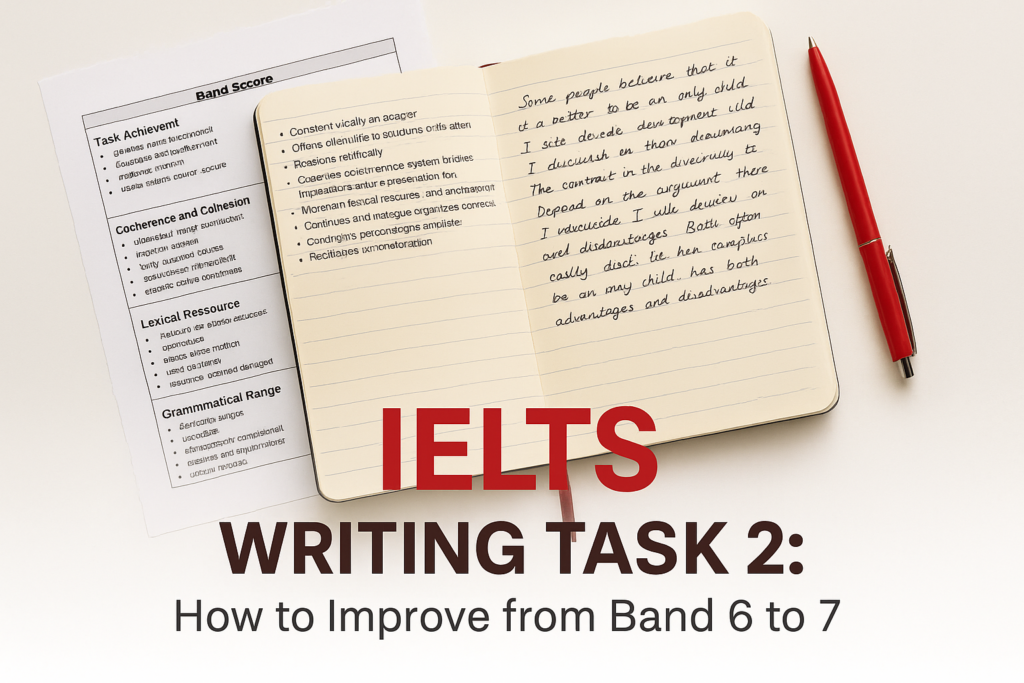
The IELTS Writing Task 2 marking rubric has four equally weighted criteria, each worth 25% of your score:
- Task Achievement (TA) — did you fully address all parts of the question?
- Coherence and Cohesion (CC) — is your essay logically organised and easy to follow?
- Lexical Resource (LR) — do you use a wide enough range of vocabulary accurately?
- Grammatical Range and Accuracy (GRA) — do you use varied sentence structures with few errors?
At Band 6, you are producing a readable, competent essay with clear ideas but noticeable limitations in at least two of these areas. At Band 7, the examiner sees an essay that is well-organised, appropriately extended, and shows genuine control — not just effort. The shift is less about trying harder and more about making smarter, more targeted choices.
Task Achievement: From Partial to Full Response
The most common Band 6 mistake in Task Achievement is addressing only part of the question. Many test takers focus heavily on one side of a discussion or develop just one aspect of a multi-part question. The examiner wants to see that you have understood all parts of the task and addressed each one sufficiently.
What Band 6 looks like: The essay has a clear main idea but the response is not fully developed. The writer might state an opinion without clearly defending it, or list reasons without explaining their significance.
What Band 7 looks like: The position is clear and consistently maintained throughout. Every point is extended with an explanation or example. If the question asks “to what extent do you agree”, the essay does not just say “I partly agree” — it explains specifically which parts, why, and with what nuance.
Action step: Before writing, underline every instruction in the question. Write one sentence per instruction confirming what you will cover. If the prompt says “discuss both views and give your own opinion”, your essay must do all three — and your opinion must appear in both the introduction and conclusion.
Coherence and Cohesion: Organising Ideas That Flow
Band 6 writers often have good ideas but struggle to connect them smoothly. Paragraphs may start well but then lose direction. Linking words get used heavily — “firstly”, “secondly”, “in addition”, “moreover” — but the essay still feels mechanical rather than logical.
The Band 7 shift: Cohesive devices are used flexibly, not mechanically. The essay uses a mix of connectors (however, therefore, consequently), pronoun reference, and sentence-level linking. Each paragraph has a clear central idea, and every sentence in that paragraph directly supports it.
Paragraph structure for Band 7:
- Topic sentence — state the main point of the paragraph clearly
- Explanation — explain why this point is relevant or true
- Example or evidence — support the point with a specific detail
- Link — show how this point connects to your overall argument
This structure, applied consistently across three to four body paragraphs, is the backbone of a Band 7 essay.
Lexical Resource: Moving Beyond Safe Vocabulary
At Band 6, vocabulary is adequate but repetitive. Writers tend to use the same words from the question, rely on a small set of common phrases, and avoid unusual or less common vocabulary out of fear of making mistakes.
Band 7 requires you to show range — using vocabulary that is precise, varied, and sometimes uncommon — while maintaining accuracy. You do not need to force difficult words into every sentence. You need to show that you can choose the right word for the right context.
Practical upgrades for lexical resource:
- Paraphrase the question prompt words in your introduction rather than copying them
- Use collocations correctly: “raise awareness”, “address a problem”, “pose a challenge” (not “do a problem”)
- Vary your noun-verb choices: instead of “people think”, use “individuals argue”, “critics contend”, “proponents suggest”
- Use less common vocabulary accurately in context — one or two well-chosen words per paragraph is enough
The IELTS Writing Task 2 Band Score Strategy guide covers lexical resource in more depth, including which vocabulary types examiners reward most.
Grammatical Range and Accuracy: Reducing Errors Without Losing Complexity
Grammar is where many Band 6 writers leave points on the table. The issue is usually not a lack of grammar knowledge — it is inconsistency. A writer might produce a perfectly complex conditional sentence and then make a basic article error in the next line.
Band 7 does not mean zero errors. It means the errors are minor and infrequent, and the range of structures is genuinely varied.
Structures that signal Band 7 control:
- Relative clauses: “The policies that governments have introduced have had mixed results.”
- Passive constructions: “It has been argued that economic growth cannot be sustained indefinitely.”
- Conditional sentences: “If more resources were allocated to education, the long-term economic benefits would be significant.”
- Nominalisations: “The globalisation of trade” (not “the way trade has become global”)
Error reduction strategy: Write your essay, then proofread specifically for your known weak points. Common Band 6 errors include missing articles (a/an/the), subject-verb agreement in complex sentences, and incorrect preposition use. Spend the last three minutes of your test on a targeted grammar check rather than adding more content.
A Practical Improvement Plan: Four Weeks to Band 7
Moving from Band 6 to Band 7 is achievable within a focused four-week block if you practise deliberately rather than just writing more essays.
Week 1 — Task Achievement focus: Write three essays specifically practising full question response. After writing each one, check: did I address every part of the question? Is my position clear in the introduction and conclusion? Did I extend every main point with explanation and example?
Week 2 — Cohesion and paragraph structure: Write two essays using the four-part paragraph structure (topic sentence, explanation, example, link). Practise varying your cohesive devices — avoid starting more than two body paragraphs with “Firstly” or “Another reason”.
Week 3 — Vocabulary and grammar upgrade: Before writing each essay, prepare five to eight topic-relevant collocations and two or three less common vocabulary items you plan to use. After writing, identify every instance where you repeated a word from the question prompt — rewrite those sentences with paraphrased alternatives.
Week 4 — Timed practice and self-marking: Write two timed essays under real exam conditions (40 minutes, no dictionary). Use the four-criteria rubric to self-assess each essay against Band 6 and Band 7 descriptors. The Unlimited IELTS Mock Tests platform gives you access to full practice tests with band score feedback to track your progress.
Common Band 6 Mistakes to Stop Immediately
These are the most frequent errors that keep IELTS Writing Task 2 responses at Band 6:
- Stating opinions without defending them — “I believe pollution is a serious problem” is not an argument. Explain why, for whom, and with what consequences.
- Using the same linking word repeatedly — “Moreover” used three times in one essay signals limited range to the examiner.
- Writing an introduction that is too long — Your introduction should be two to three sentences: background context, a paraphrase of the topic, and your position. Save the content for body paragraphs.
- Ignoring word count — 250 words is the minimum. Most Band 7 essays are 280 to 320 words. A short essay almost always loses Task Achievement marks.
- Over-correcting during writing — Writing slowly and editing constantly wastes time. Draft at speed, then proofread at the end.
Ready to find out your current IELTS band score?
Take the IELTS Express Pre-Test for just $4.99 and get your personalised band prediction with a 14-day improvement plan.
Frequently Asked Questions
How long does it typically take to improve from Band 6 to 7 in IELTS Writing Task 2?
For most learners who practise deliberately, four to eight weeks of focused preparation is enough. The key is targeting the specific criteria where you lose marks rather than writing many essays without feedback.
Do I need to write more than 250 words to get Band 7?
Yes, in practice. While 250 words is the minimum, most Band 7 responses are between 280 and 320 words. A longer essay gives you more space to fully develop your arguments and show vocabulary and grammar range.
Is it better to use complex vocabulary or simpler, accurate vocabulary in IELTS Writing Task 2?
Accuracy matters more than complexity. An incorrectly used complex word lowers your Lexical Resource score. The goal is to use a range of vocabulary — including some less common items — accurately. One well-chosen uncommon word per paragraph, used correctly, is far better than multiple advanced words used incorrectly.
What is the most important criterion to improve for the Band 6 to 7 jump?
Task Achievement and Coherence and Cohesion are where most Band 6 writers lose the most ground. Focus on fully answering every part of the question and organising your paragraphs clearly before worrying about advanced vocabulary or grammar.
Can I use a template essay structure for IELTS Writing Task 2?
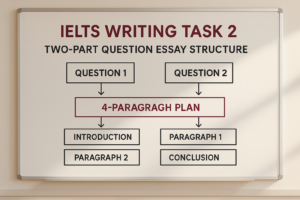
A basic structure is useful, but a rigid template can hurt your score if it prevents you from responding naturally to the question type. At Band 7 level, examiners expect you to adapt your structure to the task — whether it is a discussion, opinion, problem-solution, or two-part question.
Where can I find Writing Task 2 practice essays with band score feedback?
The IELTS Writing Task 2 Band Score Strategy guide includes worked examples at different band levels. For full practice test access with scoring, see the IELTS preparation plans at Career Wise English.