IELTS Writing Task 2 trips up thousands of test-takers every year — not because the topics are impossibly hard, but because of the same repeatable mistakes. Missing a word count, misreading the question, or writing an essay that sounds more like a conversation than an academic argument can each cost you a full band. The frustrating part is that most of these mistakes are entirely preventable once you know what to look for.
If you are not sure where your writing currently stands, the IELTS Express Pre-Test gives you a personalised band prediction in minutes — so you can identify exactly which Task 2 weaknesses to fix before your exam date.
Mistake 1: Not Fully Answering the Question
Task Achievement is worth 25% of your Writing Task 2 band score, and it is one of the most common places candidates lose marks. The examiner is checking whether you addressed every part of the question — not just the part that was easiest to write about.
Many questions have two or more sub-parts. For example: “Do the advantages of this trend outweigh the disadvantages? Give reasons for your answer and include any relevant examples.” A candidate who only lists advantages without weighing them against disadvantages has not fully completed the task. Similarly, if a question asks for your opinion, you must give a clear, consistent position — not sit on the fence and refuse to commit.
Before you write a single sentence, underline every instruction in the question. Ask yourself: what exactly is being asked? Write your answer to each part before you start your essay plan.
Mistake 2: No Essay Plan and a Weak Structure
Walking into a 250-word essay without a plan is a fast way to lose marks on Coherence and Cohesion — another 25% criterion. Many candidates start writing immediately because they are anxious about time, but skipping the planning stage almost always costs them more time than it saves.
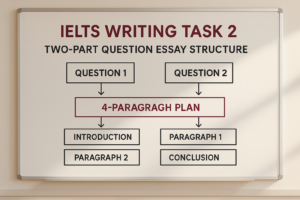
A solid IELTS Writing Task 2 essay has a predictable, examiner-friendly structure: an introduction that paraphrases the question and states your position, two body paragraphs that each develop one main idea with a supporting example, and a conclusion that restates your overall view without introducing new information.
Spending three to four minutes on a rough plan before you write gives you a roadmap. This means you write faster, stay on topic, and avoid the classic mid-essay panic where candidates realise they have nothing left to say. For a deeper look at building that framework, the IELTS Writing Task 2 Argument Framework guide walks through the exact structure for band 7 and above.
Mistake 3: Using Informal Language and Weak Vocabulary
IELTS Writing Task 2 is an academic writing task. Using casual language — contractions like “don’t” or “it’s”, colloquial phrases like “a lot of people”, or vague words like “things” and “stuff” — signals to the examiner that your Lexical Resource is limited.
Equally damaging is the opposite extreme: forcing low-frequency vocabulary into sentences where it does not fit naturally. Examiners are trained to spot misused “impressive” words. Using “utilise” when “use” is correct, or “commence” when “start” is perfectly appropriate, does not increase your score — it can actually lower it if the word is used inaccurately.
The goal is precise, varied vocabulary used correctly. Learn a bank of topic-related academic words, practise using them in sentences before your exam, and always double-check that a word fits the context.
Mistake 4: Grammar Errors That Examiners Notice Immediately
Grammatical Range and Accuracy is the fourth 25% criterion, and it covers two distinct things: whether you are using a range of grammar structures (not just simple sentences), and whether those structures are accurate.
The most common grammar mistakes in IELTS Writing Task 2 include subject-verb agreement errors (“the government have decided”), incorrect article use (“the people should exercise”), run-on sentences with no punctuation, and over-reliance on one or two sentence types. Writing only short, simple sentences keeps you at Band 5 level, no matter how accurate they are.
To push into Band 7+, practise writing complex sentences with relative clauses, conditionals, and passive constructions — but only use them when they add clarity, not just complexity for its own sake. Proofread your last paragraph before time is called; it is the section most likely to contain rushed errors.
Mistake 5: Ignoring Coherence — Your Essay Feels Like a List
A coherent essay guides the examiner from one idea to the next without confusion. When candidates use weak or repetitive linking words — or none at all — the essay reads like a disconnected list of points rather than a developed argument.
There is a common pattern here: candidates learn a set of linking words (“Furthermore”, “In addition”, “Moreover”) and then use all of them in every paragraph, which actually signals limited range rather than strong coherence. Real coherence comes from clear topic sentences that introduce each paragraph’s main idea, logical development within each paragraph, and varied transitions that reflect the actual relationship between ideas.
Each body paragraph should follow a tight structure: topic sentence → explanation → example → link back to the question. If a reader can remove a sentence from your paragraph without losing the argument, that sentence is probably not pulling its weight.
Mistake 6: Mismanaging Your Time
IELTS Writing has two tasks and 60 minutes total. Task 2 should take approximately 40 minutes. A significant number of candidates run over on Task 1, leaving themselves only 25–30 minutes for the more heavily weighted Task 2 — which is a costly mistake given that Task 2 is worth twice as much as Task 1.
Similarly, candidates who spend so long drafting perfect sentences that they never reach 250 words will be penalised regardless of quality. Word count is a hard minimum — not reaching 250 words results in an automatic Task Achievement penalty.
Practise writing complete Task 2 essays under strict timed conditions. Aim for 40 minutes door-to-door: three to four minutes planning, around 30 minutes writing, and three to four minutes checking. Use unlimited IELTS mock tests to build your pacing before exam day.
Mistake 7: Repeating the Question in Your Introduction
A surprisingly common mistake — and one that directly caps your Lexical Resource score — is copying phrases from the question prompt word-for-word into your introduction. Examiners are trained to recognise this, and copied language is not assessed as part of your score. An introduction that largely mirrors the original question essentially wastes your word count.
Instead, paraphrase the question using your own words: swap key nouns for synonyms, change sentence structure, and reframe the idea. Then add a clear thesis statement that tells the examiner your position. That two-sentence introduction — paraphrase + thesis — sets you up for a strong Task Achievement score before you even reach your first body paragraph.
Ready to find out your IELTS band score?
Take the IELTS Express Pre-Test for just $4.99 and get your personalised band prediction with a 14-day improvement plan.
Frequently Asked Questions
What is the most common mistake in IELTS Writing Task 2?
Not fully answering the question is the single most common and most damaging mistake. Task Achievement is worth 25% of your score, and many candidates address only part of the question — missing sub-parts or failing to give a clear position when the question asks for one.
How many words do I need to write for IELTS Writing Task 2?
You must write a minimum of 250 words. There is no maximum, but most high-scoring responses are between 270 and 320 words. Writing significantly over 350 words risks introducing more errors and using up time you need for checking.
Can I use informal language in IELTS Writing Task 2?
No. IELTS Writing Task 2 requires a formal, academic register. Avoid contractions (don’t, it’s), colloquial phrases (“a lot of people”), and vague vocabulary (“things”, “stuff”). Using informal language is penalised under Lexical Resource and will limit your score to Band 5 or below.
How do I avoid repeating the question in my introduction?
Paraphrase the question using your own words — change the vocabulary, restructure the sentence, and add a clear thesis statement. Do not copy phrases directly from the prompt. Examiners are trained to identify copied language, and it is excluded from your word count assessment.
How much time should I spend on IELTS Writing Task 2?
Allocate roughly 40 minutes to Task 2 and 20 minutes to Task 1. Within your 40 minutes, use approximately 3–4 minutes for planning, 30 minutes for writing, and 3–4 minutes for checking grammar and coherence. Practise this split during mock tests so it becomes automatic on exam day.