Writing about crime and punishment in IELTS Writing Task 2 is one of the most common challenges test-takers face. These essays require you to balance clear argument structure with specific vocabulary — two things that often trip up candidates aiming for Band 7 or above. Whether you are asked to discuss causes, evaluate punishment approaches, or weigh the effectiveness of rehabilitation versus deterrence, the same core skills apply.
Before we dive into the sample essay, take the IELTS Express Pre-Test to find out your current band score and identify which writing skills need the most attention. It takes less than 20 minutes and gives you a personalised improvement plan.
What IELTS Crime and Punishment Essays Look Like
Crime and punishment is a recurring topic in IELTS Academic and General Training Writing Task 2. You will rarely be asked to write about actual laws or court systems. Instead, the questions focus on social issues, human behaviour, and policy debate. Common question angles include:
- Should punishment focus on deterrence or rehabilitation?
- Is crime increasing because of poverty, poor parenting, or media influence?
- Should governments spend more on preventing crime or punishing criminals?
- Do stricter punishments actually reduce crime rates?
- Is capital punishment ever justified?
The essay type is usually an opinion essay (agree/disagree), a discussion essay (two views), or a problem/cause-solution format. Knowing the question type before you start writing is essential — it changes your structure entirely.
Sample IELTS Essay Question: Crime and Punishment
Question: Many people believe that the best way to reduce crime is to give longer prison sentences. Others, however, feel that there are better ways to reduce crime. Discuss both views and give your own opinion.
Sample Band 7+ Essay Answer
The relationship between prison sentences and crime rates is widely debated among policymakers and social researchers. While some argue that harsher penalties act as a strong deterrent, others contend that alternative approaches are far more effective in reducing criminal behaviour over the long term. This essay will examine both perspectives before presenting a reasoned position.
Those who support longer prison sentences believe that fear of punishment discourages potential offenders. The logic is straightforward: if the consequences of committing a crime are severe enough, rational individuals will choose not to break the law. Countries with high incarceration rates often report lower levels of certain violent crimes, which supporters use as evidence that strict sentencing works. In addition, keeping convicted criminals behind bars for extended periods removes them from society, providing a form of public protection during that time.
However, critics of this approach point out that most crimes are not committed after careful deliberation. Many offenders act impulsively, under the influence of substances, or out of desperation — situations in which the threat of a long sentence provides little deterrent. Furthermore, prison environments can expose individuals to hardened criminals, increasing the likelihood of reoffending upon release. Research across multiple countries consistently shows that nations with shorter sentences but stronger rehabilitation programmes achieve lower recidivism rates than those relying primarily on lengthy incarceration.
In my view, the most effective crime reduction strategy combines proportionate punishment with meaningful rehabilitation. Prison sentences serve an important function in protecting the public and signalling societal disapproval of harmful behaviour. Yet they should not be the default response to all crime. Investment in education, mental health support, and vocational training inside correctional facilities equips offenders with the tools to reintegrate productively into society. When people leave prison with skills, stability, and support networks, they are far less likely to reoffend.
In conclusion, while longer sentences may offer some deterrent effect, they are unlikely to reduce crime on their own. A balanced approach that pairs fair punishment with genuine rehabilitation delivers better outcomes for both individuals and the wider community.
Why This Essay Scores Band 7+
This sample response demonstrates the key features examiners look for under each IELTS Writing criterion:
- Task Achievement: Both views are discussed clearly, and a personal opinion is stated and supported. No question element is ignored.
- Coherence and Cohesion: Each paragraph covers one idea. Linking phrases like “However,” “Furthermore,” and “In conclusion” guide the reader logically through the argument.
- Lexical Resource: Topic-specific vocabulary appears naturally — “deterrent,” “recidivism,” “incarceration,” “rehabilitation,” “reintegrate.” These words are used accurately, not just pasted in for effect.
- Grammatical Range and Accuracy: A mix of complex and simple sentences is used throughout. Relative clauses, conditionals, and passive voice all appear without forcing them.
Aim to study each band descriptor before you write. If your response satisfies each criterion at Band 7 level independently, your overall score will reflect that.
Key Vocabulary for Crime and Punishment Essays
One of the fastest ways to lift your lexical resource score is to learn topic-specific vocabulary before exam day. For crime and punishment, consider building fluency with these word groups:
Types of crime: petty crime, violent crime, white-collar crime, cybercrime, organised crime, juvenile delinquency
Punishment vocabulary: incarceration, custodial sentence, community service, probation, capital punishment, rehabilitation programme, deterrent, recidivism, reoffending rate
Causes of crime: poverty, social inequality, lack of education, peer pressure, substance abuse, family breakdown, inadequate policing
Policy language: preventive measures, law enforcement, restorative justice, social reform, early intervention, correctional facility, parole system
Practise writing two or three sentences using each vocabulary group. Vocabulary used correctly in context scores far higher than memorised phrases inserted awkwardly into an essay.
How to Structure a Crime and Punishment Discussion Essay
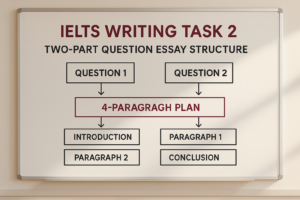
For a “Discuss both views” question like the one above, follow this reliable four-paragraph structure:
- Introduction (2–3 sentences): Paraphrase the question. Outline what the essay will cover. State your opinion briefly if it is an opinion essay.
- Body Paragraph 1 (View A): Explain the first perspective fully. Give one or two supporting points. Use specific examples or logical reasoning — not vague generalisations.
- Body Paragraph 2 (View B + your opinion): Present the contrasting view. Explain why you find this more convincing (or partially convincing). Your position should be clear here.
- Conclusion (2–3 sentences): Summarise both views. Restate your opinion. Do not introduce new information.
This structure works for the vast majority of discussion essays. Once it feels automatic, you will spend less time planning and more time writing quality sentences.
For more strategies that apply across all Task 2 question types, read our guide on IELTS Writing Task 2 Band Score Strategy — it covers how examiners apply each criterion and where most candidates lose marks unnecessarily.
Common Mistakes in Crime and Punishment Essays
After working through many IELTS essays on this topic, a few recurring patterns consistently hold scores back:
- Taking an extreme position without nuance: Saying “longer sentences never work” or “rehabilitation is the only answer” loses marks for task achievement. Examiners want balanced reasoning, even in opinion essays.
- Using informal language: Phrases like “I think it’s obvious that…” or “Obviously crime is bad” read as informal. Replace these with “It is widely acknowledged that…” or “Evidence suggests…”
- Generic examples: Saying “in many countries” without specifying is weak. Reference a specific approach or context: “Scandinavian correctional systems, for example, prioritise rehabilitation over punishment.”
- Repeating the same sentence structure: If every sentence starts with “People believe that…”, the essay lacks grammatical range. Vary your structures deliberately.
- Writing under 250 words: The minimum is 250 words, but aim for 280–310. Below 250, you lose marks immediately regardless of quality.
If you want to see how your writing holds up before exam day, access unlimited IELTS mock tests and get practice material that mirrors real exam conditions.
Ready to find out your IELTS band score?
Take the IELTS Express Pre-Test for just $4.99 and get your personalised band prediction with a 14-day improvement plan.
Frequently Asked Questions
Is crime and punishment a common IELTS Writing Task 2 topic?
Yes. Crime and punishment appears regularly in both Academic and General Training exams. It is one of the top ten recurring IELTS topics, so preparing vocabulary and at least one model argument structure for this theme is a smart use of study time.
How do I get Band 7 in IELTS Writing Task 2 for a crime essay?
To reach Band 7, you need to fully address the question, organise ideas clearly across paragraphs, use a wide range of topic-specific vocabulary accurately, and demonstrate control of complex grammar. The sample essay above shows one way to achieve all four criteria simultaneously.
Should I use examples in IELTS Writing Task 2 crime essays?
Yes, specific examples strengthen your argument and show the examiner you can support claims with evidence. Use examples from real-world contexts where possible — country-level comparisons, research findings, or observable social trends all work well. Avoid completely invented statistics.
What is the difference between deterrence and rehabilitation in IELTS essays?
Deterrence refers to punishment designed to discourage future criminal behaviour — either in the individual or in the wider population. Rehabilitation focuses on changing the offender’s mindset, circumstances, or skills so they are less likely to reoffend after their sentence ends. Understanding this distinction clearly allows you to write about crime and punishment topics with precision and earn higher lexical resource marks.
How long should an IELTS Writing Task 2 essay be?
The minimum is 250 words, but most Band 7+ essays fall between 280 and 320 words. Going over 350 words is rarely necessary and increases your risk of introducing errors. Focus on quality and precision within a tight word range rather than length alone.
For a deeper look at how IELTS Writing Task 2 is marked across all question types, visit our IELTS Writing Task 2 Practical Argument Framework — a step-by-step guide to building Band 7 arguments consistently.