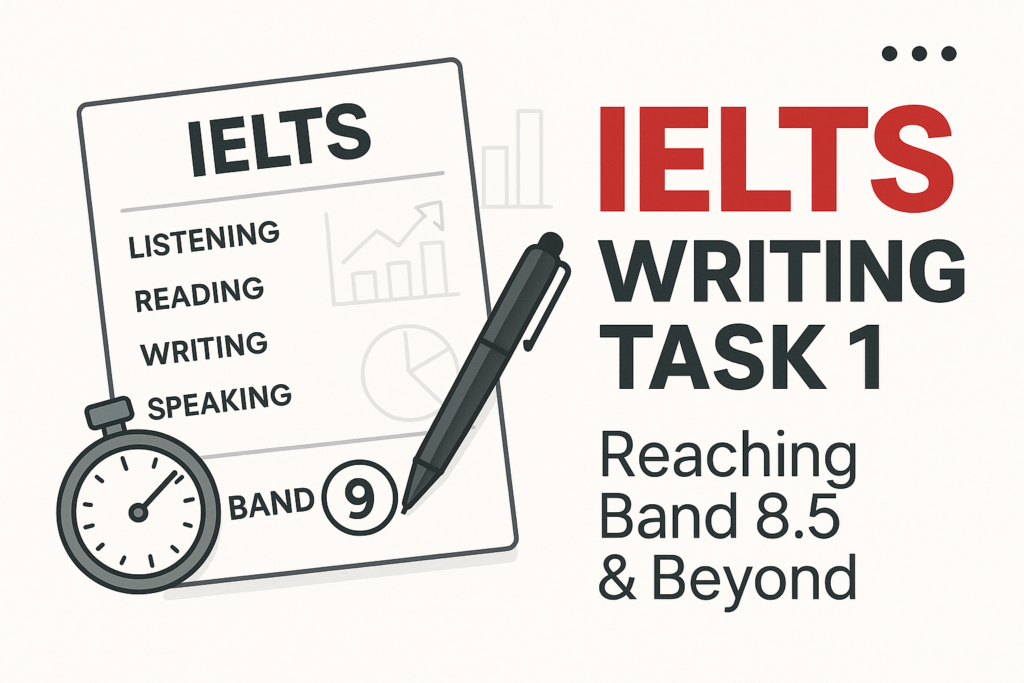
Reaching Band 8 in IELTS Writing Task 1 puts you in a very small group. At this level, your responses are well-organised, your data reporting is accurate, and your language is largely controlled. But for many test-takers, Band 8 becomes a ceiling that feels impossible to break through — not because they are making obvious errors, but because the improvements required at this stage are subtle, specific, and rarely explained clearly.
The gap between Band 8 and Band 8.5 or 9 is not about writing more. It is about writing with greater precision, naturalness, and analytical depth. This guide breaks down exactly what the examiner is looking for and how to develop the habits that push your score to the top of the scale.
Before your next practice session, take the IELTS Express Pre-Test to benchmark your current band across all four skills. At $4.99, it gives you a calibrated prediction that helps you identify whether Writing Task 1 — or another section — is holding your overall score back.
What the Examiner Looks for at Band 8.5 and 9
The four marking criteria — Task Achievement, Coherence and Cohesion, Lexical Resource, and Grammatical Range and Accuracy — carry equal weight. Understanding how the descriptors shift between Band 8 and Band 9 is essential for knowing where to focus.
At Band 8, a response uses “a wide range of structures with flexibility and accuracy,” with “rare minor errors.” At Band 9, that range must be used “with full flexibility and accuracy” — the word “full” is significant. Occasional slips that would be forgiven at Band 8 are no longer acceptable.
The same progression applies to lexical resource. Band 8 allows for “occasional inappropriacies.” Band 9 requires “idiomatic” language used “naturally and accurately with minimal errors.” In practice, this means that slightly awkward phrasing, overused connectives, or imprecise data language — things that did not cost you at Band 8 — will hold your score below 8.5.
Most high-band candidates are not making structural mistakes. They are making micro-level choices about word selection, sentence variation, and analytical framing that sit slightly below the ceiling.
Precision in Data Selection and Comparison
At Band 8, candidates report data accurately. At Band 8.5 and 9, the examiner expects you to select the most meaningful data points and compare them in a way that tells the story of the graphic — not just transcribes it.
Common Band 8 pattern:
“In 2005, sales were 4.2 million. In 2010, they rose to 6.1 million. In 2015, they fell to 5.3 million.”
This is accurate but passive. You are narrating figures rather than interpreting them.
Band 9 pattern:
“Although sales climbed sharply from 4.2 to 6.1 million between 2005 and 2010, this growth reversed significantly over the following five years, dropping by nearly one million units.”
The second version demonstrates the relationship between data points and leads the examiner through the key trend. The figures are identical; the analytical framing is entirely different.
A simple test to apply after writing any Task 1 sentence: ask yourself whether you have shown why this data point matters within the overall story of the chart. If you are only reporting a number, you are at Band 8. If you are contextualising it within a trend, you are pushing toward Band 9.
Refer to the IELTS Writing Task 1 band score guide for a breakdown of how Task Achievement descriptors are applied at each band level.
Coherence and Cohesion at the Highest Level
At Band 8, coherence is strong. At Band 9, it must be seamless — the reader should never notice the connective tissue holding the response together.
Two patterns commonly cap high-band candidates:
Over-reliance on listing connectives. Phrases like “Additionally,” “Furthermore,” and “Moreover” at the start of every sentence signal formulaic structure. Band 9 writing weaves cohesion into the sentence itself.
- Instead of “Furthermore, the proportion increased.” → “This proportion continued its upward trajectory across the same period…”
Under-used referencing. Replacing nouns with precise pronouns and demonstratives — “this figure,” “these two categories,” “the former” — tightens cohesion without adding word count. Many Band 8 candidates repeat nouns unnecessarily, which reads as less sophisticated.
A useful self-check: read your response aloud and note every time you start a sentence with a connecting word. If more than two sentences in a paragraph use the same type of opener, revise one to embed its logic into the sentence structure instead.
Lexical Resource: From Precise to Sophisticated
Band 8 lexical resource means accurate word choice and solid collocation. Band 9 requires “idiomatic” language used “naturally and accurately” — a standard that goes beyond avoiding mistakes.
Vocabulary for trends (upgrade examples):
- Solid (Band 7–8): increased, rose, declined, fluctuated
- Stronger (Band 8.5–9): surged, edged upward, contracted, oscillated, plateaued before resuming its climb
Vocabulary for proportions:
- Solid: roughly half, about a quarter
- Stronger: just under half, approximately one in four, a marginal proportion of, the overwhelming majority
The goal is not to use complex vocabulary for its own sake — it is to be more precise with fewer words. “Contracted sharply” carries more analytical information than “decreased by a large amount.”
One practical technique: after reviewing any practice response, identify one phrase that feels slightly generic and write two alternative versions — one more specific, one more natural. Over time, this builds a high-band vocabulary repertoire that feels instinctive rather than memorised.
Grammatical Range: Variation Without Risk
Band 9 grammar is not only error-free — it demonstrates “a wide range of structures.” This means deliberate variety: mixing complex sentences, relative clauses, participial phrases, and nominalisations across the response.
Most Band 8 candidates default to a reliable pattern: subject-verb-object with a subordinate clause. This is accurate but predictable.
Safe (Band 8):
“The number of students who studied abroad rose significantly, which suggests growing interest in international education.”
Varied (Band 9):
“A significant rise in the number of students studying abroad points to growing interest in international education, a trend mirrored across most age groups in the dataset.”
The second version uses nominalisation (“A significant rise”) and adds an analytical summary clause — both markers of high-band grammatical range. The information conveyed is essentially the same; the structural execution is more sophisticated.
After completing a practice response, highlight each sentence and note its structure type. If three consecutive sentences share the same pattern, revise one to introduce structural variety.
How to Build a Band 8+ Practice Routine
The difference between Band 8 and Band 9 is rarely about knowledge — it is about consistent execution under timed conditions. The habits described in this article are only useful if they are practised regularly enough to become automatic.
A structured weekly routine for high-band candidates:
Session 1 (Timed practice): Write a full Task 1 response in 20 minutes. Use a real IELTS-style graphic from a practice resource. No pausing, no revising as you go.
Session 2 (Self-assessment): Review the response against each criterion. Flag every phrase where you used a safe word instead of a better one. Flag every sentence with the same structure as the one before it. Note the specific upgrade needed.
Session 3 (Rewrite): Rewrite two or three paragraphs incorporating the upgrades identified. Not the whole response — just the sections that needed work.
Session 4 (Model comparison): Read a Band 9 model answer for a similar graphic. Note three specific techniques you have not been using.
Four focused sessions per week, each with a clear objective, will produce faster improvements than twenty minutes of unstructured practice daily. For structured mock tests to use in your practice sessions, access unlimited IELTS mock tests through Career Wise English.
The Review Strategy That Closes the Gap
Most candidates spend 18 of their 20 Task 1 minutes writing and 2 minutes scanning for errors. At Band 8.5 and above, this split needs to shift — and the review needs to be targeted, not general.
A structured 3-minute review:
- Data accuracy check: Skim every figure you cited against the original graphic. Even one wrong number costs Task Achievement marks.
- Overview check: Confirm your overview captures the main trends without including specific data points — a common error that limits the Task Achievement score.
- Cohesive device audit: Count sentence openers. If more than two use the same connective, replace one.
- Final read for naturalness: Does any phrase sound mechanical or templated? If so, revise it.
This structured approach catches the micro-level issues that separate Band 8 from Band 8.5 more reliably than a general re-read.
Ready to find out your IELTS band score?
Take the IELTS Express Pre-Test for just $4.99 and get your personalised band prediction with a 14-day improvement plan.
Frequently Asked Questions
Is Band 9 in IELTS Writing Task 1 actually achievable?
Yes, but it is genuinely rare. Very few professional or migration pathways require a Band 9 in Writing — most high-stakes requirements sit at Band 7 or 8. That said, Band 8.5 is more achievable than most test-takers realise, and the techniques in this article are precisely what the examiner rewards at that level.
What is the most common mistake Band 8 candidates make in Task 1?
Over-structured responses. Many Band 8 writers follow a rigid paragraph template so consistently that it reads as formulaic. Band 9 responses feel natural and analytical, not templated. The structure is still there — it is just not visible.
How many practice responses do I need before my next sitting?
Quality significantly outperforms quantity at high band. Five to ten carefully reviewed and self-assessed responses will do more for your score than thirty quickly written ones. Focus on incorporating specific upgrades from each session rather than simply increasing volume.
Should I aim for sophisticated vocabulary or prioritise accuracy first?
Always prioritise accuracy. A Band 8.5 response is near-perfect, not flawless. If reaching for more sophisticated vocabulary risks introducing an error, use the safer option. The examiner rewards natural sophistication — not forced complexity. Upgrade vocabulary only where you are confident the collocation is correct.
For more Writing Task 1 guidance, see the full IELTS Writing Task 1 practice test with worked examples and the IELTS Writing Task 2 band score strategy if you are also working on your Task 2 score.