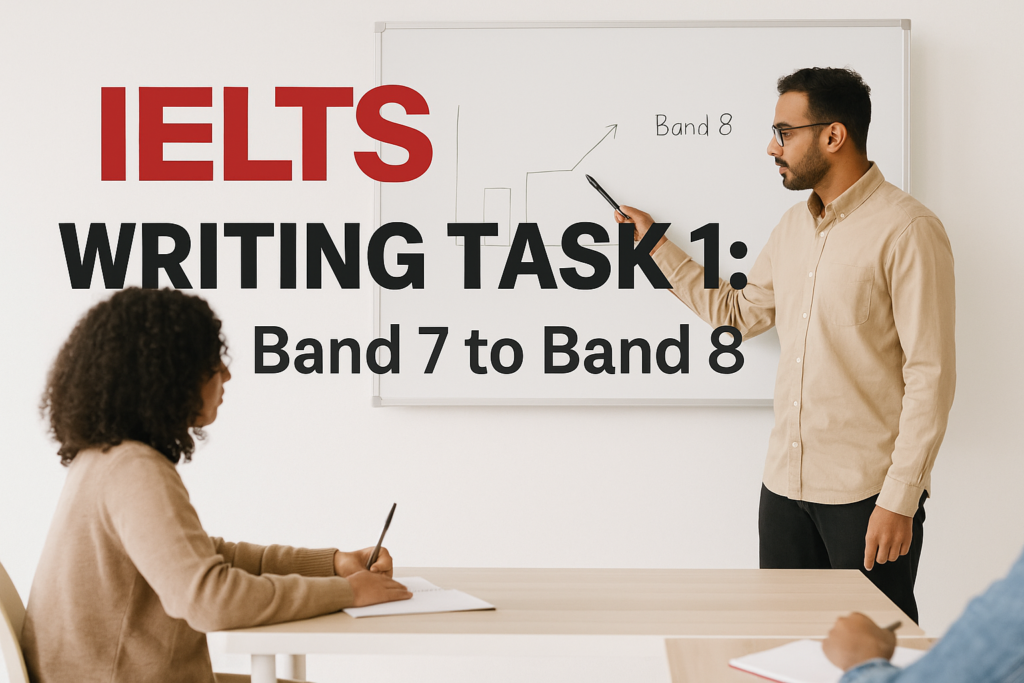
Getting a Band 7 in IELTS Writing Task 1 is a real achievement. You are selecting relevant data, organising your response logically, and writing with reasonable accuracy. But the jump to Band 8 is harder than it looks — and most candidates plateau at 7 because they do not know what they are doing differently from a Band 8 writer.
This guide breaks down the exact differences that separate a Band 7 response from a Band 8, and gives you practical steps to close the gap. Before you start drilling specific techniques, it is worth knowing your current baseline across all four skills. The IELTS Express Pre-Test gives you a personalised band prediction in about 15 minutes for $4.99 — a useful starting point if you want to know where Writing Task 1 fits within your overall score picture.
What the Examiner Expects at Band 8
The four criteria for Writing Task 1 are Task Achievement, Coherence and Cohesion, Lexical Resource, and Grammatical Range and Accuracy. Your band score is the average across all four, so a weakness in any single criterion caps your overall result.
At Band 7, an examiner sees a response that covers the key features, is generally well organised, and uses a good range of vocabulary and structures with some inaccuracies. At Band 8, the bar shifts in meaningful ways:
- Task Achievement: All key features are covered with no significant omissions, and the overview is clearly positioned and specific.
- Coherence and Cohesion: Sequencing is skilful — not just present. Cohesive devices are used flexibly, not mechanically.
- Lexical Resource: Sophisticated vocabulary is used accurately, with genuine variety in form and collocation. Errors are rare and minor.
- Grammatical Range and Accuracy: A wide range of structures is used flexibly and accurately. Errors, if any, are minor and do not affect comprehension.
The difference is mostly in execution quality and consistency, not in having a totally different approach.
The Most Common Band 7 Weaknesses
Most Band 7 writers share a handful of consistent gaps. Understanding these is the fastest way to target your practice.
Weak or buried overview. Many Band 7 writers include an overview but make it vague or hide it in the middle of the response. At Band 8, the overview must be specific enough to be genuinely useful — naming the most important trend or comparison — and it should appear clearly after the introduction.
Mechanical cohesive devices. Connecting sentences with discourse markers in a repeating cycle looks formulaic at the Band 8 level. Examiners want to see a range of cohesive strategies — substitution, reference, clause structure — not a fixed template.
Over-reporting data without analysis. Band 7 writers often list figures correctly but do not identify what the data actually shows. Band 8 requires you to group, compare, and interpret — not just narrate.
Vocabulary at the edge of accuracy. A Band 7 response typically uses a good range of vocabulary, but sometimes the wrong collocation or a slightly off word form appears. Band 8 writers use sophisticated lexis accurately, with genuine variety in how ideas are expressed.
How to Strengthen Your Overview
The overview is worth more attention than most candidates give it. A weak overview is probably the single most common reason a technically competent response stays at Band 7 rather than reaching Band 8.
A strong Band 8 overview does three things: it identifies the most striking overall trend or comparison, it names the time period or categories involved where relevant, and it avoids repeating the language of the question directly.
Compare these two examples for a line graph showing electricity consumption from 2000 to 2020:
Band 7 overview: “Overall, it can be seen that electricity consumption changed over the period.”
Band 8 overview: “Overall, industrial consumption rose substantially over the two decades while household use remained broadly stable, with the two sectors converging sharply after 2015.”
The Band 8 version is specific, comparative, and genuinely informative. The Band 7 version restates the obvious.
Practice writing overviews as a separate drill. Take any graph or chart and write only the overview — no introduction, no body paragraphs. This forces you to identify what actually matters rather than what is easiest to describe.
Upgrading Your Lexical Resource
Moving from Band 7 to Band 8 in Lexical Resource requires two things: using more sophisticated vocabulary and using it accurately. Errors in high-level vocabulary hurt more than errors in simple vocabulary, so precision matters.
The most practical areas to target are:
Collocations for describing change. Instead of “increased a lot,” a Band 8 response uses “rose sharply,” “climbed steadily,” or “surged to a peak.” Learn standard collocations for direction (rise, fall, fluctuate, plateau), degree (marginally, substantially, dramatically), and pattern (peak, trough, level off, recover).
Synonyms for reporting verbs. If you are describing a bar chart, vary how you present figures: “the data reveals,” “the figures indicate,” “the chart demonstrates.” This creates variety without reaching for inaccurate or awkward synonyms.
Nominalisation. Shifting from verb phrases to noun phrases is a marker of academic writing and a genuine Band 8 technique. Instead of “the number of students increased,” try “the increase in student enrolments.” This one shift changes the register and allows more complex sentence structures.
For structured vocabulary practice alongside a full writing programme, the unlimited IELTS mock tests at Career Wise English include examiner feedback that targets exactly these language patterns.
Developing Grammatical Range and Accuracy
At Band 7, you are already using a good range of structures with mostly accurate control. The shift to Band 8 requires using that range more flexibly — combining structures within a single sentence rather than switching between them from sentence to sentence.
Target these specific grammar areas:
Non-finite clauses. Instead of “The figure rose steadily, and it reached a peak in 2010,” use “Having risen steadily through the decade, the figure peaked in 2010.” This tightens the sentence and demonstrates sophisticated control.
Passive voice for objectivity. Academic description of charts benefits from passive constructions: “A significant increase was recorded,” “The figures were dominated by…” Use passives where they add precision or variety, not as a default.
Relative clauses for data grouping. Instead of reporting each data point separately, combine them: “The three countries that showed the sharpest decline — France, Germany, and Italy — all shared a reduction of more than 40% over the period.” This groups data intelligently and demonstrates range.
Accuracy is equally important. Review your writing for subject-verb agreement errors, article misuse, and preposition errors — these are the three most common accuracy issues at the Band 7 to Band 8 boundary.
Building Consistency Across Four Criteria
The Band 8 ceiling is set by your weakest criterion. A candidate with Band 9 vocabulary and Band 6 coherence does not average to Band 7.5 — the coherence score limits the overall result. True Band 8 performance requires every criterion to reach that level in every response.
The most practical way to build consistency is through timed practice with structured feedback. Write a full Task 1 response under exam conditions, then assess it criterion by criterion against the Band 8 descriptors. Identify which criterion produced the lowest score and design a targeted drill for that specific area.
This is more efficient than general practice. If your lexical resource is already strong but your task achievement is inconsistent, drilling vocabulary does not move your score. Drill the overview and data selection instead.
For a structured improvement plan built around mock test feedback, see the IELTS Writing Task 1 band score guide which covers how examiners apply each criterion in practice.
Ready to find out your IELTS band score?
Take the IELTS Express Pre-Test for just $4.99 and get your personalised band prediction with a 14-day improvement plan.
Frequently Asked Questions
How long does it take to improve from Band 7 to Band 8 in Writing Task 1?
Most candidates need four to eight weeks of targeted practice — provided they are drilling specific criteria weaknesses rather than just completing general practice tasks. The key is identifying your lowest-scoring criterion and working on that specifically.
Is Band 8 in Writing Task 1 achievable without a native-level vocabulary?
Yes. Band 8 Lexical Resource does not require native-level vocabulary — it requires sophisticated vocabulary used accurately and with genuine variety. Many non-native speakers reach Band 8 or higher in this criterion by focusing on academic collocations and precise word forms rather than attempting to sound like a native speaker.
What is the most common reason candidates stay stuck at Band 7?
The most common reason is a weak overview. Candidates who cover the data accurately but write a vague overview are typically held at Band 7 for Task Achievement, which caps the overall response. Fixing the overview often produces the fastest score improvement.
How is Band 8 Coherence and Cohesion different from Band 7?
At Band 7, cohesion is present but can appear formulaic. At Band 8, the examiner expects flexible and skilful use of cohesive devices — including reference, substitution, and varied clause structure — rather than a fixed sequence of discourse markers.
Should I use more complex sentences to target Band 8 in Grammar?
Not necessarily. Band 8 rewards flexible and accurate use of a wide range of structures, not complexity for its own sake. A sentence that is complex but inaccurate will hurt your score. Focus on accuracy first, then introduce more variety as that accuracy becomes consistent.
How much data should I include in a Band 8 Task 1 response?
Cover all key features — which means the main trends, the most significant comparisons, and any notable exceptions. You should not report every single data point. The skill at Band 8 is selecting, grouping, and comparing the most important information rather than narrating the chart from left to right.
For related IELTS Writing strategies, see the IELTS Writing Task 2 band score strategy guide.