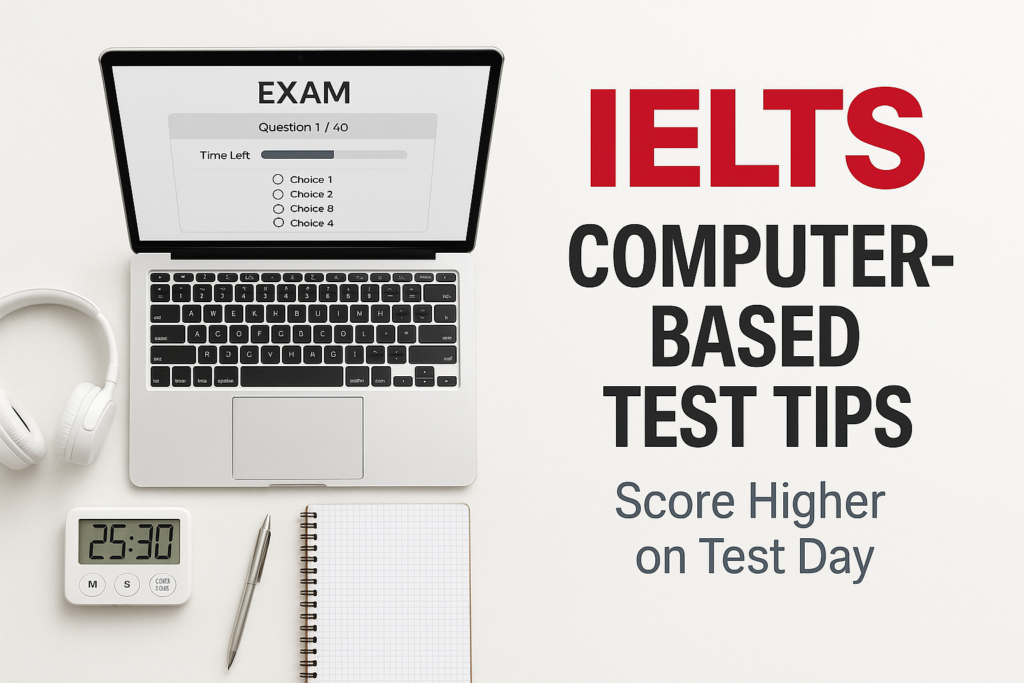
More IELTS candidates in Australia are choosing the computer-based test over the paper-based format. Results arrive in three to five days, test centres offer it several times a week, and for faster typists it removes the legibility problem that costs marks in handwritten exams. But sitting the computer-based IELTS without practising on a screen first is a common mistake — you end up spending test time adapting to the interface instead of demonstrating your English.
This guide covers the most practical IELTS computer-based test tips — the kind that actually affect your band score, not just generic exam advice.
Before diving into format-specific strategies, it’s worth knowing your current band score. The IELTS Express Pre-Test gives you a personalised band prediction in about 15 minutes for just $4.99 — a useful baseline before you start drilling CBT-specific skills.
What Is the IELTS Computer-Based Test?
The IELTS computer-based test (CBT) covers the same four sections as the paper version: Listening, Reading, Writing, and Speaking. Content, timing, and scoring are identical. The difference is purely in delivery — instead of pencil and answer sheet, you type responses and navigate questions on a computer screen.
The Speaking section remains face-to-face with a human examiner regardless of which format you choose. No computer interface is involved in that section.
For Australian test-takers sitting IELTS for migration or university entry, the CBT is now the default option at most IDP and British Council centres, with sessions available almost every day of the week.
Why the Format Difference Matters More Than You Think
Students who assume CBT and paper-based IELTS are interchangeable tend to make the same avoidable errors:
Slow typing disrupts writing fluency. If you normally plan ideas on paper first, the keyboard becomes a bottleneck mid-task. Your thinking and your output get out of sync.
Reading on screen is physically different. Scrolling through a long passage requires more active navigation than turning pages. Candidates who read primarily from books or printouts find their reading pace drops under screen conditions.
Headphone audio feels different. The Listening section plays through headphones rather than room speakers. The stereo separation in multi-speaker dialogues can catch you off guard if you’ve never practised that way.
Note-taking is more constrained. On-screen highlighting is available, but physical scratch paper rules vary by centre. You can’t freely annotate a passage the way you would on paper.
Knowing these differences in advance means you can train for them specifically.
Listening Section: IELTS Computer-Based Test Tips
The Listening section plays audio once through your headphones. You type or click answers as you go, with no chance to replay. Here’s what makes a difference:
Practise with headphones before test day. Don’t wait until the exam to hear IELTS audio through headphones. The way speakers sound in a stereo headset — particularly in multi-speaker section 3 and 4 recordings — is noticeably different from a laptop speaker. A week of headphone-based practice closes that gap.
Use the preview time actively. Before each audio section begins, you’re given time to read the questions. On computer, this is more important than on paper because you can’t glance back at a physical sheet mid-answer. Scan for question keywords and predict the answer type (a name, a number, a place) so you know what to listen for.
Move on from missed answers immediately. If you miss an answer, resist the urge to dwell on it. Hesitating for five seconds costs you the next question. Mark it for review and move on — you can return if you finish early.
Practise the full range of Listening question types using the IELTS Practice Test resources before your actual test date.
Reading Section: IELTS Computer-Based Test Tips
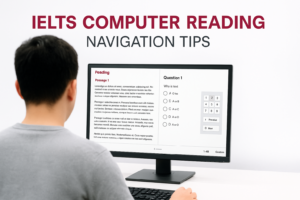
The Reading section requires sustained concentration across three long passages, all on screen. The scrolling interface is the biggest adjustment for most candidates.
Skim before you read deeply. Before going to the questions, skim the passage structure — headings, first and last sentences of paragraphs — to build a rough mental map. This is standard IELTS strategy, but on screen the temptation to read every word slowly is stronger. Resist it.
Use the highlight function. The CBT interface lets you highlight text. Use it strategically for True/False/Not Given questions where you need to locate exact claims, or for matching tasks where you’re cross-referencing multiple options. Highlighted text stays visible as you move between questions.
Track your time more deliberately. Reading is 60 minutes for three passages, approximately 20 minutes per passage. On screen, it’s easy to lose track because the interface doesn’t physically signal time passing. Check the clock at the 20-minute and 40-minute marks.
Build screen reading stamina. If you study primarily from books or printouts, shift all your reading practice to a screen at least two to three weeks before the test. Reading extended academic text on a monitor is a different cognitive load — train your eyes to sustain it.
Writing Section: IELTS Computer-Based Test Tips
Writing is where CBT preparation pays off most visibly. Candidates who’ve been training on paper and then face a keyboard on test day lose time and fluency.
Know your typing speed before it matters. You don’t need to be fast — 40 to 50 words per minute is workable for most candidates. But you need to type without hesitation. Run a quick typing test (Keybr or TypingClub are free) to benchmark where you are. If you’re below 35 wpm, spend 10–15 minutes per day on typing drills for two weeks before the test.
Use the live word count tool. The CBT interface shows a running word count. This removes one source of test anxiety — you never need to manually count. Use it as a checkpoint after completing a draft, not as a target you’re writing toward.
Practise editing on a keyboard. Editing typed text is different from crossing out and rewriting on paper. Before your test, practise cutting sentences, restructuring paragraphs, and correcting errors digitally. The muscle memory matters under pressure.
Task 1 advantage: For Academic candidates describing graphs or General Training candidates writing letters, clean typed responses are easier to proofread and polish than handwritten drafts. Use that speed advantage on a careful final pass for cohesion and word choice.
For a deeper look at Writing strategies that apply to both formats, see IELTS Writing Task 2: Band Score Strategy.
Computer-Based vs Paper IELTS: Which Format Should You Choose?
Neither format is objectively better. The right choice depends on your strengths and preparation timeline.
Choose the computer-based test if:
- You type at 35+ words per minute
- Your handwriting under time pressure is difficult to read (illegible responses lose marks)
- You want results within 3–5 days rather than up to 13
- You need scheduling flexibility — CBT sessions run more frequently at most centres
Choose paper-based if:
- Extended screen reading causes eye fatigue or headaches
- Your typing speed is well below 35 wpm and there’s no time to improve before your test date
- You find annotating passages by hand essential to your reading strategy
If you’re unsure which suits your current level, start by identifying your weaknesses. Take the IELTS Express Pre-Test for $4.99 to get your current band score and a personalised improvement plan before you commit to a test date.
Building a CBT Practice Routine That Actually Works
Effective CBT preparation has four components:
1. Switch all study sessions to screen. Reading practice, writing drafts, vocabulary work — do it all on a device. Build the screen habits before they’re tested.
2. Run timed full mocks on computer. Simulate the real environment: quiet space, headphones, strict timers, no looking anything up. One full mock per week in the three weeks before your test is a minimum.
3. Targeted typing practice if needed. Two weeks of 10-minute daily typing drills makes a measurable difference if your speed is low. Don’t wait until the week before.
4. Post-mock analysis by section. After each practice test, identify the question types or sections where you consistently lost time or marks. Target those specifically in your next study block rather than repeating full tests blindly.
For structured full-length mock practice, access unlimited IELTS mock tests to run CBT-style simulations before test day.
Ready to find out your IELTS band score?
Take the IELTS Express Pre-Test for just $4.99 and get your personalised band prediction with a 14-day improvement plan.
Frequently Asked Questions
Is the IELTS computer-based test harder than the paper-based test?
No. The question content, marking criteria, and band score scale are identical across both formats. The only difference is delivery. Candidates who practise specifically for the CBT format consistently perform at the same level as well-prepared paper-based candidates.
Can I write notes on paper during the computer-based IELTS?
Most test centres provide a small laminated notepad or erasable board for rough notes. Rules vary slightly by centre, so confirm the specifics with your test centre before the day. Don’t plan your strategy around having full sheets of blank paper available.
Do I need to be a fast typist to pass the computer-based IELTS?
Not necessarily. A typing speed of 40–50 words per minute is sufficient for most candidates to complete the Writing tasks comfortably within the time limits. The bigger factor is having well-organised ideas so you can write without stopping to think.
Is the Speaking test on computer?
No. The IELTS Speaking section is always conducted face-to-face with a certified examiner, regardless of whether you chose the computer-based or paper-based format. There is no computer interface involved.
How much faster are computer-based IELTS results?
Computer-based test results are typically available within 3–5 days. Paper-based results take up to 13 calendar days. For candidates with tight visa or enrolment deadlines, the CBT turnaround is a significant practical advantage.
Can I change my answers before submitting in the CBT?
Yes. You can navigate back to previous questions and change answers before the section time runs out. The interface also lets you flag questions for review so you can return to them before submitting.