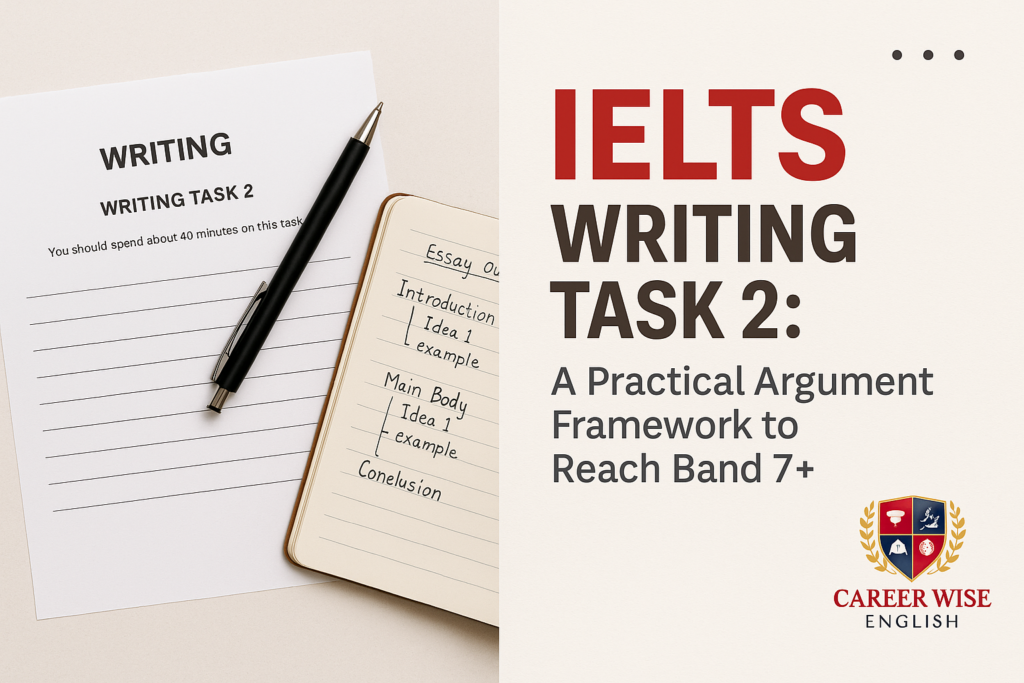
IELTS Writing Task 2 is a 40-minute academic essay worth two-thirds of your overall Writing band score. You receive a statement, opinion, or problem and must respond in at least 250 words. Examiners score your response across four criteria: Task Achievement, Coherence and Cohesion, Lexical Resource, and Grammatical Range and Accuracy. Each criterion carries equal weight.
Most candidates who plateau at Band 6 or 6.5 are not failing on vocabulary or grammar. The real problem is structure. Without a repeatable argument framework, essays drift. The position weakens mid-essay, body paragraphs repeat ideas with different words, and the conclusion adds nothing. Examiners recognise this pattern quickly.
Task 2 rewards consistency over creativity. A predictable, well-executed structure scores better than a brilliant but inconsistent one. Candidates who master a reliable framework and apply it accurately every time consistently outperform those who try to write something original under pressure.
The Six Essay Types You Will Face
Before building your framework, you need to identify which essay type you are facing. The six types that appear in IELTS Writing Task 2 are:
- Opinion / Agree or Disagree — Do you agree or disagree with a given statement?
- Discussion — Discuss both views and give your opinion.
- Problem and Solution — Identify causes of a problem and suggest solutions.
- Advantages and Disadvantages — Weigh the positives and negatives of a trend or policy.
- Double Question — Answer two separate but related questions.
- Mixed — A hybrid of discussion and opinion in a single prompt.
Each type requires a slightly different paragraph structure, but the underlying argument logic is the same. Identify your essay type in the first 60 seconds of reading the prompt. This habit prevents the most common structural error: writing a one-sided essay when the prompt asks for both views.
A reliable indicator to watch for: if the instruction line contains discuss both views or what are the advantages AND disadvantages, you must address both sides, even if you end with a personal opinion. Missing this costs Task Achievement points immediately.
A Four-Paragraph Framework That Examiners Reward
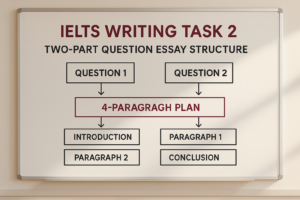
The safest structure for most Task 2 types is the four-paragraph model.
Introduction — Paraphrase the topic statement in your own words. State your clear position. Keep this to three to four sentences. Do not open with a memorised phrase like In today’s rapidly changing world. Examiners recognise these openers and they do not count toward your Lexical Resource score.
Body Paragraph 1 — Your strongest supporting point. Apply the PEEL method: Point, Evidence (a real-world example or logical reasoning), Explanation, Link back to your thesis. Every sentence in the paragraph must connect to its central idea.
Body Paragraph 2 — Your second supporting point, or the counter-argument if you are writing a Discussion essay. Apply PEEL again. If including a counter-argument, follow it with a clear rebuttal using concessive language: while some argue that…, the evidence suggests… A concession without a rebuttal is incomplete.
Conclusion — Restate your position in fresh words. Summarise your two main points in one sentence each. Add a brief forward-looking remark if space allows. Never introduce new information in the conclusion, as this is penalised under Task Achievement.
This structure is not creative. But it is reliable, and reliability is what gets you to Band 7.
How to Generate Ideas Under Exam Pressure
Running out of ideas mid-essay is one of the most common Task 2 problems for candidates in Australia, particularly those returning to study after work or preparing alongside full-time commitments.
Use the two-angle method before writing a single word. Ask: what is the economic or social angle on this topic? What is the individual versus community angle? Almost every Task 2 prompt can be read through one of these two lenses, and usually both. This gives you at least four usable ideas in under 90 seconds.
For example, if the prompt reads: Some people believe that governments should ban fast food restaurants. To what extent do you agree?
- Economic angle: tax revenue from fast food chains, employment in the sector, business freedom and market regulation
- Individual versus community angle: personal dietary choice versus the public health cost of diet-related illness
You now have material for two strong body paragraphs before you have written a single sentence of the essay. Choose the two most concrete ideas, assign one to each body paragraph, and begin your introduction.
Spending three to five minutes on planning consistently produces more coherent essays than jumping straight into writing. Candidates who plan for five minutes and write for thirty-five outperform those who write for the full forty, even when the planner has slightly weaker English overall. The plan commits you to a structure before your working memory is under pressure.
Language Patterns That Signal Band 7+ to Examiners
Lexical Resource is one of the four scored criteria and one of the most practical to improve through targeted drilling. Examiners look for evidence that you can use a range of vocabulary accurately, not that you have memorised long or unusual words.
Three language patterns that move a Task 2 essay above Band 6.5:
Hedging language — It could be argued that…, There is a strong case for…, Evidence suggests that… Hedging shows academic awareness. It signals that you understand arguments have limits and that you are positioning your ideas carefully rather than asserting facts you cannot prove.
Concession + rebuttal — While critics contend that…, a closer analysis reveals… or Although this perspective has merit, it overlooks the fact that… This pattern works particularly well in Discussion essays and shows the kind of nuanced thinking examiners associate with Band 7 and above.
Varied cohesive devices — Overusing furthermore, moreover, and in addition is a Band 6 habit. At Band 7+, transitions are purposeful: As a result…, This is particularly relevant in the Australian context because…, By contrast…, Building on this point…, It follows that… The variety signals control rather than formula.
Practise these three patterns in isolation before applying them to full essays. Write ten sentences using hedging language on any topic, then ten using concession + rebuttal. Isolated drilling transfers to exam conditions faster than full essay practice alone because it removes the cognitive load of constructing an argument at the same time as practising language.
Building a Weekly Practice System for Working Candidates
Reaching Band 7 in Writing Task 2 requires consistent, structured practice. A workable weekly system for candidates with full-time jobs or study commitments:
Monday — Timed planning only (5 minutes). Select a prompt, identify the essay type, brainstorm using the two-angle method, and outline your four paragraphs in point form. Do not write the essay.
Wednesday — Write one complete Task 2 essay under timed conditions (40 minutes). No dictionary, no pausing. Simulate exam conditions as closely as possible.
Thursday — Review your essay against the four criteria. Check: Is my position clear and consistent from introduction to conclusion? Does each body paragraph contain a single main idea? Are my cohesive devices varied? Have I used hedging or concession language at least once?
Saturday — Write targeted paragraphs that fix the specific weakness you identified on Thursday. If Body Paragraph 2 was weak, write three alternative versions with different evidence and language choices.
This system produces four to five complete essays per month while building the self-correction habit that drives real improvement. Combine it with full IELTS mock tests to benchmark your Writing band as you go. Tracking progress keeps motivation up and shows you exactly where your practice time is paying off.
If you are preparing for an Australian visa application or university admission with a fixed deadline, an IELTS Express Pre Test gives you a reliable band estimate before you commit to a test date. It removes the guesswork from timeline planning and helps you focus on the right skills in the weeks remaining.
Four Mistakes That Consistently Pull Scores Below Band 7
Knowing what to avoid is just as important as knowing what to do. These four mistakes most consistently hold Writing Task 2 scores below Band 7:
Unclear or shifting position — Candidates who hedge their own opinion throughout an Opinion essay receive low Task Achievement scores. State your position clearly in the introduction and hold it. The conclusion should reinforce, not contradict, what you said at the start.
Body paragraphs that drift off-topic — Every sentence in a body paragraph must connect to its main point. A paragraph that opens with environmental policy and drifts toward economic growth has broken coherence. PEEL keeps every paragraph focused.
Memorised openers and closers — Phrases like In today’s rapidly changing world or It is undeniable that are flagged as memorised language. They do not contribute to Lexical Resource. Replace them with natural, context-specific sentences that actually engage with the prompt.
A two-sentence conclusion — Repeating the introduction almost word-for-word wastes the conclusion’s scoring potential. Aim for three sentences: restate your position, summarise both body paragraph arguments, and add a brief forward-looking remark. This signals a complete, rounded response.
If you have been working through IELTS reading practice and listening drills alongside your writing preparation, combining those analytical skills with structured Task 2 practice compounds your improvement across all four sections.
Frequently Asked Questions
How long should IELTS Writing Task 2 be?
The minimum is 250 words, but most Band 7+ essays land between 280 and 320 words. Going beyond 320 does not earn additional marks and statistically increases the chance of errors. Quality and precision matter more than length.
Can I use personal examples in Task 2?
Yes. Real or hypothetical examples from your own experience are acceptable. The key is that the example clearly supports the argument you are making. A vague anecdote that does not connect to your main point weakens the essay rather than strengthening it.
What happens if I do not finish the essay?
An incomplete essay is penalised under Task Achievement regardless of how strong the sections you did finish are. Time management is not optional in Writing Task 2. Practise writing to the clock from your very first practice session, even if early essays feel rushed.
Is it better to strongly agree or partially agree in Opinion essays?
Both positions can reach Band 7+. A clear opinion with two well-developed supporting paragraphs is often easier to execute than a nuanced partial agreement. Choose the position you can argue most concretely, not the one that feels more sophisticated.
How do I break through a Band 6.5 plateau?
The most common cause is inconsistent argument structure, not weak vocabulary or grammar. Audit five of your recent practice essays: Is your position consistent across all four paragraphs? Does each body paragraph have one and only one central idea? Does your conclusion restate and reinforce? Fix structure first. Once that is consistent, improvements in grammar and vocabulary translate directly into score gains.
How much does Writing Task 2 affect my overall IELTS Writing band?
Writing Task 2 is worth two-thirds of the total Writing band score, with Task 1 accounting for the remaining third. Investing most of your writing preparation time in Task 2 practice is the highest-return strategy, especially when working against a deadline.