Work and employment is one of the most frequently tested topics in IELTS Writing Task 2. Whether you are sitting the Academic or General Training exam, questions about jobs, unemployment, automation, workplace conditions, and career choices appear regularly — often in disguise. Knowing how to respond with a clear argument, precise vocabulary, and well-organised paragraphs is what separates band 6.5 candidates from band 7 and above.
If you are not sure where your current IELTS level sits, the IELTS Express Pre-Test gives you a personalised band prediction in minutes, so you know exactly what you need to work on before exam day.
Why Work and Employment Essays Appear So Often in IELTS
The IELTS exam is designed to assess candidates who plan to work, study, or migrate to English-speaking countries. Work and employment sits at the heart of that purpose. Examiners draw on this topic because it is universally relevant and produces genuine differences in candidate opinion — which is exactly what Task 2 is designed to test.
Common question angles include:
- Whether technology and automation is making certain jobs obsolete
- The causes and solutions of unemployment among young people
- Whether governments should guarantee employment for citizens
- Remote work versus in-office work and its social effects
- The role of job satisfaction versus salary in career choices
- Gender inequality in the workplace
Each of these angles requires a slightly different approach, but all share the same underlying structure: a clear position, developed body paragraphs with specific support, and a concise conclusion.
Band 7+ Work and Employment Essay Sample
Below is a full sample essay written to a band 7 to 7.5 standard. The question and essay are provided together so you can see exactly how the response addresses the task.
Question: In many countries, the number of people choosing to work for themselves is increasing. What are the advantages and disadvantages of self-employment?
Sample Essay:
Self-employment has grown significantly in recent years, driven by digital platforms, changing attitudes toward work, and economic disruption. While working for oneself offers genuine benefits, it also brings challenges that many people underestimate before making the transition.
The most significant advantage of self-employment is autonomy. Individuals can set their own hours, choose their clients, and shape their working environment in ways that traditional employment rarely allows. This flexibility is particularly valuable for parents managing childcare, people with health conditions that require non-standard schedules, or highly skilled professionals who prefer to sell their expertise directly rather than through a company structure. In addition, successful self-employed workers often earn more than salaried counterparts by retaining the full margin of their labour, without a portion going to an employer’s overhead.
However, the financial instability of self-employment is a serious disadvantage that discourages many. Without a guaranteed salary, income can fluctuate dramatically, especially during economic downturns or slow periods in a given industry. Self-employed individuals are also responsible for their own superannuation contributions, tax obligations, insurance, and professional development — costs that employers typically absorb for traditional workers. This administrative burden can consume considerable time and energy, often distracting from the core work that generates income.
Furthermore, isolation is a less-discussed but genuine drawback. Office environments provide social connection, informal mentoring, and collaborative problem-solving that many people only recognise as valuable once it is absent. Remote or solo workers can struggle with motivation and miss the career-advancement opportunities that come from being visible within an organisation.
In conclusion, self-employment suits people with financial resilience, high self-discipline, and in-demand skills. For others, the security and structure of traditional employment remains the more practical choice. Ultimately, the decision should be based on an honest assessment of one’s circumstances rather than an idealised view of either model.
Word count: 283 | Estimated band: 7.0 to 7.5
How IELTS Examiners Score Work and Employment Essays
Understanding the four marking criteria helps you write more strategically. Examiners assess every Task 2 response on the same four scales, each weighted equally at 25%.
Task Achievement asks whether you have answered all parts of the question. For the sample above, that means covering both advantages and disadvantages with roughly equal development. A common mistake is writing three paragraphs on advantages and only one sentence on disadvantages — this directly lowers your Task Achievement score.
Coherence and Cohesion measures how logically your ideas are arranged and how well they connect. Each paragraph should have a clear central idea, developed with explanation and a specific example or reason. Transition phrases like However, In addition, and Furthermore guide the reader but should not be overused mechanically.
Lexical Resource rewards topic-specific vocabulary used accurately. For work and employment, that means using words like autonomy, superannuation, fluctuate, mentor, infrastructure and entrepreneurship correctly — not just inserting them for show.
Grammatical Range and Accuracy rewards a mix of sentence structures without frequent errors. If you write mostly simple sentences to play it safe, you limit yourself to around band 6. Band 7 requires some complex and compound-complex structures used accurately.
For a deeper look at how these criteria apply across essay types, the IELTS Writing Task 2 band score strategy guide breaks down each scale with worked examples.
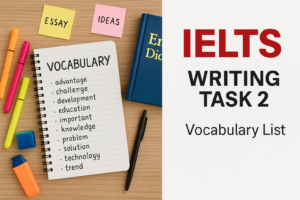
Essential Vocabulary for Work and Employment Essays
Using precise, topic-appropriate vocabulary is one of the fastest ways to lift your Lexical Resource score. Here are high-value word groups for work and employment tasks.
Employment types:
- Self-employed / freelance / independent contractor
- Permanent / casual / contract / part-time employment
- Remote worker / telecommuter / hybrid worker
Workplace conditions:
- Job security / employment stability / precarious work
- Work-life balance / flexible working arrangements
- Occupational stress / burnout / workplace culture
Economic concepts:
- Unemployment rate / structural unemployment / youth unemployment
- Automation / technological displacement / upskilling
- Labour market / workforce participation / wage gap
Cause and effect phrases:
- This has led to a significant increase in…
- One consequence of this trend is…
- As a result, many workers have been forced to…
Avoid repeating the same word more than twice in your essay. When you discuss jobs, also use employment, positions, roles, and occupations to show lexical range without becoming vague.
Common Mistakes in Work and Employment IELTS Essays
Even candidates with solid English skills regularly lose marks on work essays due to avoidable errors. These are the patterns that appear most often.
Overgeneralising without support. Statements like technology has destroyed all jobs or young people are lazy and that is why they are unemployed are too broad to score well. Every claim needs a reason or an example to be convincing at band 7.
Failing to address both sides when required. In advantages/disadvantages and discuss-both-views questions, you must give each position genuine development. One-sided essays rarely score above band 6.0 for Task Achievement.
Mixing up opinion and fact. Be careful with phrases like it is obvious that or everyone knows. In academic writing, hedging language such as it can be argued that or evidence suggests sounds more credible and demonstrates mature writing style.
Poor paragraph discipline. Each body paragraph should make one clear point. If you have three separate ideas competing in the same paragraph, examiners cannot follow your logic and your Coherence score drops.
For a full breakdown of these patterns, see the IELTS Writing Task 2 common mistakes guide — it covers errors across all essay types with corrections.
How to Structure Any Work and Employment Essay in 40 Minutes
Most candidates struggle with time, not ideas. Here is a reliable four-paragraph structure you can adapt to almost any work and employment question.
Paragraph 1 — Introduction (4 to 5 sentences, approximately 75 words): Paraphrase the question statement, state your position or indicate that you will discuss both views, and briefly outline what the essay will cover. Do not simply copy the question wording — rephrase it using synonyms and a different sentence structure.
Paragraph 2 — Main body point 1 (approximately 120 words): State your first argument clearly in the topic sentence. Explain why it is true in the next sentence. Then provide a specific example, statistic, or scenario to support it. Close the paragraph by linking back to the main question.
Paragraph 3 — Main body point 2 (approximately 120 words): Use a contrast or continuation of your first point. Follow the same topic sentence, explanation, evidence, link structure. For advantages/disadvantages questions, this is typically the disadvantage paragraph.
Paragraph 4 — Conclusion (3 to 4 sentences, approximately 60 words): Summarise your main points without copying them word-for-word. Restate your position clearly. Avoid introducing any new arguments in the conclusion.
Practice writing within time under real conditions using unlimited IELTS mock tests, which include full Task 2 writing prompts scored against the official band descriptors.
Ready to find out your IELTS band score?
Take the IELTS Express Pre-Test for just $4.99 and get your personalised band prediction with a 14-day improvement plan.
Frequently Asked Questions
What is the best structure for a Work and Employment IELTS essay?
The most reliable structure is a four-paragraph essay: introduction, body paragraph 1, body paragraph 2, and conclusion. Each body paragraph should focus on a single main argument supported by explanation and a specific example. For advantages/disadvantages questions, one body paragraph covers advantages and one covers disadvantages. For opinion questions, both paragraphs support your stated position.
How many words should an IELTS Writing Task 2 essay be?
The minimum is 250 words. Most band 7+ responses fall between 270 and 320 words. Writing significantly more than 320 words increases the risk of errors and eats into your reading time. Focus on quality and precision over length.
What vocabulary should I use in a work and employment essay?
Use topic-specific vocabulary accurately rather than attempting to impress with unusual words. High-value terms include: workforce participation, occupational mobility, labour market, structural unemployment, autonomous work, remote collaboration, skill displacement, and income inequality. Avoid repeating the same nouns more than twice — cycle through synonyms like employment, jobs, positions, and roles.
Can I use personal examples in IELTS Writing Task 2?
You can reference hypothetical personal scenarios, but IELTS Task 2 is an academic writing task. Examiners expect developed ideas and reasoned arguments, not personal anecdotes. It is fine to write, for example, a freelance designer in Australia may earn a higher rate than a salaried counterpart, but avoid writing in my country I once saw, which sounds too conversational for the expected register.
How is IELTS Writing Task 2 different from Task 1?
Task 1 asks you to describe visual information (charts, graphs, diagrams) or write a letter (General Training). Task 2 requires an essay responding to a point of view, argument, or problem. Task 2 is worth more to your overall writing band score — it carries double the weighting of Task 1, so most candidates should spend around 40 minutes on Task 2 and 20 minutes on Task 1.