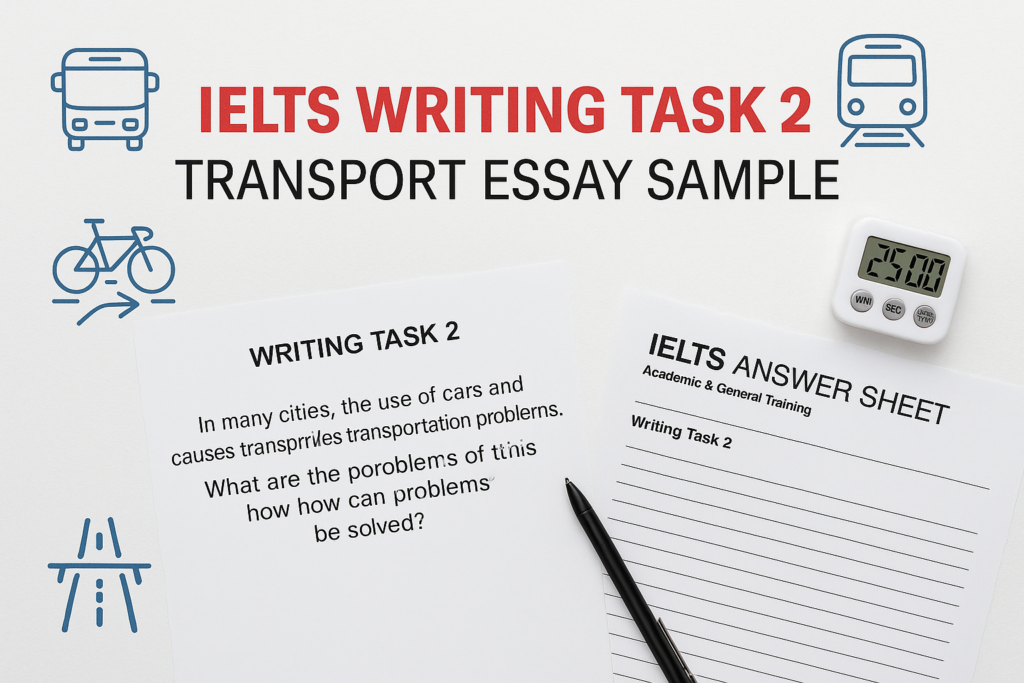
If you are looking for an IELTS Writing Task 2 Transport essay sample, you probably want more than one model answer to copy. You need to see how a strong response is built, why the ideas work, and what examiners notice when they score the essay. Transport topics appear regularly in Task 2 because they let examiners test opinion, discussion, and problem-solution writing in a very practical context.
Before you spend hours writing practice essays, it helps to check your current level first. Take the IELTS Express Pre-Test to get a quick band prediction and see whether writing is the section that needs the most attention right now.
What an IELTS Writing Task 2 Transport essay sample should teach you
A useful sample does not just give you a polished final answer. It shows you how to respond to the question directly, how to organise your position, and how to support each main point with explanation rather than random examples. That matters in transport essays because candidates often drift into general comments about cars, traffic, or pollution without clearly answering the task.
In IELTS Writing Task 2, examiners score four things: task response, coherence and cohesion, lexical resource, and grammatical range and accuracy. A transport essay sample should help you see all four. You should be able to identify the opinion, the paragraph purpose, the vocabulary choices, and the sentence control. If you cannot see those parts, the sample is not doing enough for you.
For a broader view of how Task 2 is scored, read our IELTS Writing Task 2 band score strategy. It explains what separates a solid mid-band essay from one that feels controlled from start to finish.
Common transport essay question types in IELTS Writing Task 2
Transport topics usually appear in three forms. The first asks whether governments should invest more in public transport than roads. The second focuses on problems such as traffic congestion or pollution in cities. The third asks whether changing individual behaviour, for example using bicycles or buses more often, is better than government policy alone.
The wording changes, but the trap stays the same. Candidates rush into familiar ideas without deciding what kind of response the question needs. If the task asks for an opinion, give a clear opinion. If it asks for both views, explain both views before giving your judgement. If it asks for problems and solutions, keep those two parts separate. This sounds basic, but it is where many essays lose marks.
Another issue with transport questions is that candidates sometimes write a social commentary instead of an essay. They list everything they know about commuting, city growth, fuel prices, and climate change. The result feels busy but unfocused. Good Task 2 writing is selective. You do not need every idea. You need the right ideas, explained clearly.
Transport essay structure that works under test conditions
A simple four-paragraph structure is enough for most transport topics. Start with an introduction that paraphrases the task and gives your position. Then write two body paragraphs, each built around one main reason or one side of the discussion. Finish with a short conclusion that restates your answer without adding fresh points.
This structure works because it is predictable. Under time pressure, predictability helps. You are less likely to forget your main point or repeat yourself. A transport topic does not need a clever structure. It needs a clear one.
- Introduction: paraphrase the question and state your view.
- Body paragraph 1: first main point, with explanation and a realistic example.
- Body paragraph 2: second main point, or the opposing view if the task requires both sides.
- Conclusion: summarise your position in one or two sentences.
If you want timed practice with this exact kind of structure, you can access unlimited IELTS mock tests and practise building full essays under realistic conditions rather than writing slowly without a clock.
IELTS Writing Task 2 Transport essay sample question
Here is a common style of question:
Some people think governments should spend more money on public transport, while others believe new roads are the best way to reduce traffic problems. Discuss both views and give your own opinion.
This is a discuss-both-views-and-give-your-opinion task. That means you must explain both positions clearly, then make your own view obvious. Many candidates only mention the second view briefly and then spend the whole essay defending their preference. That weakens task response because the task asked for both views, not one view plus a passing comment.
Before writing, spend a minute planning. Public transport arguments usually include lower congestion, wider access, and environmental benefits. New road arguments usually include faster movement, support for freight, and short-term relief in growing suburbs. Once you see those clusters, paragraph planning becomes much easier.
Band-focused sample answer for a transport topic
Sample answer:
People disagree about whether transport funding should go mainly to public transport systems or to the construction of new roads. While better roads can reduce pressure in some areas, I believe governments should place greater emphasis on public transport because it offers broader long-term benefits for cities and their residents.
Those who support new roads often argue that road expansion is the fastest way to ease congestion. In many cities, large numbers of people still rely on private cars because they live far from train stations or bus routes. In such cases, wider roads, bypasses, and improved motorway links can shorten travel times and make the movement of goods more efficient. This can be particularly useful in outer suburban areas, where public transport networks are often less developed and daily commuting distances are longer.
However, investing in public transport is usually a more effective strategy over time. Reliable trains, buses, and metro systems move far more people than private cars and use urban space more efficiently. As a result, they can reduce traffic congestion rather than simply shift it to another area. Public transport can also lower air pollution and commuting costs, which makes city life more affordable for ordinary residents. For example, when governments improve service frequency and coverage, more people are willing to leave their cars at home, especially for regular journeys to work or study.
In my view, road development still has a role, but it should not receive the largest share of funding. If governments keep expanding roads without improving public transport, traffic often returns as car use continues to rise. By contrast, strong public transport systems support both mobility and environmental goals, making them a better long-term investment.
In conclusion, although new roads may help in specific situations, governments should prioritise public transport because it serves more people and addresses congestion more sustainably.
This sample is not perfect because no model answer needs to be treated like a script. What matters is why it works. The opinion is clear from the introduction. Each body paragraph has one job. The examples are realistic, but they are brief. The language stays formal without sounding stiff. That balance is what you should copy, not the exact sentences.
Why this sample answer scores better than an average response
The biggest difference is control. Average essays often contain reasonable ideas, but the ideas are not organised well. A stronger essay guides the reader through the logic. In the sample above, the first body paragraph explains why some people support road building. The second explains why public transport is the better long-term choice. The conclusion then closes the argument cleanly. Nothing feels out of place.
Another strength is development. The sample does not just say that public transport is better. It explains why, using capacity, space, pollution, and cost. That gives the paragraph real weight. In weaker essays, candidates make a claim and move on too quickly. Examiners notice that. Development is one of the clearest differences between a thin essay and a convincing one.
Vocabulary also stays precise. Terms such as congestion, coverage, commuting costs, and long-term investment fit the topic naturally. There is no need to force complicated words. If you are unsure how to expand topic vocabulary without sounding mechanical, our IELTS Writing Task 2 vocabulary list is a useful place to build cleaner language for common essay themes.
Mistakes candidates make in transport essays
One common mistake is writing only about traffic and ignoring the exact question. If the task is about funding priorities, stay on funding priorities. Traffic can be part of your explanation, but it should not replace the task itself. Another frequent mistake is using examples that are too personal or too detailed. IELTS does not require real statistics or named research studies. A short, believable example is enough.
Some candidates also repeat the same idea in two paragraphs. For example, they say public transport reduces congestion in body paragraph one, then say public transport reduces the number of cars in body paragraph two. Those are almost the same point. Instead, separate your reasons clearly. One paragraph could focus on congestion and urban space. The other could focus on cost and environmental impact.
Grammar mistakes often come from trying to sound advanced. Long sentences with weak control usually hurt more than they help. It is better to write a clean sentence such as “Public transport systems can move large numbers of commuters efficiently” than a long sentence full of clauses that do not connect properly.
If you are studying on your own and want a clearer route to improvement, you can also see our IELTS preparation plans and compare guided support with independent practice.
How to plan your own IELTS Writing Task 2 Transport essay sample in 10 minutes
A strong practice routine is simple. First, read the question and underline the task words, such as discuss both views or to what extent do you agree. Second, decide your position before you start writing. Third, choose two main ideas only. Fourth, write one quick example for each body paragraph. This takes about three minutes, and it saves you from wandering in the essay itself.
Next, write the introduction in two sentences. Keep it short. Then build each body paragraph around one clear topic sentence, followed by explanation and one example. Leave two minutes at the end to check grammar, word endings, and whether your opinion stayed consistent from start to finish.
When you practise this method several times, transport essays start to feel manageable. That is the point. You are not trying to become original under exam pressure. You are trying to become reliable. Reliability is what lifts scores in Task 2.
Ready to find out your IELTS band score?
Take the IELTS Express Pre-Test for just $4.99 and get your personalised band prediction with a 14-day improvement plan.
Frequently Asked Questions
How long should an IELTS Writing Task 2 transport essay be?
You should aim for at least 250 words, but most strong answers are closer to 270 to 320 words. That gives you enough space to explain your ideas properly without padding the essay.
Do I need real examples in a transport essay?
No. IELTS does not require factual evidence or named studies. You can use short, realistic examples as long as they support your argument clearly and sound believable.
Is public transport always the best opinion in these essays?
No. There is no fixed correct opinion. You can support roads, public transport, or a balanced position. What matters is whether your answer fits the question and develops the reasoning clearly.
What vocabulary is useful for an IELTS Writing Task 2 Transport essay sample?
Useful vocabulary includes words such as congestion, commuters, infrastructure, network, coverage, road expansion, urban space, emissions, and long-term investment. Use them naturally rather than trying to force too many topic words into each sentence.
How can I improve quickly on transport topics in IELTS Writing Task 2?
Practise planning first, not just writing full essays. Learn to identify the task type, choose two main points, and build a short example for each paragraph. That is usually faster and more effective than copying model answers word for word.