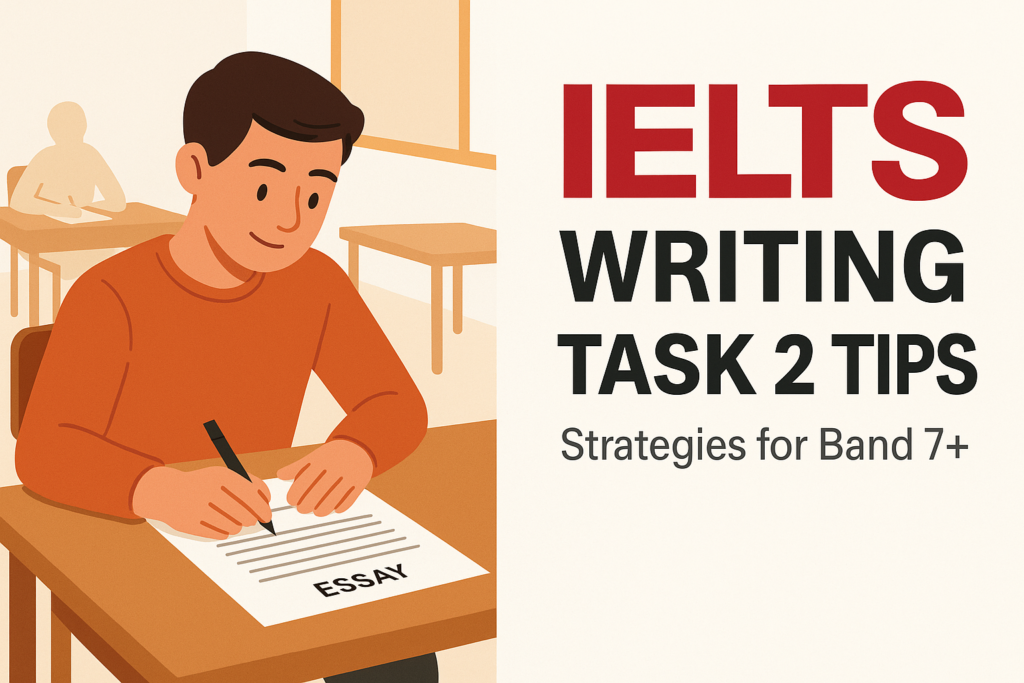
IELTS Writing Task 2 is worth 67% of your Writing band score — which makes it the single most important part of the IELTS Writing section. Yet most test-takers walk in without a clear plan, running out of time or losing marks on structure, coherence, and task achievement. The good news is that IELTS Writing Task 2 is one of the most learnable parts of the exam. With the right tips and strategies, you can consistently hit Band 7 or above.
Before diving in, it is worth knowing where you currently stand. The IELTS Express Pre-Test gives you a personalised band prediction in minutes — so you know exactly which Writing Task 2 skills to focus on first.
What Is IELTS Writing Task 2?
IELTS Writing Task 2 is an essay question that requires you to write at least 250 words in approximately 40 minutes. You are given a statement, opinion, or problem and asked to respond with a well-structured, formal essay. The task is the same for both IELTS Academic and IELTS General Training, though the topics may vary slightly.
Your essay is scored on four criteria — each worth 25% of your Task 2 band score:
- Task Achievement — Did you fully address the question?
- Coherence and Cohesion — Is your essay logically organised with smooth linking?
- Lexical Resource — Did you use a wide, accurate range of vocabulary?
- Grammatical Range and Accuracy — Did you use varied grammar structures correctly?
Understanding these four criteria is your starting point. Every tip and strategy in this guide maps directly back to improving your score in at least one of these areas.
The Four IELTS Writing Task 2 Question Types
One of the most effective IELTS Writing Task 2 strategies is recognising the question type before you write a single word. There are four main question types, and each requires a slightly different approach:
- Opinion (Agree/Disagree): You are asked to share your view and defend it. Tip — pick one side and stick to it. Sitting on the fence often leads to unclear Task Achievement.
- Discussion (Discuss Both Views): You present two sides and give your own opinion. Each main body paragraph typically covers one side.
- Problem/Solution: You identify causes or problems and propose realistic solutions. Keep causes and solutions linked — each solution should address a specific problem.
- Advantages/Disadvantages: You weigh the pros and cons of a situation. Clearly state whether advantages outweigh disadvantages, or vice versa, in your conclusion.
Misreading the question type is one of the most common reasons test-takers lose marks on Task Achievement. Take 30 seconds to identify the question type before planning.
For a deep dive into structuring arguments, see this guide on IELTS Writing Task 2 practical argument framework for Band 7.
How to Plan Your IELTS Writing Task 2 Essay in 5 Minutes
Spending 5 minutes planning before you write is one of the highest-return strategies available to you. Test-takers who skip planning tend to run out of ideas mid-essay or drift off-topic — both of which damage Task Achievement and Coherence and Cohesion scores.
Here is a simple 5-minute planning framework:
- Minute 1: Read the question carefully. Underline the key instruction and the topic. Identify the question type.
- Minute 2: Brainstorm 3–4 ideas. You only need 2 strong ones for the body — quality beats quantity.
- Minute 3: Choose your 2 main body paragraph ideas and think of 1 example or piece of evidence for each.
- Minute 4: Decide on your thesis statement (your overall position or angle).
- Minute 5: Write a quick bullet-point outline: Introduction → Body 1 → Body 2 → Conclusion.
This structure gives you a clear roadmap so you spend your 35 writing minutes executing, not second-guessing.
IELTS Writing Task 2 Structure: The Band 7+ Essay Template
High-scoring IELTS essays follow a consistent structure. Here is the Band 7+ template that IELTS examiners expect:
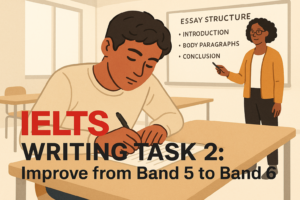
- Introduction (2–3 sentences): Paraphrase the question statement, then clearly state your position or outline what the essay will discuss.
- Body Paragraph 1 (100–120 words): Topic sentence → Explanation → Example → Link back to question.
- Body Paragraph 2 (100–120 words): Topic sentence → Explanation → Example → Link back to question.
- Conclusion (2–3 sentences): Restate your position and summarise your key points. Do not introduce new ideas here.
A well-executed 4-paragraph essay at 260–280 words consistently outperforms a rambling 350-word essay that lacks structure. Focus on quality and clarity over length — but always hit the 250-word minimum.
You can practise this structure with real exam-style questions via unlimited IELTS mock tests, which are one of the fastest ways to build automatic writing habits before test day.
Vocabulary and Grammar Tips for IELTS Writing Task 2
Lexical Resource and Grammatical Range and Accuracy together make up 50% of your Task 2 score. Here are the most practical tips for improving both:
Vocabulary Tips
- Avoid repeating the same word. Use synonyms — but only ones you are confident using correctly. An incorrect synonym is worse than a simple repeated word.
- Learn topic-specific vocabulary bundles (environment, technology, education, health) rather than random word lists.
- Use collocations naturally: “raise awareness”, “tackle the problem”, “have a significant impact”.
- Paraphrase the question prompt in your introduction — examiners notice when you simply copy the question wording.
Grammar Tips
- Use a mix of sentence types — simple, compound, and complex. One common way to show grammatical range is with relative clauses (“which”, “that”, “who”) and conditional structures (“If … , … would …”).
- Watch your articles (a/an/the). Article errors are extremely common among test-takers and affect accuracy scores.
- Avoid sentence fragments. Every sentence needs a subject and a verb.
- Check subject-verb agreement, especially in longer sentences where the subject can get separated from the verb.
For more on moving from Band 5 to Band 6 in Writing Task 2, the guide on IELTS Writing Task 2 improve from Band 5 to 6 covers the exact grammar and vocabulary shifts that make the difference.
Time Management Strategy for IELTS Writing Task 2
Many test-takers fail to finish Task 2 — or rush the conclusion — because they spend too long on Task 1. Since Task 2 carries double the marks, protect your Task 2 time first.
Recommended time split:
- Task 1: 20 minutes (write it first if you find it easier, or last if Task 2 is your strength)
- Task 2: 40 minutes — 5 planning + 30 writing + 5 reviewing
During the 5-minute review, check for: spelling errors, missing articles, subject-verb agreement, and clarity of your thesis. You will not be able to rewrite paragraphs in 5 minutes — but fixing small errors can add half a band point.
Practising under timed conditions is essential. If you have not timed yourself writing a complete Task 2 essay recently, start this week.
Ready to find out your IELTS band score?
Take the IELTS Express Pre-Test for just $4.99 and get your personalised band prediction with a 14-day improvement plan.
Take the Pre-Test Now →
Frequently Asked Questions About IELTS Writing Task 2
How many words should I write for IELTS Writing Task 2?
You must write a minimum of 250 words. There is no upper limit, but most high-scoring essays fall in the 270–320 word range. Writing significantly more than that rarely improves your score and can introduce more errors. Focus on quality and structure over word count.
Can I use personal examples in IELTS Writing Task 2?
Yes. IELTS examiners accept general examples, hypothetical examples, and personal experience. What matters is that your examples are relevant, specific, and clearly connected to the point you are making. A vague or tangential example can hurt your score more than no example at all.
What is the fastest way to improve my IELTS Writing Task 2 band score?
The fastest improvement path is: (1) identify which of the four scoring criteria is your weakest, (2) focus targeted practice on that criterion for 2–3 weeks, and (3) get feedback on your essays. Blind practice without feedback is significantly less effective. Timed practice with exam-style questions from IELTS preparation plans gives you both structure and feedback.
Is IELTS Writing Task 2 the same for Academic and General Training?
The essay format and scoring criteria are identical for both modules. The main difference is that General Training essays may involve slightly more everyday topics, while Academic essays often focus on more formal or research-oriented themes. The same tips and strategies apply to both.
How do I avoid going off-topic in IELTS Writing Task 2?
Going off-topic is a Task Achievement error. To prevent it: always refer back to your plan before each paragraph, keep your topic sentences tightly focused on the question, and do not introduce new arguments in your conclusion. If you are writing something that would not appear in your introduction’s thesis, it probably does not belong in the essay.