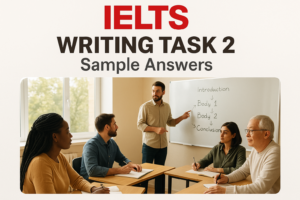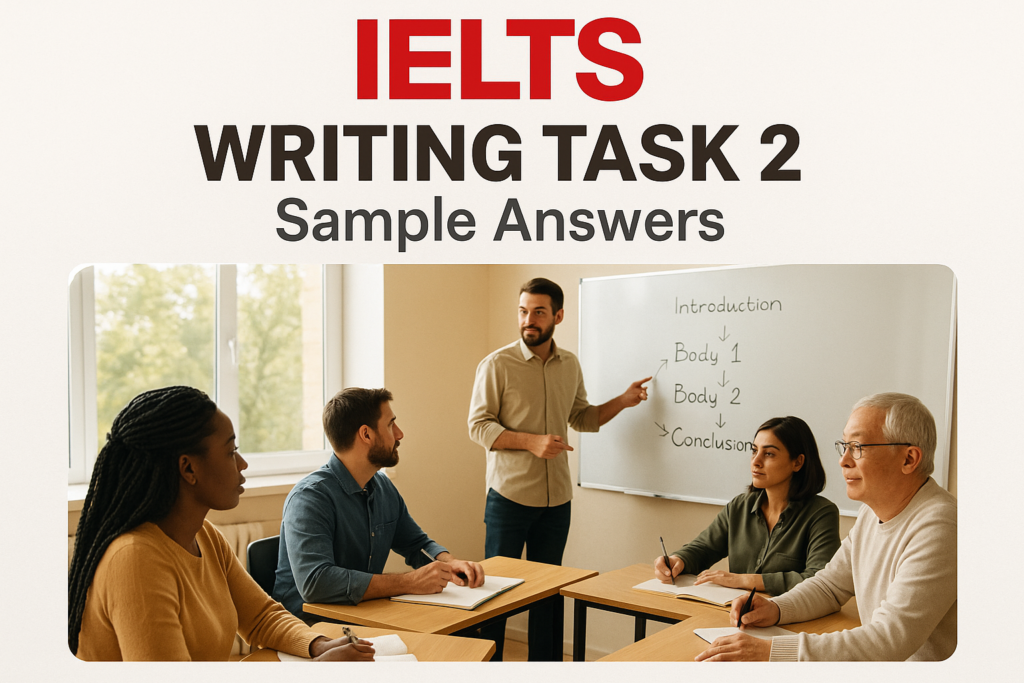
If you are preparing for the IELTS Writing Task 2, studying sample answers is one of the most practical ways to understand what examiners actually look for. A strong sample answer shows you how to build an argument, connect ideas clearly, and meet the band descriptors across all four marking criteria. Whether you are aiming for Band 6, 7, or 8, reading and analysing real examples will sharpen your writing faster than theory alone.
Before you start practising, it helps to know where you stand right now. The IELTS Express Pre-Test gives you a quick band estimate so you can focus your preparation where it matters most.
Why IELTS Writing Task 2 Sample Answers Matter for Your Preparation
Reading sample answers is not about memorising templates. It is about understanding how high-scoring responses are structured, how arguments are developed, and how grammar and vocabulary are used naturally. The IELTS Writing Task 2 is worth two-thirds of your total writing score, so getting this section right has a direct impact on your overall band.
When you study sample answers carefully, you start to notice patterns. Band 7 and 8 responses share certain characteristics: a clear position stated early, well-developed body paragraphs with specific examples, and cohesive linking between ideas. Band 5 and 6 responses, on the other hand, tend to have vague arguments, repetitive vocabulary, and weak paragraph structure.
The difference between these bands is not about using complex words. It is about communicating your ideas with precision and logic.
How IELTS Writing Task 2 Is Scored: The Four Criteria
Every Task 2 response is assessed against four criteria, each worth 25% of your writing score:
- Task Response (TR): Did you answer the question fully? Is your position clear throughout the essay?
- Coherence and Cohesion (CC): Are your ideas organised logically? Do paragraphs flow naturally from one to the next?
- Lexical Resource (LR): Do you use a range of vocabulary accurately and appropriately?
- Grammatical Range and Accuracy (GRA): Do you use a variety of sentence structures with control over errors?
Understanding these criteria is the first step. The second step is seeing how they look in practice, which is exactly what sample answers provide.
Sample Answer: Opinion Essay (Band 7–8 Level)
Question: Some people believe that university education should be free for everyone. Others think students should pay for their own education. Discuss both views and give your own opinion.
There is an ongoing debate about whether university education should be funded entirely by the government or whether students should contribute to the cost themselves. While free education would increase access for disadvantaged groups, I believe a shared funding model is more sustainable and fair.
Those who support free university education argue that it removes financial barriers. Students from low-income families often cannot afford tuition fees, which means talented individuals miss out on higher education simply because of their financial situation. In countries like Germany and Norway, where university is free, participation rates are higher across all income levels. This suggests that removing fees does increase equality of opportunity.
On the other hand, fully government-funded education places a significant burden on taxpayers, many of whom did not attend university themselves. When students invest their own money in education, they tend to take their studies more seriously and choose courses with stronger employment outcomes. A partial fee structure, supported by income-contingent loans like Australia’s HECS-HELP system, allows students to access education without upfront costs while still contributing once they are earning.
In my view, the most balanced approach is one where the government subsidises a significant portion of tuition while graduates repay a manageable share through their future earnings. This protects access without placing the full cost on either party.
What Makes This a Band 7–8 Response
This response works because it addresses both sides of the argument with specific examples (Germany, Norway, Australia’s HECS system). The position is stated in the introduction and reinforced in the conclusion. Paragraphs are clearly organised around one main idea each, and linking words like “on the other hand” and “this suggests” create natural flow without being mechanical.
The vocabulary is precise without being forced. Phrases like “income-contingent loans”, “equality of opportunity”, and “employment outcomes” show topic-specific language used naturally.
Sample Answer: Problem–Solution Essay (Band 6–7 Level)
Question: In many cities, traffic congestion is becoming a serious problem. What are the causes of this, and what solutions can be suggested?
Traffic congestion is a growing issue in many urban areas around the world. The main causes are the increasing number of private vehicles and poor public transport systems. Several practical solutions could help reduce this problem.
One of the primary causes of traffic congestion is the rise in car ownership. As more people can afford vehicles, roads become overcrowded during peak hours. In cities like Sydney and Melbourne, commuters often spend over an hour in traffic each way because public transport does not cover all areas effectively. When buses and trains are unreliable or inconvenient, people naturally prefer to drive.
To address this, governments could invest in better public transport networks that reach suburban areas. Cities like Singapore and Tokyo have efficient rail systems that make driving unnecessary for most commuters. Another solution is to introduce congestion charges in city centres, which has proven effective in London. These charges discourage unnecessary driving and generate revenue that can be reinvested in transport infrastructure.
In summary, traffic congestion is largely caused by over-reliance on private cars and gaps in public transport. Improving transport networks and introducing congestion pricing are realistic steps that can make a measurable difference.
What Keeps This at Band 6–7
This response is well-organised and answers the question clearly. The examples are relevant and the paragraphs are logically structured. It sits at Band 6–7 rather than 7–8 because the vocabulary range is more limited, the sentence structures are less varied, and the ideas, while correct, lack the depth and nuance of a higher-band response. With more specific data and more complex sentence patterns, this could move to Band 7.
If you want to practise with full-length timed essays, unlimited IELTS mock tests let you simulate real exam conditions and track your progress over time.
Common Essay Types You Need to Practise
IELTS Writing Task 2 questions fall into a few main categories. Each type requires a slightly different approach:
- Opinion (Agree/Disagree): State your view clearly and support it with reasons and examples. You can partially agree, but your position must be consistent throughout.
- Discussion (Both Views): Present both sides fairly, then give your own opinion. Do not sit on the fence without a clear stance.
- Problem–Solution: Identify the causes and propose realistic solutions. Be specific rather than vague.
- Advantages–Disadvantages: Weigh up both sides. If the question asks for your opinion, include it. If it does not, you can remain neutral.
- Two-Part Question: Answer both parts equally. Do not spend 80% on one part and rush the other.
Practising at least two or three sample answers from each type builds confidence and helps you recognise question patterns under exam pressure.
How to Use Sample Answers Effectively
Reading sample answers passively will not improve your score. To get real value from them, use this approach:
Step 1: Read the question first. Before looking at the sample, spend two minutes planning your own response. What would your thesis be? How would you structure your paragraphs?
Step 2: Read the sample answer. Compare their structure and argument with your plan. What did they include that you missed? How did they introduce their examples?
Step 3: Identify band-specific features. Look at the marking criteria and find evidence in the sample. Where does the writer demonstrate lexical resource? Where is coherence strongest?
Step 4: Write your own version. Using the same question, write a complete response. Then compare it with the sample. This active comparison is where real improvement happens.
Step 5: Get feedback. Self-assessment has limits. Having your writing reviewed against the band descriptors shows you exactly where to focus next.
Mistakes That Lower Your Band Score in Task 2
Studying sample answers also helps you recognise what to avoid. These are the most common issues that drag scores down:
- Not answering the question: If the question asks you to discuss both views and give your opinion, you must do all three. Missing any part means you cannot score above Band 5 for Task Response.
- Memorised phrases and templates: Examiners are trained to spot memorised language. Phrases like “in this day and age” or “it goes without saying” signal a rehearsed response and limit your Lexical Resource score.
- Underdeveloped paragraphs: A body paragraph with one sentence and no example or explanation will not score well. Each paragraph needs a clear topic sentence, supporting detail, and a link to your overall argument.
- Ignoring word count: The minimum is 250 words. Writing fewer than 240 words triggers an automatic penalty. Aim for 270–290 words to give yourself enough space to develop ideas without overwriting.
- Poor time management: You have 40 minutes for Task 2. Spend 5 minutes planning, 30 minutes writing, and 5 minutes reviewing. Rushing the plan almost always produces a weaker essay.
For a deeper look at what holds scores back, the IELTS Writing Task 2 common mistakes guide covers each issue with practical fixes.
Building Your Own Sample Answer Collection
The best sample answer bank is the one you build yourself. Every time you write a practice essay, save it. Note the question type, your estimated band, and what you would change next time. Over four to six weeks, you will have a personalised collection that shows your progress and highlights recurring weaknesses.
Pair your own essays with published samples from trusted sources. Compare how you handle the same question type. This side-by-side approach is far more effective than reading samples in isolation.
If you want structured feedback on your writing and a clear sense of your current band level, the IELTS Writing Task 2 band score guide breaks down exactly what examiners look for at each level.
Ready to find out your IELTS band score?
Take the IELTS Express Pre-Test for just $4.99 and get your personalised band prediction with a 14-day improvement plan.
Frequently Asked Questions
Where can I find reliable IELTS Writing Task 2 sample answers?
The most reliable sources are official IELTS practice materials published by Cambridge and the British Council. Preparation sites like Career Wise English also publish sample answers written to specific band levels with examiner-style commentary. Avoid random samples from forums or social media, as these are often inaccurate or poorly written.
How many sample answers should I study before my IELTS test?
Aim to read and analyse at least 10 to 15 sample answers across different question types (opinion, discussion, problem–solution, advantages–disadvantages). Focus on understanding why each sample scores at its band level rather than trying to memorise content. Quality of analysis matters more than quantity.
Can I use ideas from sample answers in my own IELTS essay?
You can use similar arguments and supporting points, but you must express them in your own words. Copying phrases directly from memorised samples will lower your Lexical Resource score, as examiners specifically look for this. Use sample answers to learn structures and argument patterns, then develop your own language for expressing those ideas.
What is the difference between a Band 6 and Band 7 sample answer?
A Band 6 response answers the question and is generally well-organised, but ideas are not fully developed and vocabulary is limited. A Band 7 response shows a clear position throughout, uses a wider range of vocabulary with flexibility, and has fewer grammatical errors. The main differences are in depth of argument, precision of language, and consistency of quality across the whole essay.
Should I time myself when writing practice answers?
Yes. Timing is a core part of IELTS preparation. In the real test, you have 40 minutes for Task 2, and many candidates struggle with time pressure. Practise under timed conditions from early in your preparation so that planning, writing, and reviewing become second nature by test day.
Is it better to write my own essays or just read sample answers?
Both are important, but writing your own essays is where real improvement happens. Reading samples teaches you what good writing looks like, but writing practice builds the skills you need under exam conditions. A balanced approach is to study two or three samples per question type, then write your own response to the same question and compare results.