Understanding Government Spending Questions in IELTS Writing Task 2
Government spending is one of the most common IELTS Writing Task 2 topics. You will see questions about public funding for education, health, infrastructure, defence, and the arts. Many test takers struggle with this topic because they are not sure how to structure a balanced argument about where governments should direct their budgets.
If you are preparing for IELTS and want to know where you currently stand, take the IELTS Express Pre-Test to get a personalised band score prediction and a 14-day improvement plan.
This guide gives you a full band 7+ sample essay on government spending, along with a step-by-step breakdown of how to plan, write, and improve your response on test day.
Sample Essay Question
Some people believe that governments should spend money on public health services rather than on other areas such as defence and infrastructure. To what extent do you agree or disagree?
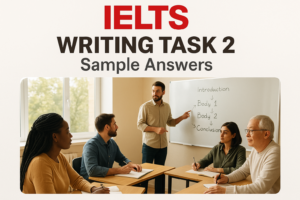
Full Band 7+ Sample Essay
Public health is fundamental to the wellbeing of any society, and some argue that it should receive priority in government budgets over areas such as defence and infrastructure. While I largely agree that health funding deserves significant allocation, I believe a balanced approach is necessary to maintain a functioning society.
There are strong reasons why public health should be a spending priority. A healthy population is the foundation of a productive economy. When governments invest in hospitals, preventive care, and medical research, they reduce the long-term costs associated with treating chronic diseases. Countries with well-funded health systems, such as Australia and the United Kingdom, tend to have higher life expectancy and lower rates of preventable illness. Furthermore, public health crises like the COVID-19 pandemic demonstrated that underfunded health systems can collapse under pressure, leading to far greater economic damage than the original cost of adequate investment.
However, it would be short-sighted to neglect defence and infrastructure entirely. National security is a basic function of government, and without adequate defence spending, a country may be vulnerable to external threats. Similarly, infrastructure—including roads, bridges, public transport, and digital networks—is essential for economic growth and daily life. A country with excellent hospitals but crumbling roads and unreliable power supply would still face significant challenges. These areas of spending are not competing with health; they are interconnected.
The most effective approach is proportional allocation based on current needs. During a health crisis, governments should increase health spending temporarily. In times of stability, infrastructure investment might take priority to support long-term growth. The key is flexibility rather than rigid prioritisation of any single sector.
In conclusion, while public health should remain a high priority in government budgets, it should not come at the complete expense of defence and infrastructure. A balanced and responsive approach to public spending produces the best outcomes for citizens.
How to Plan a Government Spending Essay in Under Five Minutes
Planning is the difference between a band 6 and a band 7 essay. Most test takers who score below band 7 on Task 2 skip the planning stage entirely and start writing immediately. This leads to disorganised arguments, repetition, and weak conclusions.
Here is a practical five-minute planning method for government spending essays. First, read the question twice and underline the key instruction words. Second, decide your position. You do not need to pick an extreme view. A nuanced position—such as “I largely agree but with some reservations”—is perfectly acceptable and often easier to develop with supporting points.
Third, write down two main ideas for your primary argument and one point for the opposing side. This gives you a clear three-paragraph body structure. Fourth, think of one specific example for each main point. Real-world examples from countries you know about, or general knowledge about health, education, or infrastructure systems, work well.
This planning approach works for any IELTS Writing Task 2 question, not just government spending topics. If you want to practise with realistic test conditions, try our unlimited IELTS mock tests to build your timing and confidence.
Key Vocabulary for Government Spending Essays
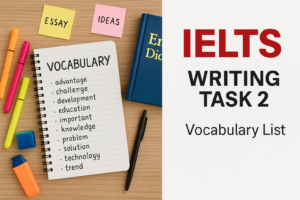
Using precise vocabulary is one of the fastest ways to improve your band score in IELTS Writing Task 2. Examiners specifically assess your lexical resource, which means the range and accuracy of your word choices.
For government spending essays, these terms will help you write with greater precision. Use allocate or direct funds to instead of saying “spend money on.” Replace important with essential, critical, or fundamental depending on context. Instead of saying “people think,” use commentators argue, citizens contend, or there is growing consensus that as appropriate.
For discussing priorities, use terms like take precedence over, warrant greater investment, or should be weighted more heavily in budget decisions. When presenting opposing views, use phrases like conversely, on the other hand, advocates of increased defence spending maintain that, and despite these arguments, there is a case for.
Avoid repeating the same word throughout your essay. If you use “government” in your first paragraph, switch to “authorities,” “public bodies,” or “the state” in later paragraphs. This variety shows range without forcing unusual vocabulary.
Common Mistakes That Cost Marks on Government Spending Essays
The most common mistake on government spending essays is writing a list of points without developing them. Saying “governments should spend more on health because it is important” does not demonstrate the analytical thinking examiners expect. You need to explain why it matters, give evidence, and connect it to your overall argument.
Another frequent error is ignoring the specific focus of the question. If the question asks about health versus defence, do not write a general essay about why education matters. Stay focused on the areas mentioned in the question and only bring in additional topics if they directly support your argument.
Grammar errors in complex sentences also cost marks. Many candidates try to write long, complicated sentences to impress the examiner but end up with run-on sentences or unclear pronoun references. It is better to write clear, accurate sentences of moderate length than to attempt complex structures that contain errors.
A fourth mistake is writing a conclusion that simply repeats the introduction. Your conclusion should summarise your position in slightly different words and leave the reader with a clear understanding of where you stand on the issue.
If you are making these mistakes regularly, it helps to get structured feedback on your writing. The IELTS Writing Task 2 band score strategy guide breaks down exactly how examiners assess each criterion so you can target your weakest areas.
How This Essay Meets Band 7+ Criteria
Understanding why this sample essay scores well helps you replicate the approach in your own writing. The essay meets band 7+ criteria across all four assessment areas.
For Task Response, the essay directly addresses the question, takes a clear position, and develops the argument with relevant supporting points. The writer acknowledges both sides without sitting on the fence.
For Coherence and Cohesion, the essay follows a logical structure with a clear introduction, body paragraphs that each focus on one main idea, and a conclusion that ties everything together. Linking words are used naturally rather than forced.
For Lexical Resource, the essay demonstrates a range of vocabulary related to government spending, health, and policy. Words like proportional allocation, preventive care, and responsive approach show topic-specific knowledge.
For Grammatical Range and Accuracy, the essay uses a mix of simple, compound, and complex sentences accurately. There are no significant grammatical errors, and the writer demonstrates control over conditional structures and relative clauses.
Practise With Real Test Conditions
Reading sample essays helps, but the real improvement comes from writing your own responses under timed conditions. Set a timer for 40 minutes, write your response to the question above, and then compare it to the sample essay in this guide.
Pay attention to where your argument structure differs. Did you include a clear thesis? Did you develop each point with evidence? Did you address the opposing view? These are the areas that separate band 6 from band 7.
If you want structured practice with instant feedback, see our IELTS preparation plans for access to full writing assessment tools and mock tests.
Ready to find out your IELTS band score?
Take the IELTS Express Pre-Test for just $4.99 and get your personalised band prediction with a 14-day improvement plan.
Frequently Asked Questions
What are the most common government spending topics in IELTS Writing Task 2?
The most common government spending topics include health versus defence, education versus military spending, infrastructure versus social services, and arts funding versus practical investment. Questions typically ask you to discuss priorities or evaluate whether one area deserves more funding than another.
How long should my IELTS Writing Task 2 essay be?
Your essay should be at least 250 words. Most successful candidates write between 270 and 300 words. Writing significantly more than 300 words can lead to errors and time pressure. Focus on quality of argument rather than word count.
Can I use personal examples in a government spending essay?
You can reference personal knowledge or observations, but academic-style evidence is more effective. Referring to specific countries, health systems, or well-known policy outcomes makes your argument more convincing than personal anecdotes.
Should I agree or disagree completely in IELTS Writing Task 2?
You do not need to fully agree or disagree. A balanced position—such as “I largely agree but recognise the importance of other areas”—is acceptable and often easier to develop. The key is being clear about your position and supporting it consistently throughout the essay.
How do I improve my vocabulary for IELTS Writing Task 2?
Read articles about government policy, economics, and social issues from sources like the BBC or The Guardian. Note down useful phrases and practise using them in your own essay writing. Focus on collocations and topic-specific terms rather than memorising unusual individual words.
What is the best essay structure for government spending questions?
A four-paragraph structure works well for most government spending essays. Write an introduction with your thesis, then two body paragraphs covering your main arguments and one addressing the opposing view, and finish with a conclusion that restates your position. This structure is clear, logical, and easy to follow under time pressure.