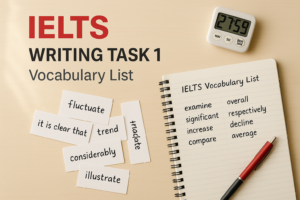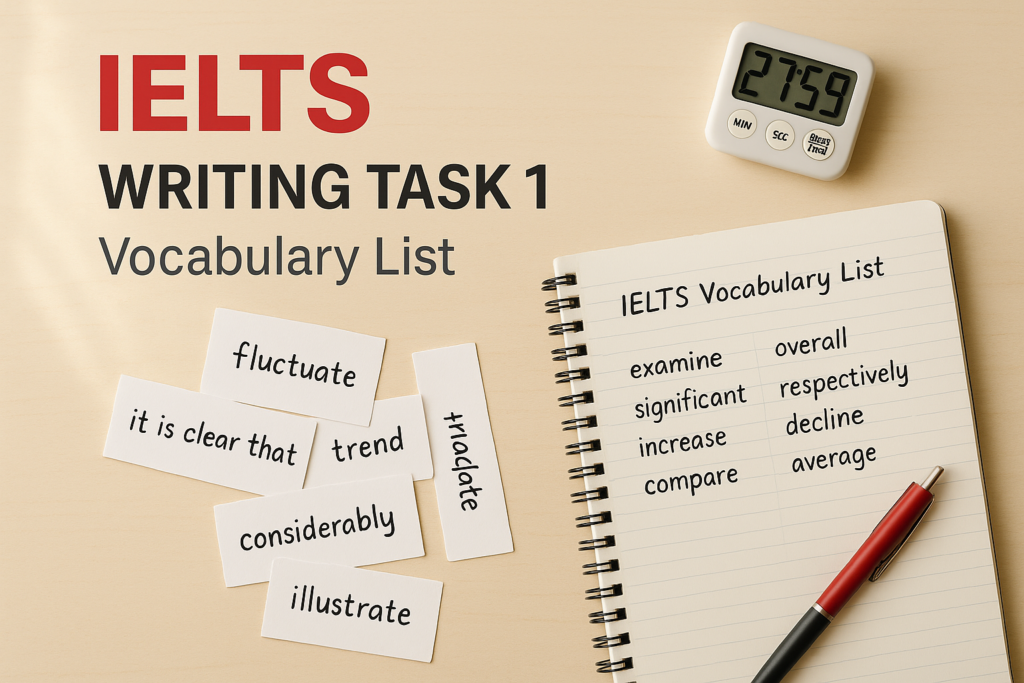
Vocabulary is one of the most concrete things you can improve before your IELTS test. Unlike grammar, which takes time to rewire, a targeted vocabulary list for Writing Task 1 gives you a set of ready-to-use phrases that you can apply to almost any graph, chart, table, or diagram.
The challenge is knowing which words to learn. Many candidates memorise long synonym lists without understanding when to use each one — which actually hurts their score. Examiners penalise inaccurate word choice, so the goal isn’t variety for its own sake; it’s accuracy paired with range.
If you’re not sure what band your current writing is sitting at, the IELTS Express Pre-Test is a $4.99 diagnostic that gives you a personalised band prediction and a 14-day improvement plan — worth doing before you commit to heavy vocabulary study.
Why Vocabulary Counts for 25% of Your Task 1 Score
IELTS Writing Task 1 is marked on four criteria, each worth 25%:
- Task Achievement
- Coherence and Cohesion
- Lexical Resource
- Grammatical Range and Accuracy
Lexical Resource is entirely about vocabulary — the range of words you use, how accurately you use them, and whether your word choice suits the academic register. A Band 7 in Lexical Resource requires “sufficient range of vocabulary to allow some flexibility and precision” with “less common lexical items used with some awareness of style.” Band 8 requires “wide resource” used “fluently and flexibly.”
In practical terms: if you’re using the same five reporting verbs (“shows,” “rises,” “falls,” “increases,” “decreases”) across every Task 1 response, your Lexical Resource score is capped. Expanding your word bank with precise, task-appropriate vocabulary is the fastest route to pushing your band above 6.5.
Vocabulary for Describing Trends (Verbs + Adverbs)
The most important vocabulary category for Academic Task 1 is trend language — words that describe how data changes over time.
Upward trend verbs:
- rise / rose / risen
- increase / increased
- climb / climbed
- grow / grew / grown
- surge / surged (for sharp, rapid increases)
- soar (use sparingly — for dramatic increases only)
- expand / expanded (for quantities like market share or population)
Downward trend verbs:
- fall / fell / fallen
- decrease / decreased
- decline / declined
- drop / dropped
- dip / dipped (for minor, short-term falls)
- plummet / plummeted (for dramatic, sharp decreases)
- contract / contracted (for market or economic contexts)
Flat / stable trend verbs:
- remain stable / remained stable
- level off / levelled off
- plateau / plateaued
- hold steady
- stay constant
Degree adverbs (pair with trend verbs):
- sharply / dramatically (steep changes)
- significantly / substantially (notable but not extreme)
- steadily / gradually (consistent, even change)
- slightly / marginally (very small change)
- rapidly (fast change, direction neutral)
Pairing accurately is critical. “Rose marginally” and “rose dramatically” convey very different magnitudes — use the one that actually matches the data in front of you.
Vocabulary for Comparing Data
Comparison language is essential for charts with multiple categories, groups, or time periods.
Higher/lower comparisons:
- was higher than / was lower than
- exceeded / surpassed
- was approximately twice as high as
- was roughly half the level of
- was significantly greater than / was considerably lower than
Similar/equal comparisons:
- was similar to / was comparable to
- was roughly the same as
- showed little difference from
- was virtually identical to
Difference language:
- There was a [slight/significant/notable] difference between X and Y
- X and Y diverged from [year/point]
- The gap between X and Y [widened/narrowed] over the period
- By [year], X had overtaken Y
To practise applying this vocabulary under realistic timed conditions, the IELTS Writing Task 1 practice test on the Career Wise English site includes Academic and General Training tasks you can work through with a timer.
Vocabulary for Time and Sequencing
Line graphs, bar charts with multiple time points, and process diagrams all require time expressions. These help examiners follow the logic of your response.
Time period openers:
- In [year] / Between [year] and [year]
- Over the [20-year / 40-year] period
- During the period shown / Throughout the period
- By [year] / By the end of the period
Sequencing for process diagrams:
- Initially / First / In the first stage
- Following this / Subsequently / Next
- After that / Once [X] is complete
- Finally / In the final stage
- The process begins with… / The cycle concludes with…
Change markers:
- Before [year] / Prior to [year]
- After [year] / From [year] onwards
- During the first half of the period
- In the latter part of the period
Vocabulary for Overviews
The overview paragraph is often the most under-developed section in lower-band responses. A strong overview needs specific language to identify the most significant trend or comparison — not just a restatement of the title.
Overview openers:
- Overall, it is clear that…
- The most notable feature of the data is…
- In general, the data suggest that…
- Overall, [X] showed the most significant change, while [Y] remained relatively stable.
Overview content phrases:
- a consistent upward / downward trend
- a gradual but steady increase
- the most dramatic change
- the dominant category throughout the period
- a pattern of [growth / decline / fluctuation]
- a clear inverse relationship between X and Y
One of the most common reasons candidates get capped at Band 6 in Task Achievement is writing an overview that only describes what the chart is (e.g., “The chart shows data about transport use in five countries”) rather than what it reveals (e.g., “Overall, car use dominated across all five countries, though public transport increased steadily in urban areas after 2005”). For a deeper look at how band scores work in practice, see our IELTS Writing Task 1 band score guide.
Vocabulary for Specific Chart Types
Different task types have their own vocabulary demands.
For pie charts:
- accounted for [X]% of the total
- made up nearly a quarter / a third / half
- represented the largest / smallest share
- combined, X and Y accounted for more than half
For maps (Academic):
- was replaced by / was converted into
- a new [building/road/park] was constructed
- the area to the [north/south/east/west] underwent significant development
- remained largely unchanged / was left undeveloped
- the original [structure] was demolished
For diagrams / processes:
- is fed into / is transferred to
- undergoes a [heating/cooling/filtering] process
- is converted into / is transformed into
- is then passed through [stage/component]
- the output is [collected/directed/returned]
For tables:
- the highest / lowest figure was recorded in [country/year/category]
- the figures for X ranged from [low] to [high]
- [Country] showed the greatest variation across categories
Words and Phrases to Avoid or Use Carefully
Vocabulary errors hurt your Lexical Resource score just as much as limited vocabulary. These are the most common mistakes:
Overused / vague words:
- “very big / very small” → use “substantial” / “marginal” instead
- “a lot of” → use “a significant proportion of” or a specific figure
- “went up / went down” → these are fine but over-relied on; mix in more precise verbs
False range — using synonyms that don’t fit:
- “The data skyrocketed” when the increase was 3% — inaccurate adverb choice hurts more than it helps
- “The figures plummeted” for a 10% fall — reserve strong language for genuinely dramatic shifts
Incorrect register:
- Avoid contractions (“it’s,” “don’t”)
- Avoid informal phrases (“loads of people,” “a big jump”)
- Avoid hedging with first person (“I think this shows”)
Repetition without awareness:
- If you use “increased” three times in a paragraph, examiners notice
- Aim for at least three different trend verbs per response
To see how high-scoring responses actually deploy this vocabulary in context, the IELTS Writing Task 1 sample answers guide includes Band 6, 7, and 7.5 examples with analysis — useful for checking your own word choices against real models.
Ready to find out your IELTS band score?
Take the IELTS Express Pre-Test for just $4.99 and get your personalised band prediction with a 14-day improvement plan.
Frequently Asked Questions
Q: How many vocabulary words do I need to learn for IELTS Writing Task 1?
You don’t need a massive vocabulary — you need the right vocabulary used accurately. A core set of around 80–100 task-specific words and phrases (trend verbs, comparison language, overview openers, chart-specific phrases) is enough to cover most Task 1 scenarios. Quality of usage matters more than raw quantity.
Q: Can I reuse the same vocabulary list for every Task 1 question?
A core vocabulary set transfers across most tasks, but you’ll need to adapt for specific chart types. The trend and comparison vocabulary listed above applies broadly, but map, diagram, and process tasks require their own set of stage and transformation phrases. Build a flexible core list and add chart-specific extensions for each type.
Q: Does using advanced vocabulary guarantee a higher band in Task 1?
No — and attempting vocabulary beyond your current accuracy level can lower your score. Band descriptors reward accurate use of less common vocabulary, not uncommon vocabulary used incorrectly. It’s better to use “rose steadily” accurately than to attempt “escalated exponentially” and get the context wrong. Build vocabulary in context by studying real Task 1 examples alongside the phrases.
Q: What’s the difference between Lexical Resource and Task Achievement in Writing Task 1?
Task Achievement assesses whether you’ve addressed the task properly — covering key features, writing an overview, and selecting relevant data. Lexical Resource assesses the language you’ve used to do that — range, accuracy, and appropriateness. You can write a well-structured response with strong data selection (good Task Achievement) but still score Band 5 in Lexical Resource if your vocabulary is limited or repetitive. Both criteria need work.
Q: Should I memorise vocabulary lists by chart type or by function?
By function is more efficient. Learning “trend verbs,” “comparison phrases,” and “overview language” as separate categories means you can combine them across different task types, rather than having separate lists for bar charts, line graphs, and pie charts. Add a small chart-specific extension (like map language or process verbs) once your core functional vocabulary is solid.
Need more Task 1 help? Practice with unlimited IELTS mock tests that include Writing Task 1 tasks — timed and marked against the same four IELTS criteria.