IELTS Writing Task 1 trips up more test-takers than it should. The section is only 20 minutes, worth one-third of your Writing band, and asks you to do something straightforward: describe a chart, graph, map, or diagram. Yet the average score for this task remains stubbornly low — not because the charts are hard, but because most candidates describe what they see rather than analyse it.
The difference between Band 5 and Band 7 in Writing Task 1 is not vocabulary size or grammar complexity. It is structure, selection, and precision. The strategies in this guide target exactly those three areas.
Before working through these tips, it helps to know your current Writing band. The IELTS Express Pre-Test gives you a section-by-section band prediction for $4.99 — useful context before you start fixing things.
Understand What the Examiner Is Actually Marking
Four criteria. Equal weight. Knowing them is not optional.
Task Achievement — Did you address the task fully? Does your response include an overview? Did you cover the key features with appropriate data support?
Coherence and Cohesion — Is your response logically organised? Does it move from overview to body clearly? Is the linking language varied and accurate?
Lexical Resource — Can you use vocabulary precisely? Is your range appropriate? Are specialist words (rise, plateau, fluctuate, peak) used correctly?
Grammatical Range and Accuracy — Do you use a mix of sentence structures? Are there consistent errors, or occasional ones?
Most Band 5 responses underperform on Task Achievement — specifically, the overview is missing or weak. Most Band 6 responses have a reasonable overview but limited vocabulary range. Band 7 requires all four criteria to be clearly met.
Write the Overview Before Anything Else
This is the single most important tip in this entire guide.
The overview is a summary of the most significant trends or comparisons in the chart. It should appear early — either at the end of the introduction or as a standalone paragraph — and it should contain no specific figures.
The overview exists to show the examiner that you can read a chart analytically. You are not describing everything. You are selecting the most important patterns.
Weak overview (Band 5):
“The chart shows data about car sales in five countries from 2010 to 2020.”
Strong overview (Band 7):
“Overall, car sales rose across all five countries over the period, with Japan recording the most significant growth while France remained the weakest performer throughout.”
The second version makes two analytical claims: a general direction and a contrast. It does not use any specific numbers. This is what Band 7 Task Achievement looks like in the overview paragraph.
Practise writing overviews daily — even if you do not write the full response. One overview paragraph per chart is an efficient way to build this skill.
Group Data; Never List It
Listing data is the most common structural error in Writing Task 1. A response that reports each data point individually — left to right, country by country, year by year — reads like a table, not an analysis. Examiners do not reward lists.
Grouping means identifying which data points share a pattern and describing them together.
Listing (Band 5):
“France had 40 units in 2010. Germany had 35 units in 2010. Japan had 45 units in 2010. France rose to 60 units in 2020. Germany rose to 50 units in 2020.”
Grouping (Band 7):
“France, Germany, and Japan all recorded increases over the decade, though the pace of growth varied significantly — Japan climbed from 45 to 85 units, while France and Germany showed more modest gains of around 20 units each.”
The grouped version covers the same data in fewer words, uses a contrast within the same sentence, and reads analytically rather than mechanically.
To build this skill, practise rewriting listed descriptions. Take a Band 5 response and consolidate every two or three sentences into one well-structured sentence.
Build a Reliable Vocabulary Set for Data Description
Limited or inaccurate vocabulary for change is one of the clearest Band 5 markers. Examiners notice immediately when a candidate uses only “increased” and “decreased” throughout a response.
What Band 7 looks like in practice:
Verbs of increase (graded by intensity):
Slight: edged up, nudged higher, crept upward
Moderate: rose, grew, climbed, increased
Sharp: surged, jumped, soared, spiked
Verbs of decrease (graded by intensity):
Slight: dipped, slipped, eased slightly
Moderate: fell, dropped, declined, decreased
Sharp: plunged, plummeted, collapsed
Verbs of stability:
remained stable, levelled off, plateaued, held steady, stayed constant
Approximators (use these with every figure):
approximately, roughly, just under, just over, around, nearly, slightly above
Using approximators signals awareness that IELTS Task 1 figures are selected to illustrate trends, not to be transcribed exactly. “Around 45 units” reads more natural than “exactly 45 units” and demonstrates appropriate lexical resource.
Accuracy matters more than volume. Using “plummeted” for a slight fall will cost marks. Learn the intensity level of each word before using it.
Access unlimited IELTS mock tests to practise describing real charts with this vocabulary in timed conditions.
Manage Your 20 Minutes Like a Professional
Time management in Writing Task 1 is where Band 6 responses often fall apart. Candidates either rush the overview to get to the data, or spend too long on the body paragraphs and leave no time to review.
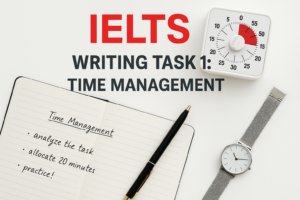
A practical 20-minute breakdown:
- 2–3 minutes: Study the chart. Identify the main trend, the most significant contrast, and one or two supporting data points.
- 2 minutes: Write the overview paragraph. Do not move on until this is done.
- 10–12 minutes: Write two body paragraphs, grouping similar data and supporting each claim with figures.
- 2–3 minutes: Review for errors — tense consistency, article use, spelling, linking word accuracy.
The key discipline is writing the overview before the body paragraphs. Candidates who start with body paragraphs often write three or four data-heavy paragraphs and then realise they have no time for the overview. The overview is worth more to your Task Achievement score than any single body paragraph.
Structure Your Body Paragraphs Around Comparisons
The most effective body paragraph structure for Task 1 is: claim → data → comparison.
Make a claim about the main pattern. Support it with one or two specific figures. Follow with a contrast or exception.
Example body paragraph:
“Sales in France and Japan both showed strong growth over the period. France rose from approximately 40 units in 2010 to just over 60 units by 2020, while Japan’s increase was considerably steeper, climbing from 45 to nearly 90 units over the same period. Germany, by contrast, showed comparatively modest growth, ending the decade at only 50 units.”
This paragraph covers three countries in six lines, includes specific figures, uses a comparison construction (“while”), and signals a contrast (“by contrast”). It is not complex — it is structured.
For further practice with structure and visual data interpretation, the IELTS Writing Task 1 practice test provides realistic task inputs with model answer guidance.
Handle Different Chart Types Consistently
Many candidates practise only with bar charts or line graphs and then lose marks on process diagrams, maps, or table comparisons. Each chart type has slightly different conventions, but the core strategy stays the same: overview first, key features selected, data grouped.
Line graphs: Focus on trend direction (up/down/stable), rate of change (sharp/gradual), and turning points (peak/trough).
Bar charts: Focus on comparative values across categories — highest, lowest, most similar, biggest gap.
Pie charts: Focus on the largest and smallest segments, and notable groupings (e.g., three categories together account for more than half the total).
Tables: Identify the most striking comparisons across rows or columns. Avoid listing every cell.
Process diagrams: Use passive voice throughout (“the material is heated”, “the mixture is filtered”) and describe stages in sequence using clear linking language.
Maps: Use directional language (to the north of, adjacent to, along the eastern edge) and focus on what changed versus what stayed the same.
Practising all six types before your exam removes the surprise factor entirely.
Ready to find out your current IELTS band score?
Take the IELTS Express Pre-Test for just $4.99 and get your personalised band prediction with a 14-day improvement plan.
Frequently Asked Questions
How long should an IELTS Writing Task 1 response be?
The minimum is 150 words, but examiners do not reward length for its own sake. A well-structured response of 170–200 words that covers the key features clearly will score better than a 250-word response that pads with irrelevant detail. Quality and selection matter more than word count above the minimum.
Should the overview be a separate paragraph or part of the introduction?
Either is acceptable, but many candidates find it cleaner to write the overview as its own short paragraph after the introduction. This makes it easy for the examiner to locate and rewards you immediately for Task Achievement. Whichever placement you choose, the overview must be present and must identify the main trend without using specific figures.
Can I use the same vocabulary in every Task 1 response?
Yes — a reliable set of 20–30 words for data description is more useful than a large vocabulary you cannot use accurately. Consistency and accuracy in lexical resource score higher than variety with errors. Build your core set, know the intensity level of each word, and use approximators with every figure.
Is it okay to express an opinion in Writing Task 1?
No. Writing Task 1 is a purely descriptive task. Personal opinions, explanations for trends, and predictions do not belong in this section and will lower your Task Achievement score. Describe only what the data shows.
What is the best way to practise IELTS Writing Task 1 at home?
Use real charts under timed conditions. After writing each response, compare it to a model answer and identify exactly where your structure, vocabulary, or data selection differs. Daily overview practice (without writing the full response) is an efficient supplement. For structured practice with real IELTS-style charts, use our unlimited mock tests.