The IELTS Academic Writing section gives you 60 minutes total — and most candidates spend too much of it on Task 1. You have 20 minutes for Task 1 and 40 minutes for Task 2, yet many test-takers either rush Task 1 and lose marks on accuracy, or overrun it and leave Task 2 unfinished. Both decisions cost you band score points that are genuinely hard to recover.
Before investing more time in practice, take the IELTS Express Pre-Test to find out exactly where your Writing score stands right now. It takes 15 minutes and gives you a personalised band prediction with a targeted improvement plan.
Why Time Management Matters in IELTS Writing Task 1
IELTS Writing Task 1 asks you to describe a visual — a bar chart, line graph, pie chart, table, process diagram, or map — in at least 150 words. You are assessed on four criteria: Task Achievement, Coherence and Cohesion, Lexical Resource, and Grammatical Range and Accuracy.
Here is what most candidates miss: Task 2 is worth double the marks. That means your 40-minute investment in Task 2 has twice the scoring impact of your 20 minutes on Task 1. When you overrun Task 1, you are essentially borrowing time from the section that determines your Writing band score more than anything else.
Getting the time split right is not about rushing. It is about working to a structure that lets you deliver a complete, accurate Task 1 response and still arrive at Task 2 with enough time to write a well-organised argument.
How Much Time Should You Spend on IELTS Writing Task 1?
The standard guidance is 20 minutes for Task 1 and 40 minutes for Task 2. That ratio reflects the mark weighting. In practice, experienced IELTS coaches recommend being slightly conservative with Task 1 — aim to finish in 18 to 20 minutes and use any remaining seconds to re-read for errors rather than extend your word count beyond 200.
A common misconception is that writing more in Task 1 will earn more marks. It will not. A focused 165-word response that covers all key trends accurately will outscore a 230-word response that wanders off-topic or repeats the same observation in different words.
Your goal in Task 1 is to identify the key data points, write a clear overview, and stop.
A Proven 20-Minute Plan for IELTS Writing Task 1
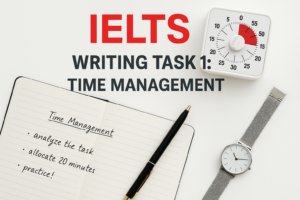
Structuring your 20 minutes into clear phases prevents the two most common timing errors: spending too long analysing the visual and running out of time to write, or starting without a plan and losing direction mid-paragraph.
Here is a framework that works under real exam conditions:
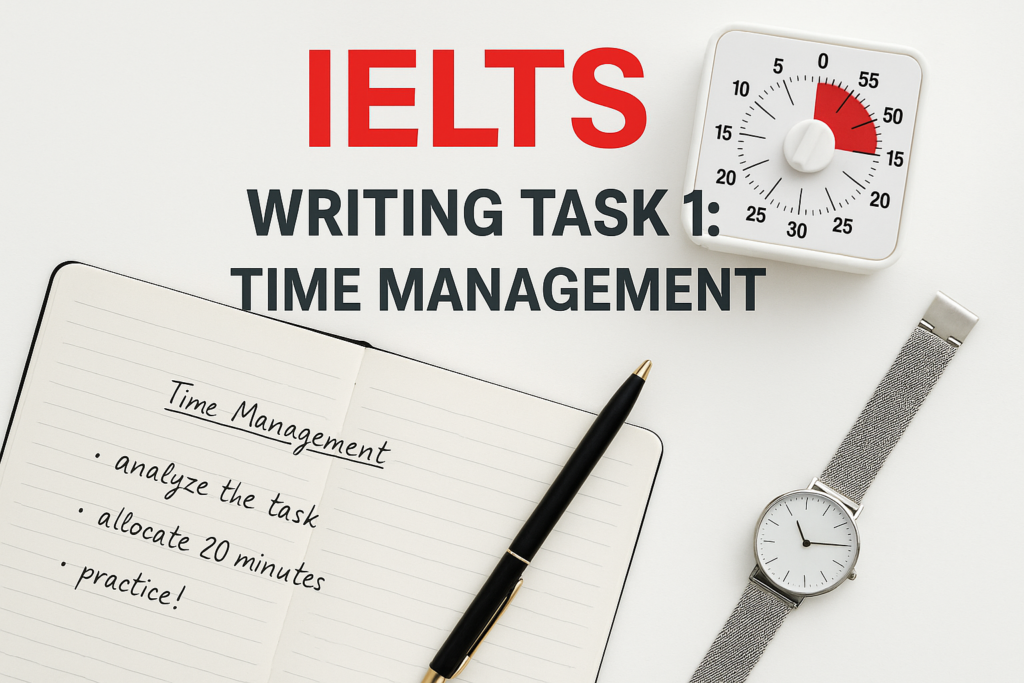
- Minutes 1-3: Analyse the visual. Read the title and axis labels. Identify the highest and lowest values, any significant changes, and the overall trend or pattern. Note two or three key features — these form your overview and body paragraphs.
- Minutes 3-5: Plan your response. Decide on your paragraph structure: Introduction (paraphrase the question prompt), Overview (two key trends), Body Paragraph 1 (specific data with comparisons), Body Paragraph 2 (additional data). Four to six bullet points is enough.
- Minutes 5-18: Write your response. Follow your plan. Aim for 150-175 words. Use specific figures and link them with appropriate language (rose sharply, remained stable, accounted for approximately). Do not add personal opinions or draw conclusions not visible in the data.
- Minutes 18-20: Proofread. Check for subject-verb agreement, article errors, and any missing data references. Fix small errors here rather than in the margins during Task 2 time.
For structured Task 1 practice with timed conditions, our IELTS Writing Task 1 Practice Test lets you rehearse this framework against exam-style visuals.
The Biggest Time Management Mistakes in IELTS Writing Task 1
Most Task 1 overruns come from a handful of predictable errors. Recognising them in your own practice is the fastest path to fixing them.
- Describing every single data point. You are not expected to mention every figure in a table or every point on a line graph. Select the most significant trends. Examiners reward selective summary skills, not comprehensiveness.
- Re-reading and rewriting mid-paragraph. Second-guessing your vocabulary or sentence structure halfway through a response loses time and momentum. Write to your plan and review at the end — not during.
- Writing the introduction last. Some candidates skip the introduction and plan to return to it. This breaks flow and often results in a rushed or inconsistent opening paragraph. Write it first, even if it only takes 30 seconds to paraphrase the prompt.
- Checking word count repeatedly. Glancing at your word count mid-response wastes time. If you follow the 20-minute framework, 150-175 words is a natural output. Trust the structure.
- Spending extra minutes to perfect Task 1. There is no such thing as a perfect Task 1 at the cost of Task 2. Once you reach 20 minutes, stop and move on.
How to Build Your Timing Through Practice
The only reliable way to lock in your timing is repeated, timed practice under realistic conditions — no pausing, no looking things up, and no editing once your 20 minutes is up.
When you first start practising, you will likely need 25 to 28 minutes for Task 1. That is completely normal. The goal is to gradually compress your analysis and planning phases without rushing your writing. Track your time on each micro-phase separately so you can clearly see where you are losing minutes.
For the most realistic preparation, use our Unlimited IELTS Mock Tests to practise Task 1 and Task 2 together under full exam conditions. Practising them separately gives you individual task timing — practising them together trains the 60-minute cognitive load that the actual exam demands.
Aim to complete at least ten fully timed Task 1 responses before your exam. After each one, review your overview quality, data selection, and any overrun minutes.
Managing Time When You Feel Stuck in the Exam
Even with solid preparation, you may encounter a visual on exam day that feels unfamiliar — an unusual map question, a multi-line graph, or a process diagram you have not seen before. Here is how to keep moving without losing time:
Give yourself exactly 60 extra seconds of analysis time. Write down three observable features from the visual. Start writing based on those three points. Once you begin, the response structure typically becomes clearer as you go.
If you remain unsure about specific data interpretation, describe what you can see factually and accurately. A partial response that covers the main trends will always score higher than a stalled attempt or one that overruns into Task 2 time.
The biggest timing risk in the exam is freezing. Keep writing — forward momentum is more valuable than perfection in Task 1.
How Your Band Score Is Affected by Timing Issues
Time overruns affect two criteria simultaneously. In Task 1, rushing to finish means you miss key trends, which lowers your Task Achievement score. In Task 2, running short on time means an underdeveloped argument, which also lowers Task Achievement — but with double the mark impact.
A candidate who writes a clean, correctly timed Task 1 at band 6.5 and a well-developed Task 2 at band 7 will outscore a candidate who writes an excellent Task 1 at band 7.5 but a truncated Task 2 at band 5.5. The mark weighting makes this inevitable.
Time management is not a soft skill in IELTS — it is a direct scoring mechanism. Candidates who treat it as a core skill to practise deliberately and consistently tend to perform one to two bands above those who focus only on vocabulary and grammar. For a broader picture of how band scores are calculated across all four sections, the IELTS Band Score Framework is worth reading before your test.
Ready to find out your IELTS band score?
Take the IELTS Express Pre-Test for just $4.99 and get your personalised band prediction with a 14-day improvement plan.
Frequently Asked Questions
How many minutes should I spend on IELTS Writing Task 1?
Aim for 20 minutes maximum. This reflects the mark weighting — Task 2 is worth twice as much. Finishing Task 1 in 18 to 20 minutes and moving on is more valuable than polishing it for 25 to 30 minutes.
What is the minimum word count for IELTS Writing Task 1?
The minimum is 150 words. You will receive a penalty for going significantly under this. However, there is no scoring advantage to writing far above it — 160 to 180 words is the ideal range for Task 1.
Can I use bullet points in IELTS Writing Task 1?
No. Task 1 requires connected prose, not bullet points or lists. Use linking language to connect your observations into full sentences and paragraphs, exactly as you would in a formal report.
What should I include in my overview paragraph?
Your overview should identify the two most significant trends or features visible in the data — without quoting specific numbers. Think of it as a one-sentence summary of what the visual shows at a glance. It is typically placed after your introduction paragraph, as a short standalone section before the body paragraphs.
What happens if I run out of time on Task 1?
If you are approaching 20 minutes and still writing Task 1, stop and move to Task 2. An incomplete Task 1 is better than a truncated Task 2 because Task 2 carries double the marks. If you finish Task 2 early, you can always return to Task 1 to add a sentence or correct errors.