Many IELTS test-takers are caught off guard by Writing Task 1. Unlike Task 2, there is no essay to write and no opinion to argue. Instead, you must describe data — a graph, a chart, a diagram, or a process — in precise, formal English within 20 minutes. Working through an IELTS Writing Task 1 practice test regularly is one of the most reliable ways to build the speed, accuracy, and vocabulary you need on exam day.
This guide explains how Task 1 works, what examiners look for, how to practise effectively, and which mistakes to stop making right now.
Before you dive into practice, it helps to know where you currently stand. The IELTS Express Pre-Test gives you a personalised band prediction and a 14-day improvement plan — a good starting point before committing to a full study schedule.
What Is IELTS Writing Task 1?
IELTS Writing Task 1 is the first section of the Academic IELTS Writing test. You are given a visual — such as a bar chart, line graph, pie chart, table, map, or process diagram — and asked to summarise the key information in at least 150 words.
The task is worth roughly one-third of your total Writing score. Most candidates underestimate it, spending too long on Task 2 and producing a rushed, incomplete Task 1 response.
Your answer must:
- Describe the main trends or features accurately
- Group data logically
- Use precise vocabulary for change, comparison, and proportion
- Stay objective — no personal opinion
Why an IELTS Writing Task 1 Practice Test Improves Your Score
Practice tests serve two purposes. First, they train you to spot patterns quickly — where the data peaks, where it dips, which category dominates. Second, they build the writing habits needed to produce clear, examiner-ready sentences under time pressure.
Without timed practice, most test-takers write too slowly, miss key data points, or fall back on vague language (“it went up a lot”). Timed Writing Task 1 practice forces you to make decisions quickly and accurately — exactly what the exam requires.
One session a week will not move your score. Two to three timed sessions per week, each followed by a review against a model answer, creates real improvement. The review step is just as important as the writing itself.
Understanding the Four Marking Criteria
Before you practise, you need to understand how Task 1 is marked. Examiners score your response against four criteria, each worth 25% of your Task 1 score.
Task Achievement
This measures whether you addressed all parts of the task — whether you described the main features accurately and highlighted the most significant data points.
A common error here: describing every single number without identifying what matters most. Examiners reward candidates who select and organise key information, not those who list every data point in sequence.
Coherence and Cohesion
This looks at how logically your response is organised and how well you connect ideas. Good paragraphing, cohesive devices (“in contrast”, “by comparison”, “meanwhile”), and clear sequencing all count here.
Aim for a clear overview paragraph followed by two body paragraphs that group related data.
Lexical Resource
This measures the range and accuracy of your vocabulary. For Task 1, this mainly means words and phrases for describing trends — verbs like rise, decline, stabilise, surge, fluctuate — alongside language for making comparisons.
Repeating the same words (“increased”) throughout your response signals a limited range. Using inaccurate vocabulary, even in a grammatically correct sentence, costs marks.
Grammatical Range and Accuracy
This looks at sentence variety and error rate. A mix of simple and complex structures, accurate punctuation, and consistent tense use is the target.
For Task 1, take particular care with comparative structures (“the highest proportion”, “more than double”), passive voice for process diagrams, and tense consistency when data covers a fixed time period.
How to Use an IELTS Writing Task 1 Practice Test Effectively
Running through a practice test the wrong way wastes time. Here is the approach that produces real results.
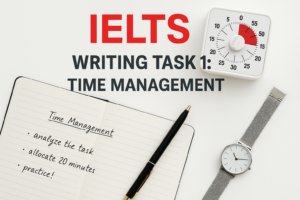
Time yourself strictly. Set a timer for 20 minutes. Stop when it rings. This is the most important habit to build.
Plan before you write. Spend two to three minutes identifying the key trends and deciding how to organise your paragraphs. Planning prevents the most common Task 1 error — producing a long list of numbers with no logical structure.
Write the overview in your second paragraph. The overview summarises the most notable features without specific data. Many candidates omit this entirely and lose marks for Task Achievement.
Use precise language. Instead of “the number went up”, write “the proportion increased sharply, reaching its peak in 2018 at 45%.” That level of precision is what separates Band 6 responses from Band 7+.
Review against a model answer. After you finish, compare your response to a strong model. Note what the model included that you missed. Pick up vocabulary you can reuse. Look for structural differences in how the data was grouped.
Pairing your sessions with quality practice materials makes a real difference. The Unlimited IELTS Mock Tests resource includes Task 1 practice materials you can use repeatedly with full review support.
Common IELTS Writing Task 1 Mistakes to Stop Making
These are the most frequent errors in Task 1 — and they are all preventable.
Writing a personal opinion. Task 1 is a description, not a commentary. Do not write “I think this is interesting because…”. Your job is to report data objectively.
No overview paragraph. An overview is not optional. It is a required element of a complete Task 1 response. Missing it consistently lowers your Task Achievement score.
Using the wrong tense. If the chart shows data from 2000 to 2020, use past tense. If the data is projected, use future forms. Mixing tenses carelessly makes your response harder to follow.
Describing every number. Selectivity is a skill. Examiners want to see that you can identify what is significant — not that you can translate every data point into a sentence.
Ignoring units. If a graph measures population in millions, your response must reflect that. Writing “the population was 45” instead of “the population was 45 million” is a factual error.
Writing Task 1 Practice: Graph and Diagram Types
Academic Task 1 questions use a range of visual formats. Your practice should cover all of them, since each type requires slightly different language and structure.
- Line graphs: Focus on trends over time. Use time expressions and language for describing change.
- Bar charts: Focus on comparison between categories or across time points.
- Pie charts: Focus on proportion and share. Percentages and fractions are central.
- Tables: Require careful data selection — tables often contain a lot of information, and candidates must identify the most significant comparisons.
- Maps: Require spatial language and the ability to describe change between two time periods.
- Process diagrams: Require passive voice and sequencing language (“firstly”, “subsequently”, “as a result”).
Practising across all six types means you will not be caught off guard on exam day.
If you are also working on Task 2, the structured approach to argument and evidence is covered in our IELTS Writing Task 2 Band Score Strategy guide.
How to Build Your Task 1 Practice Schedule
A structured schedule removes guesswork. Here is a simple four-week framework.
Weeks 1–2: Focus on line graphs and bar charts. These are the most common Task 1 types. Write one timed response per session and review immediately after.
Week 3: Move to pie charts and tables. Focus on proportional language and comparison structures.
Week 4: Practise maps and process diagrams. These types require vocabulary not used in data-based tasks, so they need dedicated attention.
Throughout the cycle, keep a vocabulary log. When you find a useful phrase in a model answer — “remained relatively stable at approximately”, “experienced a gradual decline” — add it to your log and practise using it.
Ready to find out your current IELTS band score?
Take the IELTS Express Pre-Test for just $4.99 and receive a personalised band prediction with a 14-day improvement plan built around your actual weak areas.
Frequently Asked Questions
How many words should I write for IELTS Writing Task 1?
The minimum is 150 words. Most high-scoring responses are between 170 and 200 words. Writing significantly more than 200 words is unnecessary and tends to introduce more errors without raising your score.
Is Writing Task 1 easier than Task 2?
Many candidates find Task 1 more predictable once they learn the structure and vocabulary for each chart type. It requires a different skill set than essay writing — precision with data, an objective tone, and clean organisation.
How should I practise for IELTS Writing Task 1 at home?
Work in timed sessions using real practice materials. Write the response, then compare it to a model answer. Focus on what you missed or expressed less accurately, and add useful phrases to a dedicated vocabulary log.
Can I use personal pronouns in Writing Task 1?
Avoid first-person pronouns (“I”, “we”) in Task 1 responses. The task calls for an objective description, and personal language shifts the tone away from the formal register examiners expect.
What is the most common reason for a low Task Achievement score?
Missing the overview paragraph. It summarises the two or three most notable features of the data without quoting specific numbers — and it must appear in every Task 1 response.
Your Next Step With Task 1 Practice
IELTS Writing Task 1 rewards preparation. Once you understand how each chart type works, which vocabulary patterns apply, and how to produce a well-structured response in 20 minutes, your score becomes predictable and improvable.
The most effective path is structured practice: timed sessions, reviewed against model answers, with consistent vocabulary building across all six visual types. A pre-test to establish your current baseline gives you a clear picture of where your effort will produce the fastest results.
Start with the chart types you find most difficult. That is where the highest gains are.