Band 5 in IELTS Writing Task 1 is a frustrating place to be. You can describe a chart. You can write sentences that make sense. But something keeps the examiner from awarding that extra band — and without knowing exactly what that is, more practice just reinforces the same habits.
The gap between Band 5 and Band 6 is not about writing more. It is about writing differently. Examiners at Band 6 reward accuracy, organisation, and appropriate language — three things that are completely trainable once you understand what “appropriate” actually means at this level.
Before diving into the fixes, it helps to know where you stand right now. Take the IELTS Express Pre-Test ($4.99) to get a section-by-section band prediction — including Writing — so you can focus on the exact criteria holding your score at 5.
Why Band 5 Feels Like a Plateau
The honest reason most test-takers sit at Band 5 for longer than expected: they practise describing, not analysing. They write a list of what they see in the chart. The examiner does not reward lists. They reward the ability to select, group, and compare the most significant information.
At Band 5, IELTS examiners typically observe:
- An overview that is missing or very thin
- Data reported point by point rather than grouped by trend
- Vocabulary that is basic or partly inaccurate (using “increased” and “rose” interchangeably, missing specific verbs like “plateaued” or “fluctuated”)
- Short, uncombined sentences that reduce grammatical range
- Minor errors throughout that affect clarity
None of these issues are fixed by writing more Task 1 responses — not unless you know how to correct them first.
The Four Criteria and What Band 6 Requires
IELTS Writing Task 1 is marked on four equal criteria. Moving from Band 5 to Band 6 means showing clear improvement across all four, not just one.
Task Achievement — At Band 6, your overview must be present and relevant, and you must cover the key features without over-describing minor details. Select two or three main trends and make them the focus of your response.
Coherence and Cohesion — Band 6 requires your writing to move logically from overview to body paragraphs. Use a range of linking words (however, whereas, by contrast, while), not just “first”, “second”, “finally”.
Lexical Resource — Band 6 expects accurate use of vocabulary related to describing data — verbs of movement, nouns for change, approximators (approximately, roughly, just under). Errors in word form (e.g., “the amount of peoples”) pull you back to Band 5.
Grammatical Range and Accuracy — At Band 6, you need a mix of sentence structures: some complex (using relative clauses or while/whereas constructions), some simple. Consistent errors in subject-verb agreement, article use, or tense keep you at Band 5.
Fix 1: Write the Overview First, Every Time
The overview is the single most important paragraph in IELTS Writing Task 1. It is where Band 5 test-takers lose the most marks.
A strong overview does two things: it identifies the most significant trend or comparison, and it does so without any specific figures. Numbers belong in the body paragraphs.
Band 5 overview:
“The bar chart shows information about sales in four countries between 2010 and 2020.”
Band 6 overview:
“Overall, sales in all four countries increased over the decade, with France showing the most significant growth while Germany remained the lowest performer throughout.”
The second version makes a claim. It picks a main trend and a meaningful comparison. That is all the examiner needs to see in the overview — not a summary of everything in the chart.
Practise writing one overview sentence that covers the main trend and one that notes a clear contrast or exception. Do this for every chart you study, even if you do not write the full response.
Fix 2: Group Data, Do Not List It
Band 5 responses read like a table — item by item, left to right. Band 6 responses group similar patterns together.
If a line graph shows four countries and two of them follow a similar trend, mention them together: “France and Germany both experienced steady growth throughout the period, rising from approximately 30 to 50 units.” That one sentence covers two data points and includes a comparison. It is more efficient and more sophisticated than two separate sentences.
To practise this skill, take any chart you have worked on before and try to rewrite the body paragraphs so that you have no more than three sentences per paragraph. This constraint forces you to combine data points rather than list them.
Fix 3: Expand Vocabulary for Data Description
A limited vocabulary for change and comparison is the most visible Band 5 marker. Examiners can spot it immediately.
At Band 6, you need to show you can vary verbs, nouns, and approximators. Build a working set of around 20 expressions and practise using them accurately:
Verbs of increase: rose, climbed, grew, increased, surged, jumped
Verbs of decrease: fell, dropped, declined, decreased, dipped, plummeted
Verbs of stability: remained stable, levelled off, plateaued, stayed constant
Nouns: a rise, a fall, a decline, a surge, a fluctuation, a peak, a trough
Approximators: approximately, roughly, just under, just over, around, nearly
The key is accuracy, not volume. Using “plummeted” for a small drop is inaccurate and will cost you marks. Learn the scale of intensity for each word.
Access our unlimited IELTS mock tests to practise with real Writing Task 1 charts and track your vocabulary range across multiple attempts.
Fix 4: Add Grammatical Complexity Without Errors
Band 6 does not require complex grammar on every line. It requires a mix — some simple, some complex — with consistent accuracy.
The easiest way to add complexity to Writing Task 1 is through while/whereas sentences: “While France saw a sharp increase over the period, Germany’s figures remained relatively unchanged.” This construction creates a comparison in a single sentence, which also helps with coherence.
Relative clauses are another safe option: “Germany, which had the lowest figures in 2010, showed the most dramatic growth by 2020.”
Focus on two or three sentence structures you can use reliably. Band 6 is not about variety for its own sake — it is about demonstrating control.
Fix 5: Time Your Responses Properly
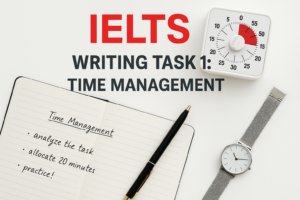
A Band 5 Task 1 response often suffers because the writer runs out of time and either rushes the ending or leaves the overview underdeveloped. IELTS Writing Task 1 should take 20 minutes maximum.
A workable split:
- 2–3 minutes: Study the chart and identify the main trends
- 1–2 minutes: Write your overview (do this before body paragraphs)
- 10–12 minutes: Write two body paragraphs
- 2–3 minutes: Read and correct
If you regularly go over 20 minutes in practice, your Band 6 attempt in the real exam will not be your best work. Timed practice with realistic charts is the only way to fix this.
Ready to find out your IELTS band score?
Take the IELTS Express Pre-Test for just $4.99 and get your personalised band prediction with a 14-day improvement plan.
Frequently Asked Questions
What is the main difference between Band 5 and Band 6 in IELTS Writing Task 1?
Band 6 requires a clear, relevant overview; accurate grouping and comparison of data; varied vocabulary for change; and a consistent mix of sentence structures. At Band 5, one or more of these elements is missing or inconsistent.
How long should an IELTS Writing Task 1 response be?
The recommended minimum is 150 words. A Band 6 response typically falls between 160–200 words. Writing too much (over 250 words) often leads to coherence issues and time pressure on Task 2.
Can I improve from Band 5 to Band 6 in Writing Task 1 with just four weeks of practice?
Yes, for most test-takers, Band 5 to Band 6 is achievable in four to six weeks of focused daily practice — provided you are targeting the specific criteria, not just writing responses and moving on. Reviewing model answers and identifying where your writing diverges is more efficient than volume practice alone.
Do I need to use all the data in the chart to reach Band 6?
No. Band 6 Task Achievement does not require you to mention every figure. It requires you to cover the key features and main trends accurately. Selective, well-supported description beats exhaustive listing every time.
What is the best way to practise IELTS Writing Task 1 at home?
Use real past exam charts, set a 20-minute timer, and review your response against a Band 6 model. Focus on whether your overview is present and trend-based, whether you have grouped similar data points, and whether your vocabulary for change is accurate. You can also use our IELTS Writing Task 1 practice test to work through structured exercises with examiner-style feedback guidance.