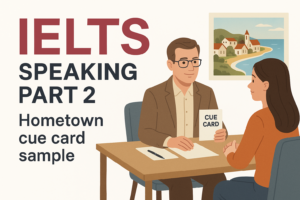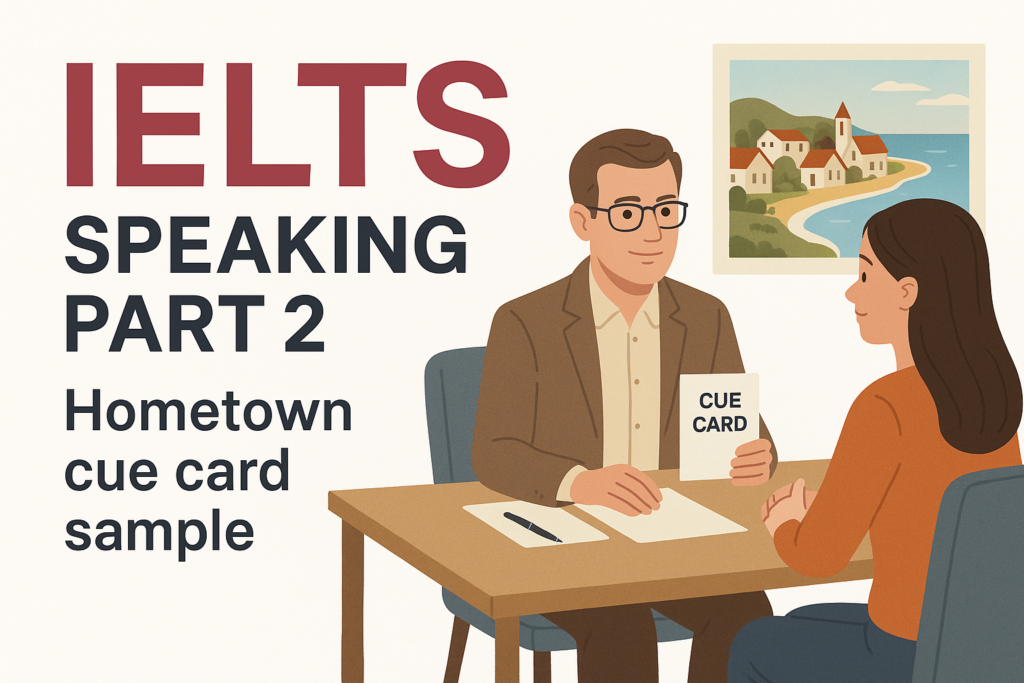
If you are looking for an IELTS Speaking Part 2 hometown cue card sample, you probably do not just need a model answer to copy. You need to see how a strong response is built, how long it should feel, and how to keep talking naturally when the examiner asks you to describe a place you know very well. Hometown topics sound simple, but that is exactly why many candidates become vague, repetitive, or too memorised.
Before you spend weeks guessing whether speaking is really the problem, take the IELTS Express Pre-Test to get a quick band prediction and see whether Part 2 is the section holding your overall score back.
What the hometown cue card usually asks you to do
In IELTS Speaking Part 2, you may get a card asking you to describe your hometown, a part of your hometown, or a place in your hometown that matters to you. The exact wording can change, but the task usually stays close to the same idea. You may need to say where it is, what it is like, what people can do there, and explain why it is important to you.
This is a familiar topic, which sounds helpful at first. The problem is that familiar topics tempt candidates to relax too much. They start with one clear point, then drift into general statements such as “it is very beautiful” or “many people live there”. Those sentences are not wrong, but they do not give the examiner much language to work with. A stronger answer uses specific details, a clear structure, and a natural personal voice.
If you already know the overall format of the speaking test, that helps. If not, spend a little time reviewing the timing, scoring, and what examiners are actually listening for before you practise this cue card again.
IELTS Speaking Part 2 hometown cue card sample answer
Here is a sample answer you can study and adapt:
“I would like to talk about my hometown, which is a coastal city in the south of my country. I grew up there, and even though I do not live there full-time now, it still feels like the place that shaped me the most.
What I like about it is that it is busy enough to have everything you need, but it still feels relaxed compared with a big capital city. There is a long beach, a town centre with small cafes and local shops, and a few older neighbourhoods where people still know each other quite well. In the morning, you can see people walking along the waterfront, and in the evening the area becomes a social place where families and friends spend time together.
For me, the most memorable part of my hometown is the old market area near the centre. When I was younger, I used to go there with my parents on weekends, so I still connect that place with family life and a sense of routine. It has changed over the years, but it still has the same atmosphere, which I find comforting.
I think my hometown is important to me because it gives me a strong sense of identity. Whenever I go back, I feel more grounded. It reminds me of where I started, the people I grew up with, and the pace of life I still enjoy most. So although I appreciate living in other places for work or study, my hometown is still the place I feel most attached to.”
This answer works because it sounds personal, organised, and easy to follow. It does not try to sound clever every second. Instead, it gives the examiner clear content, a few time references, and natural emotion without becoming dramatic.
Why this IELTS Speaking Part 2 hometown cue card sample works
A strong Part 2 answer usually does three things well. First, it gives the examiner a clear picture. Second, it develops ideas rather than listing them. Third, it stays natural. This sample does all three.
- It has a simple structure: location, description, personal memory, and reason for importance.
- It uses specific details: the beach, cafes, the old market area, weekend visits with family.
- It includes feeling without overacting: words such as comforting, grounded, and attached sound human, not scripted.
- It moves through time naturally: past memories, present description, and current reflection all appear in one answer.
This is also why memorising a generic hometown paragraph usually fails. If your answer could fit any city in any country, the examiner hears that straight away. The goal is not to sound perfect. The goal is to sound like a real person describing a real place with enough detail to hold the answer together for two minutes.
How to build your own answer without sounding memorised
The safest way to prepare is not to memorise full sentences. Build a small speaking map instead. Think of your answer in four parts:
- Where it is: coastal city, small town, suburb near a major city, mountain area, and so on.
- What it looks or feels like: crowded, quiet, modern, traditional, green, practical, friendly.
- One personal memory: school, childhood routine, family outing, local festival, favourite street.
- Why it matters now: identity, comfort, opportunity, community, or family connection.
That framework helps because you can speak more freely inside it. If one detail disappears on test day, you still know where the answer is going. You are not depending on one memorised sentence to unlock the next.
It also helps to speak in images rather than abstract ideas. Instead of saying your hometown is “nice”, say there is a riverside path where people jog in the morning. Instead of saying it is “interesting”, mention an old district, a food market, or a local park where community events happen. Specific details make fluency easier because they give you something real to talk about.
Useful language for describing your hometown naturally
You do not need rare vocabulary for this topic. In fact, simple, well-fitted language often sounds stronger than difficult words used badly. What you need is range that still feels natural.
- To describe size and pace: fairly small, medium-sized, quite spread out, fast-paced, relaxed, close-knit
- To describe atmosphere: welcoming, lively, peaceful, traditional in some areas, modern in others
- To talk about change: it has grown a lot, it has become more crowded, it has developed quickly, some parts have stayed the same
- To express connection: I feel attached to it, it feels familiar, it shaped me a lot, it still feels like home
Try to use these naturally inside a full idea. For example, “My hometown is fairly small, but it has grown quite quickly in the last ten years” sounds better than dropping advanced adjectives one after another. In the speaking test, clean language wins.
If you want more structured speaking practice, access unlimited IELTS mock tests and record yourself answering two or three hometown-style cards under timed conditions. That is a much better habit than reading model answers silently.
Common mistakes candidates make on hometown topics
The first mistake is being too general. Candidates say their hometown is beautiful, busy, or famous, but they do not explain what that means. The second mistake is trying to impress the examiner with over-prepared language. A hometown topic is personal, so overly polished phrases often sound detached from real experience.
Another problem is weak organisation. Some candidates mention transport, weather, food, schools, population, and tourism all in one answer without linking any of it clearly. That creates movement, but not coherence. The examiner should be able to follow your answer easily from beginning to end.
A final issue is running out of content after 40 seconds. Usually, that happens because the speaker gave only description and no memory, comparison, or reflection. When you prepare this topic, make sure you can talk about:
- what your hometown is like now
- how it has changed
- what memory stands out
- why it matters to you personally
Once you add those layers, the answer becomes much easier to extend naturally.
How hometown topics connect to Part 3 follow-up questions
After your long turn, the examiner may move into Part 3 questions about cities, community, development, or why people leave their hometowns. This is where good Part 2 preparation helps. If your cue card answer already included ideas about change, identity, and lifestyle, you will have more to work with in the discussion.
Typical follow-up questions may ask whether old and young people view hometowns differently, whether cities are becoming less community-focused, or why some people prefer to move away. You do not need to predict the exact question. You just need enough flexible language to compare, explain causes, and give a short opinion.
That is one reason this topic matters more than it looks. It is not just a two-minute monologue. It can set up the next stage of the speaking test. If you want to strengthen that transition, the IELTS Speaking Part 2 and Part 3 framework is worth studying because it shows how fluent Part 2 development supports stronger Part 3 discussion.
A simple practice method for this cue card
Use one cue card, but practise it three different ways. On the first attempt, focus on structure. On the second, focus on sounding more personal. On the third, focus on pace and clarity. This prevents you from turning the answer into one frozen script.
- Round 1: speak for up to two minutes using your four-part map.
- Round 2: replace at least two details with more specific memories or examples.
- Round 3: listen back and cut any sentence that sounds learned rather than natural.
This method works because speaking improvement is often subtractive. You do not always need more language. Sometimes you need cleaner language, better examples, and a more believable tone.
If you are serious about lifting your speaking score, it helps to check your full profile rather than guessing from one topic. If you want extra support, check the preparation options on the site, but first make sure speaking is actually the real bottleneck.
Ready to find out your IELTS band score?
Take the IELTS Express Pre-Test for just $4.99 and get your personalised band prediction with a 14-day improvement plan.
Frequently Asked Questions
How long should an IELTS Speaking Part 2 hometown answer be?
You should aim to speak for close to two minutes if possible. The answer does not need to be fast. It needs enough detail, clear organisation, and natural extension so you do not stop too early.
Can I memorise an IELTS Speaking Part 2 hometown cue card sample?
You can study a sample, but memorising full sentences is risky. It is safer to remember a structure, a few useful phrases, and one or two personal examples that sound real when you say them aloud.
What vocabulary is best for a hometown topic?
Use simple descriptive language that fits your real experience, such as relaxed, crowded, close-knit, coastal, traditional, or modern. Specific and natural vocabulary usually scores better than difficult words used only to impress.
What if my hometown is small and I do not have much to say?
That is not a problem. You can still talk about atmosphere, daily life, changes over time, a personal memory, and why the place matters to you. Small towns often give better personal content than large cities.
How can I improve after using one IELTS Speaking Part 2 hometown cue card sample?
Record yourself, listen for vague sentences, and replace them with more specific details. Then practise the same topic again with a slightly different structure so your answer stays flexible instead of becoming a script.