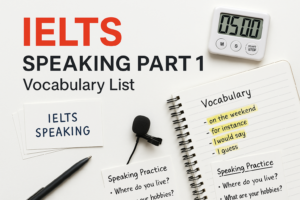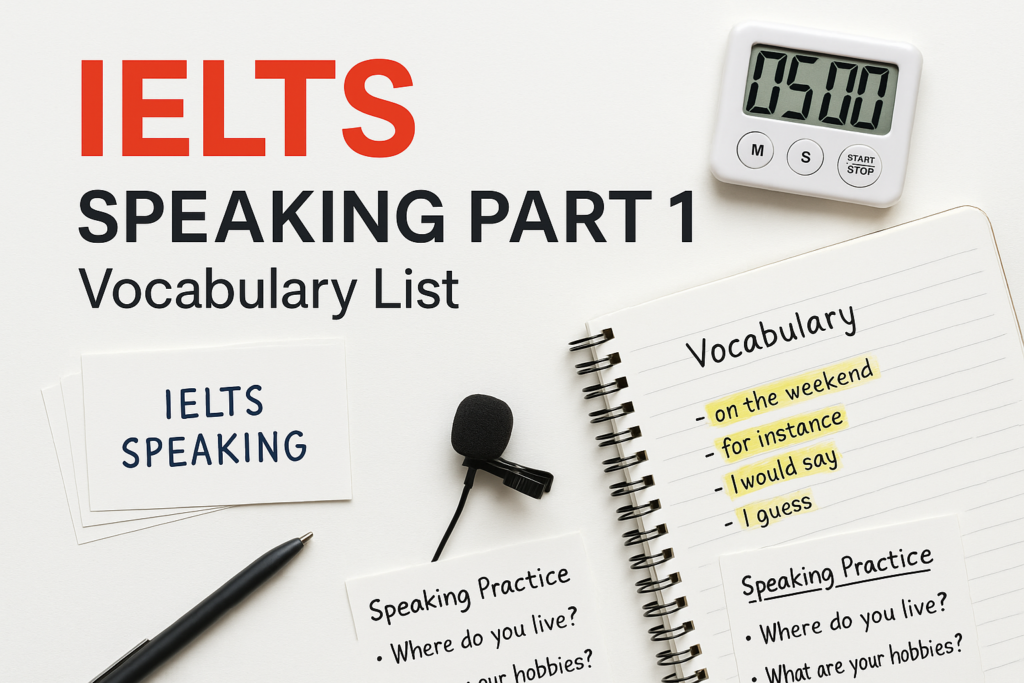
If you are searching for an IELTS Speaking Part 1 vocabulary list, you probably already know that short, basic answers can hold your score down. Part 1 is not the hardest section of the speaking test, but it is where examiners first hear your fluency, control, and range. If your language sounds repetitive, vague, or memorised, the impression is weak from the start. A better vocabulary list helps, but only if it gives you words you can actually use in real answers.
Before you start collecting more phrases, it helps to know your current level clearly. Take the IELTS Express Pre-Test to get a quick band prediction and see whether speaking is the skill that needs the most work now.
IELTS Speaking Part 1 vocabulary list: what kind of words actually help?
The most useful vocabulary for Part 1 is not rare or academic. It is everyday English that sounds precise, natural, and flexible. Examiners ask about familiar topics such as your home, work, studies, hobbies, food, transport, and weekends. That means your language needs to fit normal conversation. If you try to force advanced expressions into simple questions, your answer can sound unnatural very quickly.
A good Part 1 vocabulary list should help you do three things. First, it should replace weak words such as “good”, “nice”, and “interesting” with clearer choices. Second, it should give you short expressions that help you extend an answer naturally. Third, it should help you speak more specifically about your routine, preferences, and habits. That is what raises the quality of your answer without making it feel rehearsed.
If you want a full overview of how this section is marked, our IELTS Speaking Test complete guide explains the scoring criteria and where vocabulary fits into the bigger picture.
Why memorising long word lists usually backfires
Many candidates think vocabulary improvement means learning as many new words as possible. In Part 1, that approach often causes more problems than it solves. The examiner is asking short personal questions. You need answers that are clear, immediate, and believable. If you pause to search for a fancy word, or if you use a phrase that does not match the question properly, your fluency drops.
The better approach is to build small topic-based banks. Learn useful words for common areas, then practise speaking with them until they feel normal. This matters because vocabulary in IELTS speaking is judged through live use, not through your notebook. A phrase only helps if it comes out at the right moment, with the right meaning, and in a natural sentence.
There is another reason long lists fail. They often mix formal written vocabulary with spoken English. In Part 1, you do not need to sound like an essay. You need to sound like a confident person having a conversation. Simple but exact language almost always scores better than language that is ambitious but awkward.
Topic-based vocabulary for common IELTS Speaking Part 1 questions
Below are practical vocabulary groups you can use across the topics that appear most often in Part 1. The goal is not to memorise every word. The goal is to notice patterns and choose language that feels natural for your own life.
Home and neighbourhood
- quiet, lively, convenient, residential, well connected
- close to public transport, within walking distance, a bit crowded, family-friendly
Instead of saying, “My area is good,” you could say, “My neighbourhood is quite quiet and well connected, so it is easy to get around without a car.” That answer sounds more developed straight away.
Work or study
- demanding, rewarding, practical, flexible, fast-paced
- meet deadlines, work under pressure, learn on the job, build new skills
These words help you describe routine and responsibility more clearly. That matters because work and study questions are common, and very basic answers can make your vocabulary range look narrow.
Free time and hobbies
- unwind, switch off, keep fit, catch up with friends, spend time outdoors
- part of my routine, whenever I get the chance, once in a while, to clear my head
This kind of language makes your answer sound more personal and less mechanical. It also helps you extend a response with a natural reason.
Food, shopping, and daily life
- home-cooked, affordable, fresh, time-saving, reliable
- stick to a budget, pick up a few essentials, eat out occasionally, try new places
Small phrases like these are useful because Part 1 often tests ordinary life topics. Good answers sound realistic, not impressive for the sake of it.
Useful phrases to extend your answer naturally
Vocabulary is not only about nouns and adjectives. Short linking phrases help you move from a basic reply to a fuller answer. That is important in Part 1 because one-sentence answers often sound underdeveloped, while overlong answers can sound rehearsed. The middle ground is usually best.
- To be honest, …
- It depends, but generally …
- The main reason is that …
- What I like most is …
- I would say …
- These days …
- Compared with the past …
- It is part of my routine …
For example, if the examiner asks, “Do you enjoy cooking?” a weak answer might be, “Yes, I do. It is interesting.” A stronger answer could be, “Yes, I do, especially on weekends. The main reason is that it helps me switch off after a busy week, and I usually make something simple at home.” The words are not difficult. The improvement comes from better structure and more precise vocabulary.
If you want to practise these patterns under real timing pressure, access unlimited IELTS mock tests. Timed speaking practice makes it easier to turn vocabulary into usable speaking habits.
Words and habits that often reduce your score
Some vocabulary choices are not wrong, but they are overused. Words such as “good”, “bad”, “big”, “small”, “interesting”, and “nice” appear in too many answers. When every topic gets the same language, your speaking starts to sound flat. It becomes harder for the examiner to hear range.
Another common problem is filler. Candidates rely on “um”, “you know”, “like”, or “I think” too often while trying to buy time. A short pause is fine. Repeating the same filler again and again is not. It makes your answer sound less controlled, even when your ideas are actually fine.
Memorised chunks can also hurt you. If every answer begins with the same sentence frame, the examiner may feel that you are repeating learned material instead of responding naturally. That does not mean you should avoid useful phrases. It means you should keep them flexible. Use them as tools, not scripts.
For a deeper look at what examiners notice, our IELTS Speaking Part 1 band score guide is worth reading alongside your vocabulary work.
How to practise an IELTS Speaking Part 1 vocabulary list the right way
The best method is simple. Choose one topic, learn eight to ten useful words or expressions, then answer five or six Part 1 questions on that topic out loud. Record yourself. Listen back and check whether the vocabulary sounded natural. If it felt forced, trim the list and keep only the expressions you can use comfortably.
A second useful drill is substitution practice. Take a basic sentence such as “My neighbourhood is good” and rewrite it in three more precise ways. For example, “My neighbourhood is quiet and convenient,” “It is quite lively, especially at night,” or “It is family-friendly and close to everything I need.” This trains flexibility, which is more valuable than memorising one perfect answer.
You should also mix vocabulary with answer structure. Aim for a simple pattern: direct answer, reason, small detail. That keeps your response natural and gives your new language somewhere to go. Without structure, even good vocabulary can sound random.
If you are not sure whether self-study is enough, you can also see our IELTS preparation plans and compare guided support with practising on your own.
A seven-day plan to make new vocabulary usable in the test
Day 1: Choose two high-frequency topics such as home and work. Build a short list of practical words and expressions for each one.
Day 2: Write five sample answers, but keep them short and natural. Do not write long model responses.
Day 3: Record yourself answering ten Part 1 questions with no script. Use your new vocabulary where it fits naturally.
Day 4: Review the recording. Remove any word that sounded awkward or slowed you down.
Day 5: Add two new topics such as hobbies and food. Repeat the same process.
Day 6: Do a mini mock test with random Part 1 questions. Focus on sounding calm and clear, not clever.
Day 7: Review again and keep a final list of words that truly feel like your own English.
This plan works because it is realistic. Part 1 vocabulary improves through use, not through copying lists. Once the language becomes part of your normal speaking rhythm, your answers sound more fluent, more specific, and more confident.
What a strong Part 1 answer sounds like
A strong answer usually sounds direct, specific, and easy to follow. It does not sound rushed. It does not sound memorised. It also does not try too hard. If the examiner asks about music, you could say, “Yes, I listen to music most days, especially when I am commuting. It helps me unwind, and I usually go for podcasts or acoustic playlists rather than anything too loud.” That answer shows range without showing off.
That is the real purpose of an IELTS Speaking Part 1 vocabulary list. It should help you describe everyday life with more control. When you can do that, the examiner hears clearer vocabulary range, but also better fluency and better coherence. In other words, good vocabulary supports the whole answer, not just one scoring category.
Ready to find out your IELTS band score?
Take the IELTS Express Pre-Test for just $4.99 and get your personalised band prediction with a 14-day improvement plan.
Frequently Asked Questions
How many words should I learn from an IELTS Speaking Part 1 vocabulary list?
Focus on small useful sets, not huge lists. Around eight to ten words or expressions per topic is usually enough if you can use them naturally in real answers.
Do I need advanced vocabulary for IELTS Speaking Part 1?
No. You need natural and precise vocabulary for everyday topics. Clear spoken English scores better than unusual words that sound forced or inaccurate.
Can memorising vocabulary improve my speaking score?
It can help only if the vocabulary becomes usable in live speech. If you memorise phrases but cannot use them naturally, your fluency may actually get worse.
What topics should I study first for Part 1?
Start with the most common ones: home, work, study, hobbies, food, transport, and weekends. These topics appear often and give you plenty of chances to reuse practical vocabulary.
How can I sound less repetitive in IELTS Speaking Part 1?
Replace weak words such as “good” and “interesting” with more exact choices, and practise adding a reason or detail after your first sentence. That makes your answer sound fuller and less repetitive.