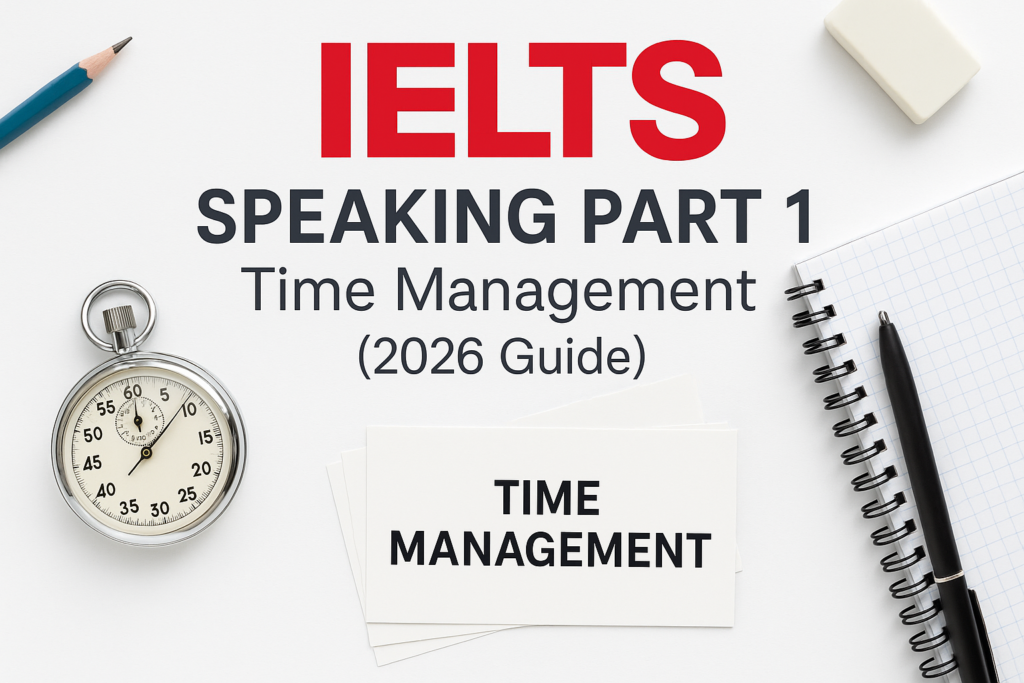
If you are looking for IELTS Speaking Part 1 time management help, the real problem is usually not speaking too slowly. It is speaking without control. Some candidates answer in five seconds and stop. Others keep talking until the answer becomes thin, repetitive, or awkward. Part 1 is short, but it shapes the examiner’s first impression of your fluency, clarity, and confidence. Good timing makes your answers sound natural from the first question.
Before you start drilling more Part 1 questions, it helps to check your current level honestly. Take the IELTS Express Pre-Test to see whether speaking is really the section holding your score back, or whether timing is only one part of a bigger issue.
What IELTS Speaking Part 1 time management really means
Time management in Part 1 does not mean racing through answers. It means giving the examiner enough language to judge you well, without drifting so far that your answer loses shape. Part 1 usually lasts about four to five minutes, and the examiner moves through a series of short personal questions. You do not control the clock. What you can control is the size and quality of each answer.
A well-timed Part 1 answer is usually one direct response, one clear reason, and one small detail or example. That is often enough. If your answer is shorter than that, it can sound underdeveloped. If it is much longer, it can start to sound rehearsed or unfocused. Strong candidates do not treat every question like a short speech. They answer cleanly, then let the conversation move on.
This matters because fluency and coherence are not just about speaking without pauses. They are also about pacing. When your pacing is steady, your grammar sounds more controlled, your vocabulary comes out more naturally, and your ideas are easier to follow.
How long should a Part 1 answer be?
There is no perfect word count, but there is a practical target. For most Part 1 questions, aim for roughly two to three sentences. That usually gives you enough space to answer properly without rambling. A one-sentence answer can work if the question is very simple, but if every answer is that short, the examiner hears limited development very quickly.
At the other extreme, long answers create a different problem. Candidates often believe that more speaking automatically means a better score. It does not. If your answer circles the same idea, repeats the same vocabulary, or starts to drift away from the question, extra time does not help you. It usually exposes weakness.
A simple rule helps here. If you have answered the question, explained why, and added one useful detail, stop. You do not need to squeeze in a second example, a side story, and a final summary. Part 1 is not built for that.
Why candidates lose control of timing in Part 1
Most timing problems come from one of three habits. The first is fear of silence. A candidate gives a reasonable answer, notices a small pause, then keeps talking just to fill space. The second is overthinking vocabulary. Instead of answering simply, the candidate searches for a more impressive word and loses momentum. The third is memorisation. Rehearsed answers often sound longer than necessary because they are built to impress rather than to respond.
Another common issue is starting too wide. If the examiner asks, “Do you enjoy cooking?” a focused answer might explain whether you like it, when you do it, and why. A badly timed answer jumps into childhood memories, favourite dishes, health goals, and weekend routines. By the end, the candidate has used a lot of time but said very little clearly.
If you want to feel the pace of real test conditions, access unlimited IELTS mock tests and practise answering short questions under light pressure. That is much more useful than writing long scripted answers in a notebook.
A simple answer structure that keeps your pacing natural
The safest Part 1 structure is short and repeatable:
- Answer: give a direct reply straight away.
- Reason: explain why you feel that way.
- Detail: add one concrete example, habit, or comparison.
For example, imagine the examiner asks, “Do you enjoy mornings?” A weak answer might be, “Yes, I do.” A rushed candidate stops there. A rambling candidate might keep talking until the point disappears. A better answer sounds like this: “Yes, I do, especially on workdays. I feel more focused early in the day, so I usually handle difficult tasks before lunch.” That answer is not long, but it is complete.
This structure also protects you when you feel nervous. Under pressure, candidates often forget that simple frameworks are useful. They think good speaking has to sound spontaneous and complex all the time. In reality, clear structure is what makes spontaneous speech sound calm.
If you are still building your foundation, it helps to practise with short Part 1 question sets and listen for where your answers become either too thin or too long.
How to manage time across common Part 1 topics
Part 1 questions are usually about familiar topics such as home, work, study, hobbies, food, weekends, or transport. That familiarity is helpful, but it can also trick you into talking too much. Because the topics feel easy, candidates often relax their answer structure and start chatting. Friendly conversation is good. Unfocused chatting is not.
The best approach is to keep the same timing logic across all topics. Answer the question. Give a reason. Add one detail. Then stop. Whether the topic is your hometown or your favourite weather, the structure still works.
Here are a few examples of the right answer size:
- Home: “Yes, I like my neighbourhood because it is quiet and well connected. It is close to public transport, so daily life feels easy.”
- Hobbies: “I read quite a lot, mainly in the evening. It helps me switch off after work, especially if I have had a busy day.”
- Food: “I prefer cooking at home most of the time because it is cheaper and healthier. I only eat out when I want to meet friends or save time.”
Notice what these answers do not include. They do not pile on extra explanation after the point is already clear. That is what good IELTS Speaking Part 1 time management looks like. You give enough language to sound natural, then you trust the next question to do the rest.
What to do when your mind goes blank
Blank moments are normal, especially at the start of the speaking test. The mistake is turning a small blank into a timing disaster. If your mind stalls, do not panic and do not try to invent a perfect answer. Buy yourself a second with a natural opening, then move into a simple point.
Useful recovery phrases include:
- To be honest, I have not thought about that much, but…
- I would say it depends, although…
- Probably, yes, because…
These phrases work because they sound conversational, not theatrical. They also give you a clean way into the answer. Once you start, keep the response small. A blank moment often tempts candidates to overcompensate by talking too long. That usually makes the answer weaker, not stronger.
If timing issues are affecting your score more broadly, the IELTS Speaking Part 1 band score guide explains what examiners hear when an answer is too thin, too long, or poorly connected.
Practice drills that improve timing without making you sound rehearsed
The best timing drills are short, repeatable, and slightly uncomfortable. That is the point. You want to get used to answering clearly under light pressure, not only when you have plenty of time to think.
- 30-second answer drill: choose a Part 1 question and answer it in about 20 to 30 seconds. Record yourself and check whether the answer felt complete.
- one-reason, one-detail drill: force yourself to give only one reason and one detail. This trains control and stops rambling.
- random topic drill: mix easy topics with boring ones. Timing often breaks down when the topic feels dull or unfamiliar.
- restart drill: if you lose your place, pause, restart the sentence cleanly, and continue. This helps you recover without spiralling.
Keep these sessions short. Ten focused minutes is enough if you are really paying attention. A long practice block can become sloppy, and sloppy practice teaches bad timing just as effectively as good practice teaches control.
It also helps to listen back with one clear question in mind: did this answer finish at the right moment? Do not only check grammar or vocabulary. Timing is a skill on its own, and it improves faster when you assess it directly.
Signs your pacing is helping your score
You do not need a stopwatch in the real test, but you do need a feel for good rhythm. Usually, your pacing is in a healthy place when your answers sound finished rather than abandoned, and finished rather than overextended. There is a difference, and you can hear it quite quickly in recordings.
Good pacing usually has these signs:
- your first sentence answers the question directly
- your second sentence adds a clear reason or explanation
- you stop before repeating yourself
- your pauses sound natural, not panicked
- your tone stays conversational rather than performance-heavy
Bad pacing shows up in predictable ways too. Very short answers make the interaction sound flat. Very long answers often become repetitive. Uneven answers, where one question gets five seconds and the next gets fifty, can make the whole performance feel unstable. The goal is not identical answer length every time. The goal is steady judgement.
The goal is steady pacing, not speed
Many candidates treat time management like a speed problem, but Part 1 is really a judgement problem. You need to know when an answer has done enough. Once you learn that, the section becomes much less stressful. You stop chasing perfect wording. You stop talking just to prove something. You simply answer well, then move on.
That is why IELTS Speaking Part 1 time management can lift your score even if your English level has not changed dramatically. Better pacing makes your current English easier for the examiner to hear. It gives your ideas shape. It gives your fluency more stability. It makes you sound more in control, which is exactly what strong Part 1 performance should do.
Ready to find out your IELTS band score?
Take the IELTS Express Pre-Test for just $4.99 and get your personalised band prediction with a 14-day improvement plan.
Frequently Asked Questions
How long should an IELTS Speaking Part 1 answer be?
Most strong answers are about two to three sentences. That is usually enough to answer clearly, explain why, and add one small detail without sounding repetitive.
Can long answers improve my Part 1 speaking score?
Only if the extra language stays relevant and controlled. In most cases, long answers hurt timing because candidates start repeating themselves or moving away from the question.
What is the best structure for IELTS Speaking Part 1 time management?
A simple structure works best: direct answer, one reason, and one detail. It keeps your response natural and helps you stop at the right moment.
What should I do if I go blank in Part 1?
Use a natural opener such as “To be honest” or “I would say”, then give a simple answer. Do not wait for a perfect idea. A calm, smaller answer is better than a delayed, overcomplicated one.
How can I practise timing for IELTS Speaking Part 1 at home?
Use short recorded drills. Answer one question in about 20 to 30 seconds, then listen back and check whether the answer felt complete, relevant, and easy to follow.