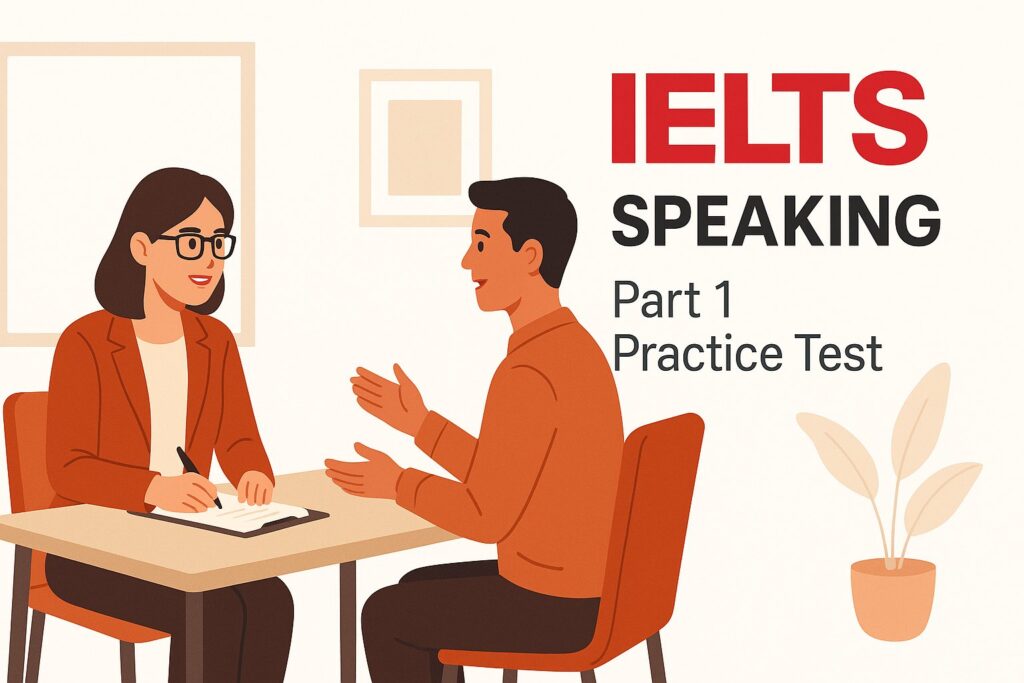
IELTS Speaking Part 1 is the first section of your IELTS Speaking test — and it sets the tone for everything that follows. Lasting four to five minutes, this part involves the examiner asking you familiar questions about yourself: your home, your studies, your hobbies, and your daily routines. It sounds straightforward, but many test-takers underperform here simply because they have never practised under real conditions.
This guide walks you through exactly what to expect, how to answer effectively, and how to use a Speaking Part 1 practice test to build your confidence before test day. If you want to know where your speaking currently sits, the IELTS Express Pre-Test gives you a personalised band prediction for just $4.99 — a fast way to find your baseline before you start practising.
What Happens in IELTS Speaking Part 1?
Part 1 runs for four to five minutes. The examiner introduces themselves and asks you to confirm your identity. After that, they ask questions on two or three everyday topics. These topics are chosen from a standard pool and are the same for Academic and General Training candidates.
Common Part 1 topics include:
- Your hometown or where you live now
- Your work or studies
- Your family
- Hobbies and free time (reading, music, sport, cooking)
- Daily routines (morning habits, transport, exercise)
- Food and eating habits
- Travel and holidays
- Technology and social media
- Weather and seasons
- Shopping and fashion
The examiner sticks to a script during Part 1. They will not prompt you or ask follow-up questions beyond the test questions. This is different from Part 3, where the discussion is more open-ended.
How Your Part 1 Answers Are Assessed
IELTS Speaking is marked on four equally weighted criteria:
- Fluency and Coherence — Do you speak without long pauses or repetition? Do your ideas connect logically?
- Lexical Resource — Do you use a range of vocabulary accurately?
- Grammatical Range and Accuracy — Do you use a variety of structures correctly?
- Pronunciation — Is your speech clear and easy to understand?
Part 1 answers should be concise but developed. A one-word reply is too short. A two-minute monologue is too long. Aim for two to four sentences per answer — a direct response followed by a brief reason or example.
Common Mistakes in IELTS Speaking Part 1
Understanding what goes wrong helps you avoid the same pitfalls in your own practice test.
1. Answering too briefly. “Yes, I like reading” scores poorly. Add a reason: “Yes, I like reading, especially historical fiction, because it helps me understand different cultures and time periods.”
2. Using memorised scripts. Examiners are trained to detect rehearsed answers. If your response sounds scripted, they may steer you off-topic. Practise ideas, not word-for-word scripts.
3. Pausing excessively before answering. Long silences hurt your Fluency score. Use natural filler phrases — “That’s a good question to think about…” — to buy a moment while staying fluent.
4. Using the same vocabulary repeatedly. If you say “good”, “nice”, and “great” to describe everything, your Lexical Resource score will suffer. Practice using synonyms and collocations.
5. Speaking in one tone. Flat, monotone delivery affects Pronunciation marks. Vary your intonation naturally — the examiner is assessing communication, not perfection.
IELTS Speaking Part 1 Practice Test: Sample Questions and Model Answers
Use the questions below as a real practice test. Record yourself answering each one, then review your recordings for fluency, vocabulary range, and grammar variety. For structured feedback against actual band descriptors, unlimited IELTS mock tests let you practise under exam conditions as many times as you need.
Topic: Your Hometown
Question: Where are you from originally?
Model answer (Band 7 level): I’m originally from Bandung, a city in West Java, Indonesia. It’s known for its cooler climate compared to the capital, Jakarta, and it has a very vibrant arts and food scene. I lived there until I was eighteen before moving to study in a different city.
Topic: Work and Study
Question: Do you prefer studying in the morning or at night?
Model answer (Band 7 level): Definitely in the morning. I find my concentration is much sharper early in the day before distractions start building up. I try to tackle anything that requires deep focus — like reading complex texts or writing — before midday, and leave lighter tasks for the afternoon.
Topic: Hobbies
Question: Is there a hobby you have always wanted to try?
Model answer (Band 7 level): I’ve always wanted to learn pottery. There’s something appealing about working with your hands and creating something tangible. I think it would also be a good way to switch off from screens, which I spend far too much time looking at these days.
How to Structure Your Speaking Part 1 Practice Sessions
Random practice is less effective than structured sessions. Here is a four-step approach that mirrors how real IELTS preparation works:
Step 1 — Topic list warm-up. Choose two topics from the common list above. Brainstorm three to five vocabulary items and one or two personal examples for each topic before you start speaking.
Step 2 — Timed practice. Set a timer for five minutes and answer four to six questions from your chosen topics without stopping. Treat it like the real exam.
Step 3 — Record and review. Play back the recording and note: How many filler sounds (“um”, “er”) did you use? Did you answer the question directly? Did your sentences connect logically?
Step 4 — Vocabulary expansion. After reviewing, identify two or three words you overused or could have replaced with more precise vocabulary. Write down alternatives and practise using them in new sentences.
For a complete overview of the full speaking exam, including Parts 2 and 3 strategies, see the IELTS Speaking Test complete guide. And if you want to extend your practice to all four skills, IELTS practice tests covering Reading, Listening, Writing, and Speaking are available in one place.
Vocabulary Strategies for High-Scoring Part 1 Answers
Your vocabulary range is one of four equally weighted scoring criteria. Here are practical strategies to lift your Lexical Resource score:
Use topic-specific collocations. Instead of “I do exercise,” say “I keep fit by cycling to work.” Instead of “I like food,” say “I’m quite adventurous when it comes to trying new cuisines.”
Avoid repetition within an answer. If you use “interesting” once, use “engaging” or “thought-provoking” next time. Examiners notice lexical variety within even a single turn.
Learn hedging language. Part 1 topics are personal, so hedging sounds natural and fluent: “I’d say I’m fairly sociable,” “I suppose I spend most of my free time…” These phrases also give you a fraction of extra planning time.
Practise topic word banks. For each common Part 1 topic, build a personal word bank of ten vocabulary items. Study them actively — in sentences, not isolated lists.
Pronunciation Tips for Part 1
You do not need a native accent to score well. You need to be understood and to use intonation that sounds natural. Focus on these areas:
- Word stress: English stress patterns are unpredictable. Practise the stress patterns of new vocabulary items as you learn them.
- Linking sounds: Natural speech involves linking words together (“I’d have to say…” not “I… would… have… to… say…”). Practise linking sounds in short phrases.
- Sentence rhythm: English is stress-timed, meaning stressed syllables fall at regular intervals. Avoid giving equal weight to every syllable.
- Question intonation: When the examiner asks a question, your answer should open with a confident rising-or-falling pattern that signals you understand and are responding naturally.
Ready to find out your IELTS band score?
Take the IELTS Express Pre-Test for just $4.99 and get your personalised band prediction with a 14-day improvement plan.
Frequently Asked Questions
How long is IELTS Speaking Part 1?
Part 1 lasts four to five minutes. The examiner asks questions on two or three familiar topics. It is the shortest of the three speaking parts but sets the tone for your overall speaking score.
Can I prepare specific answers for Part 1 questions?
You can prepare ideas and vocabulary for common topics, but avoid memorising full scripts. Examiners are trained to detect rehearsed answers and may redirect you off-topic if they suspect scripted responses. Focus on building flexible language around familiar subjects rather than memorising word-for-word replies.
What band score can I get in IELTS Speaking Part 1?
The overall Speaking band is based on all three parts, not Part 1 alone. However, a strong Part 1 helps you establish rapport and fluency early. Band 7 answers in Part 1 tend to be direct, well-developed with reasons or examples, and use a range of vocabulary without overusing simple words.
How many questions does the examiner ask in Part 1?
The examiner typically asks three to four questions per topic, covering two to three topics in total. This means you may answer between six and twelve questions across the full Part 1 section, depending on your answer length and the pace of the conversation.
Is it better to give long or short answers in Part 1?
Aim for medium-length answers: two to four sentences. Too short (one sentence) signals limited language ability. Too long (rambling for two minutes) can suggest you are not listening or are avoiding the question. A clear direct answer plus a brief reason or example is the target structure for every Part 1 response.