If you are preparing for IELTS, understanding how the examiner scores your Speaking Part 1 responses is one of the most practical steps you can take. Many test takers focus heavily on vocabulary lists and grammar rules, but miss the specific performance markers that actually move the needle from band 5 to band 7 — or from band 7 to band 8. This guide breaks down exactly how band scores are calculated in IELTS Speaking Part 1, what examiners listen for in each score range, and how to build the habits that push your score higher.
If you are not sure where your current speaking level sits, the IELTS Express Pre-Test is a fast way to get a personalised band prediction before you start targeted practice.
What Is IELTS Speaking Part 1?
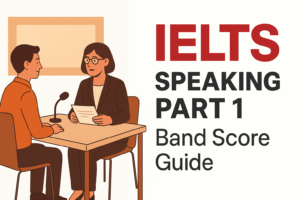
IELTS Speaking Part 1 is the opening section of the speaking test and lasts between four and five minutes. The examiner asks you familiar, everyday questions about yourself — topics such as your home, family, work, studies, hobbies, daily routines, and personal preferences. There are typically two or three topic areas covered, with two to three questions per topic.
Unlike Parts 2 and 3, Part 1 is not designed to test complex arguments or abstract thinking. Its purpose is to get you speaking naturally and comfortably. The examiner uses it to establish a baseline impression of your spontaneous spoken English. That said, your performance here still contributes to your overall score, so consistent precision in Part 1 can help anchor a strong final band.
How IELTS Speaking Is Scored: The Four Criteria
All three parts of the IELTS Speaking test — including Part 1 — are assessed against the same four criteria. Each criterion carries equal weight (25% each):
- Fluency and Coherence (FC): How smoothly you speak and how logically your ideas connect. Hesitation and self-correction both affect this.
- Lexical Resource (LR): The range, accuracy, and appropriateness of your vocabulary. Paraphrasing and idiomatic language count here.
- Grammatical Range and Accuracy (GRA): How varied and accurate your grammatical structures are. Using only simple sentences caps your score.
- Pronunciation (P): How clearly you are understood. Accent is not penalised, but consistent mispronunciation of common words is.
Understanding this framework helps you practise smarter — rather than just “speaking more”, you target each dimension deliberately.
Band Score Descriptors for Speaking Part 1: What Each Level Looks Like
The following breakdown shows the typical speaking profile for each band range during Part 1 questions. These are practical descriptions based on the official IELTS Speaking Band Descriptors.
Band 4 to 5: Noticeable Communication Gaps
At this level, the candidate can communicate basic meaning but with frequent hesitation, limited vocabulary, and recurring grammatical errors. Responses to Part 1 questions are often very short — sometimes just one or two sentences — and rely heavily on simple, repeated structures. Pronunciation errors make some words difficult to understand without guessing. The examiner can follow the general meaning, but significant effort is required.
Band 5 to 6: Functional but Limited
A band 5–6 candidate speaks with some fluency in familiar territory (which is exactly what Part 1 covers), but struggles when topics move slightly outside their comfort zone. Responses begin to extend with some reasoning, but coherence is uneven — ideas jump around or trail off. Vocabulary is adequate but narrow. Grammar includes a mix of simple and attempted complex structures, with frequent errors in the latter. This is the most common range for test takers who have not done structured speaking practice.
Band 6 to 7: Consistent and Mostly Accurate
At band 6–7, the candidate manages Part 1 comfortably. Responses are extended, relevant, and generally coherent. Vocabulary is more varied and idiomatic language starts to appear naturally. Grammatical errors are present but rarely cause misunderstanding. Pronunciation is clear and consistent. The examiner can follow everything without effort. The distinguishing factor between band 6 and band 7 is whether vocabulary and grammar complexity feel natural or forced.
Band 7 to 8: Flexible and Natural
A band 7–8 speaker handles Part 1 effortlessly. Responses are well-developed without being over-rehearsed. Vocabulary is precise and contextually appropriate — not just “big words” but the right words. Complex grammar (conditionals, passive constructions, relative clauses) appears naturally rather than as a performance. Hesitation, when it occurs, sounds like natural speech rather than a language gap. The candidate sounds like a confident non-native English user rather than someone translating in their head.
Band 8 and Above: Near-Native Fluency
At band 8+, speaking feels almost effortless. The candidate uses a wide range of vocabulary with precision, varied sentence structures, and consistent pronunciation that places minimal strain on the listener. In Part 1, this looks like fully developed responses that stay on point, use nuanced language (hedging, expressing preference with sophistication), and demonstrate strong cohesive devices (however, on the other hand, what I particularly enjoy is…) without sounding scripted.
The Most Common Mistakes That Cap Band Scores in Part 1
Even well-prepared candidates make these errors. If you are stuck at a particular band, one or more of these is likely the reason.
1. Answers That Are Too Short
Giving one-sentence answers to Part 1 questions signals a band 5 fluency level, even if your vocabulary is strong. The examiner needs to hear enough language to assess all four criteria. Aim for three to five sentences per response: answer + reason + example or development.
2. Memorised, Scripted Responses
Examiners are trained to detect rehearsed speech. If your answer sounds like it was written and memorised, it will score lower on Fluency and Coherence — because true fluency means generating language in real time, not recalling stored text. Use templates as frameworks, not scripts.
3. Vocabulary Repetition
Using the same adjective or phrase repeatedly (e.g., “very good”, “I really like”, “it’s very important”) drags down your Lexical Resource score. Build a habit of paraphrasing — if you said “enjoy”, try “find it rewarding” or “get a lot out of” next time.
4. Avoiding Complex Grammar
Simple present and simple past are safe but limit your GRA score. In Part 1, you have natural opportunities to use conditionals (“If I had more time, I would…”), perfect tenses (“I’ve been doing this since…”), and relative clauses (“The thing that I find most challenging is…”). Use them.
5. Ignoring Pronunciation Until Test Week
Pronunciation is built over months, not days. Word stress, connected speech, and sentence rhythm all affect how clearly you communicate. Regular speaking practice — ideally with audio feedback — is the only way to improve this criterion reliably.
How to Improve Your Band Score in IELTS Speaking Part 1
Structured practice beats random conversation. Here is a practical approach that targets each criterion directly.
Practise With Timed Self-Recording
Record yourself answering common Part 1 questions. Listen back critically — how long were your responses? Did you repeat words? Were your sentences varied? Most candidates are surprised by how different their spoken English sounds compared to what they thought they said.
Use the Answer-Reason-Example Framework
For every Part 1 question, train yourself to follow: Answer → Reason → Example (or extension). This automatically extends your response without making it feel forced. For example, “I prefer mornings because I feel more focused then. I usually do my most difficult tasks before noon and leave routine work for the afternoon.” That is a natural, developed answer that gives the examiner language to assess.
Build Topic-Specific Vocabulary Banks
Part 1 topics are predictable: home, work, hobbies, food, transport, weather, technology, daily routines. For each topic, build a list of ten to fifteen high-value words and collocations — not rare vocabulary, but precise and varied language. “I find it quite therapeutic” is more effective than “I like it very much.”
Work on Cohesive Devices
Coherence in Part 1 improves with deliberate use of connectors: “That said…”, “In terms of…”, “What I find interesting is…”, “Having said that…”. These signal to the examiner that your ideas are organised — a key Fluency and Coherence marker.
For access to full mock speaking tests that simulate the real exam environment, the unlimited IELTS mock tests from Career Wise English let you practise under test conditions and build genuine test-day readiness.
Part 1 in Context: How It Connects to Your Overall Speaking Score
Your IELTS Speaking score is calculated as a holistic average across all three parts — but Part 1 sets the tone. A strong Part 1 performance creates a positive first impression that can subtly influence how the examiner hears your later responses. Conversely, a hesitant, short Part 1 creates a lower baseline that is difficult to fully recover from in Parts 2 and 3.
For a complete picture of the IELTS Speaking test, including Part 2 and Part 3 frameworks, see the IELTS Speaking Test: Complete Guide. For more on how band scores are calculated across all four skills, the IELTS Band Score Practical Framework covers the full scoring system in detail.
Ready to find out your IELTS band score?
Take the IELTS Express Pre-Test for just $4.99 and get your personalised band prediction with a 14-day improvement plan.
Frequently Asked Questions
Is IELTS Speaking Part 1 easier than Parts 2 and 3?
Part 1 uses familiar, everyday topics which means many candidates feel more comfortable with it. However, “easier” topics do not mean you can score any less precisely. The examiner is still assessing all four criteria — fluency, vocabulary, grammar, and pronunciation — and a weak Part 1 drags down your overall speaking score just as much as a weak Part 3.
How long should my answers be in IELTS Speaking Part 1?
Aim for three to five sentences per question — enough to demonstrate your language range without rambling. One-sentence answers are too short; very long answers can lose coherence and eat into the examiner’s question time. The Answer-Reason-Example framework reliably produces the right length.
Does my accent affect my IELTS Speaking score?
Your native accent does not penalise you. Pronunciation is assessed on how easily a listener can understand you — not on whether you sound British, American, or Australian. Consistent mispronunciation of common words or syllable stress errors that cause misunderstanding will affect your score, but a regional accent will not.
Can I ask the examiner to repeat a question in Part 1?
Yes. If you did not hear or understand a question, it is perfectly acceptable to say “Could you say that again, please?” or “Sorry, could you repeat the question?” Asking once will not affect your score. However, asking the examiner to repeat every question suggests a listening comprehension issue, so use this sparingly.
What topics come up most often in IELTS Speaking Part 1?
The most common Part 1 topic categories include: your home or accommodation, work or study, hobbies and free time, food and cooking, transport and travel, weather and seasons, technology and social media, and daily routines. Preparing two to three natural responses for each topic area will cover the vast majority of Part 1 questions you encounter.
How is the final IELTS Speaking band score calculated?
The examiner scores you on each of the four criteria (Fluency and Coherence, Lexical Resource, Grammatical Range and Accuracy, and Pronunciation) on a scale from 1 to 9. These four scores are averaged to produce your final Speaking band score, which is then rounded to the nearest 0.5. All three parts of the speaking test contribute to this average — there is no separate Part 1 band score.