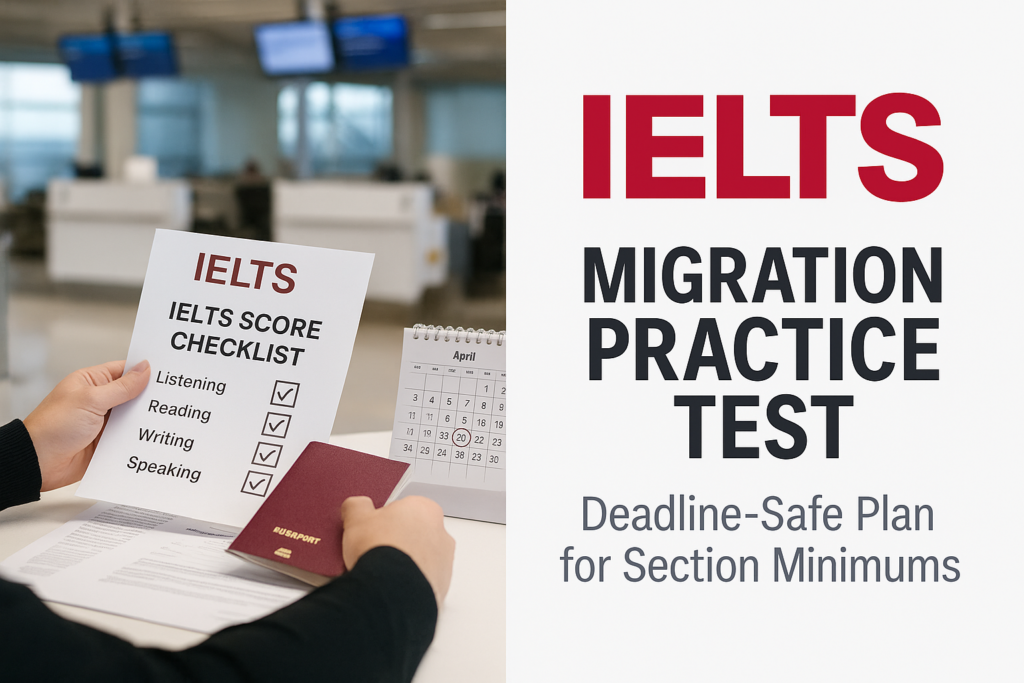
When people prepare for migration, IELTS is not just an exam. It is a gate in your timeline. A delayed score can hold up an application, push back a job start, or force a rushed retake when you are already under pressure.
That is why a strong ielts practice test for migration to australia strategy needs to do more than improve language skills. It needs to protect deadlines and section minimums while giving you enough confidence to book the real test at the right time.
If you want an immediate baseline before building your study calendar, start with the IELTS Express Pre Test. Then use the system below to turn results into a realistic migration-focused action plan.
Why Migration Candidates Need a Different IELTS Strategy
General IELTS advice often focuses on overall improvement. Migration candidates need a sharper lens: section minimums, application timing, and risk control. A good overall band can still fail your pathway if one section drops below the required threshold.
A migration-safe strategy is built on three practical rules:
- Protect section minimums first, not just overall band.
- Use evidence from timed practice tests, not confidence-based guesses.
- Plan booking and retake windows against real visa or skills-assessment milestones.
This approach reduces panic decisions. It also helps you avoid expensive rebook cycles that happen when candidates sit too early without stable section performance.
Start With a Baseline That Mirrors Test-Day Pressure
Your first full mock should be strict and realistic. If the environment is too comfortable, your score will look better than your real readiness.
For a useful baseline:
- Sit all sections in sequence under official timing.
- Remove pauses, dictionary checks, and mid-test corrections.
- Use a quiet space and a stable device setup.
- Mark answers immediately and capture exact error patterns.
This baseline gives you two essential signals: your likely current band range and your highest-risk section for migration outcomes. If you need a timing refresher before the first attempt, review IELTS Test Format and then rerun the full mock properly.
Protect Section Minimums Before Chasing Overall Band
Migration outcomes are often section-sensitive. Candidates frequently spend too much time polishing strengths while one weak section keeps failing the minimum.
Use this priority model:
1. Identify the weakest section by consistency, not one-off score.
2. Map the top two repeated error categories in that section.
3. Allocate 50% of weekly study time to those high-impact errors.
4. Keep maintenance practice on stronger sections to prevent score drift.
For example, if Writing repeatedly drops below target, the solution is rarely “write more essays randomly.” The better move is targeted work: thesis clarity, body paragraph support, grammar control under time, and a checklist-led rewrite routine.
Build a 14-Day Migration-Safe Practice Cycle
This two-week cycle is practical for busy adults and gives enough data to make a booking decision with confidence.
Days 1–2: Full benchmark and forensic review
Run one full test, then audit each section deeply. Tag every mistake by type and impact. Keep notes short but specific.
Days 3–5: Weak-section repair sprint
Focus on your highest-risk section first. Use timed mini-sets and immediate review. Avoid passive study during this phase.
Days 6–7: Balanced performance block
Reintroduce all four skills with moderate timing pressure. Check whether your weak-section fixes hold when cognitive load increases.
Days 8–10: Writing and speaking quality upgrade
Use structured prompts, model comparisons, and recorded responses. Prioritise coherence, development, and controlled grammar.
Days 11–12: Full mock under strict conditions
Run a second full test in one sitting. Compare score stability with Day 1 and note whether section minimum risk is reducing.
Days 13–14: Decision and buffer planning
Decide whether to book now or run one more correction loop. If timeline pressure exists, reserve a retake buffer in advance.
If you need sustained test volume after this cycle, use Unlimited IELTS Mock Tests to keep score tracking consistent.
A Booking Rule That Reduces Retake Risk
Do not book based on “feeling ready.” Book based on evidence. A simple decision framework can save time and stress.
Book the official test when all four conditions are true:
- Your two latest full mocks are at or above target band range.
- No section repeatedly falls below required minimum.
- Error frequency in your weakest section is trending down.
- Timing control remains stable in late Listening and Reading tasks.
If one section is unstable, delay briefly and run another focused correction week. In most cases, that short delay is less costly than a full retake cycle.
Common Migration Prep Mistakes (and Fixes)
Mistake 1: Studying hard but not measuring risk
Many candidates spend hours studying but cannot answer one key question: “Which section could still fail my migration requirement?”
Fix: Track section risk weekly with a traffic-light method:
- Green: stable above target
- Amber: near minimum with inconsistency
- Red: below minimum or volatile
Mistake 2: Treating practice tests as score collection only
Practice tests are diagnostic tools, not trophies. Without structured review, repeated tests create fatigue more than improvement.
Fix: For every full test, record top errors, reason for each error, and one concrete correction action for the next week.
Mistake 3: Ignoring timeline maths
Some candidates prepare without mapping test date, result release, document readiness, and application windows.
Fix: Build a migration calendar that includes:
- target application milestone
- preferred test date window
- contingency retake date
- final document submission buffer
Mistake 4: Overloading the week with unrealistic targets
Ambitious plans fail when they ignore your routine. Missed sessions quickly become stress cycles.
Fix: Use sustainable blocks. Four focused weekday sessions plus one long weekend session is better than a perfect plan you cannot maintain.
Weekly Dashboard You Can Actually Use
Keep your tracking system simple. One page per week is enough if it includes the right fields.
Recommended dashboard sections:
- Latest mock scores by section
- Top three recurring error types
- Section-minimum risk status (green/amber/red)
- This week’s correction priorities
- Booking decision status (book / hold / retest)
This dashboard prevents random study decisions. It keeps your effort tied to migration outcomes rather than generic motivation.
Migration Timeline Mapping: Reverse-Plan From Your Lodgement Date
A lot of stress disappears when you reverse-plan. Start from your intended application or document submission date and work backward. This gives you a practical view of how much IELTS margin you truly have.
Use this reverse-planning sequence:
- Final lodgement target date
- Document collection and verification window
- Preferred IELTS test date (primary attempt)
- Result release buffer
- Retake contingency window
- Final review checkpoint before each booking decision
When candidates do this on paper, they usually notice one of two issues: either they planned too little buffer, or they delayed test readiness decisions for too long. Both are fixable once visible.
Set a simple timeline rule: never let your IELTS timeline have only one path. Always keep a Plan A and Plan B test window. This is not pessimism. It is risk management.
Plan A should be used when mock stability is strong and section minimums are protected. Plan B exists in case one section unexpectedly drops on test day. Without Plan B, candidates often accept weak timing decisions because they feel cornered.
In practice, this means reserving calendar space for:
- one full correction cycle after your primary mock milestone
- one optional retake booking window
- one admin buffer for paperwork and uploads
This structure protects mental bandwidth. Instead of worrying every day, you can focus on weekly execution because your timeline already includes controlled fallback options.
How to Balance IELTS Prep With Work and Family
Most migration candidates in Australia are balancing full schedules. You do not need perfect days. You need consistency plus smart sequencing.
A practical weekly rhythm:
- Monday: Listening correction + vocabulary transfer accuracy
- Tuesday: Reading timing strategy + passage-three focus
- Wednesday: Writing Task 2 structure and rewrite
- Thursday: Speaking fluency and example expansion
- Saturday or Sunday: Full mock or long mixed timed set
Short, high-quality sessions usually beat marathon study blocks that lead to burnout. The goal is stable, repeatable performance under pressure.
FAQ
How many full IELTS practice tests should migration candidates do each month?
For most candidates, 4 to 6 full mocks per month works well when paired with deep review. More tests help only if analysis quality stays high.
Should I delay booking if only one section is below target?
Usually yes, especially when your pathway requires section minimums. One weak section can stop progress even with a strong overall band.
What is the safest way to plan for a possible retake?
Set a contingency test window before your first official attempt. That reduces panic and protects migration timelines if results are slightly below target.
Can I prepare effectively if I only have 60–90 minutes per day?
Yes. Focused daily blocks with clear error targets can produce strong gains, especially when combined with one weekly full mock.
Final Migration-Ready Checklist
Before your next two-week cycle starts, confirm these points:
- I know my exact section minimum targets.
- I can name my top two recurring error patterns.
- My weekly calendar is realistic for my routine.
- I have a booking rule based on test evidence.
- I have a contingency retake buffer in my timeline.
If you can tick all five, your preparation is likely moving in the right direction. If not, reset now and simplify. Migration prep rewards clear priorities and disciplined review, not random effort.
For broader planning, this IELTS Preparation Complete Guide is a strong companion to your migration-focused practice cycle.