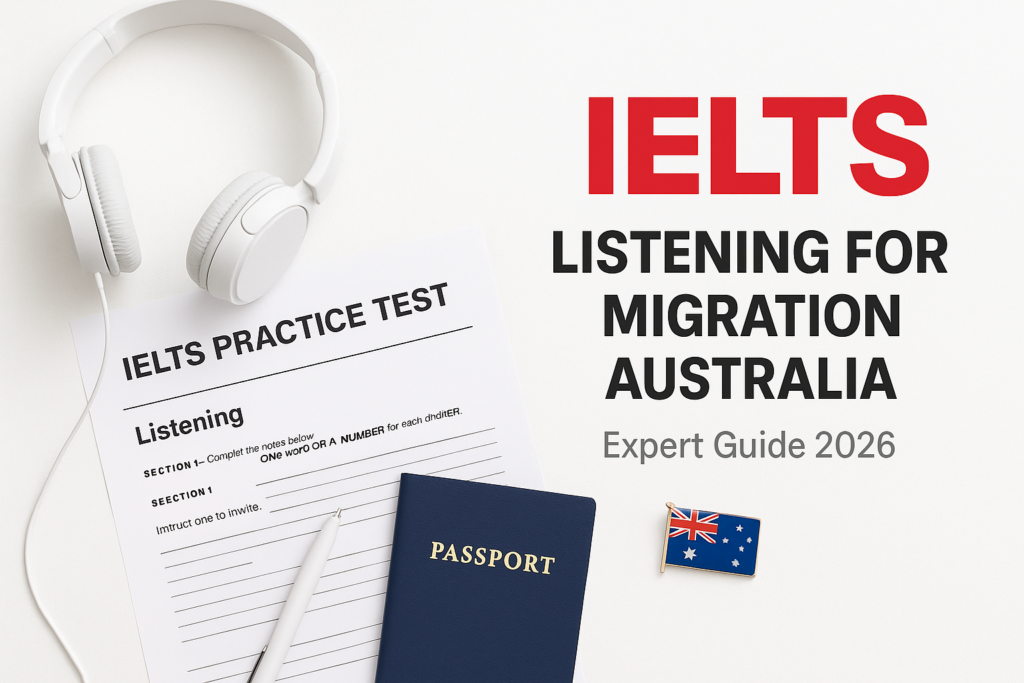
If you’re applying for a visa to migrate to Australia, passing the IELTS test is one of the most important steps in your journey. Of the four sections — Reading, Writing, Speaking, and Listening — the Listening section often catches applicants off guard. It moves fast, the accents vary, and a single moment of distraction can cost you a whole band score.
The good news is that IELTS Listening is one of the most improvable sections with the right approach. This guide walks you through everything you need to know: what score you need for your visa, how the test works, and the strategies that move the needle fastest. Before diving in, it’s worth checking your current level — the IELTS Express Pre-Test gives you a personalised band prediction in under 20 minutes so you know exactly where you stand.
What IELTS Listening Score Do You Need for Migration to Australia?
The band score you need depends entirely on your visa pathway. Australian migration uses either IELTS Academic or IELTS General Training, and the listening requirements differ by visa type.
For most skilled migration visas — including the Subclass 189, 190, and 491 — you need a minimum overall score of 6.0, with no individual band below 6.0. Some occupations assessed by specific bodies (like ANMAC for nurses or Engineers Australia) require a minimum of 7.0 in each section, including Listening.
For employer-sponsored visas (Subclass 482 and 494), the minimum is generally 5.0 overall with no band below 5.0. However, many employers and occupations require higher. Partner visa applicants (Subclass 309/100 and 820/801) typically need a functional English score, which translates to at least 4.5 in each section.
The critical point: migration visas often have section minimums, not just overall score requirements. A high Reading or Writing score cannot compensate for a low Listening score. Every band counts independently.
How the IELTS Listening Test Works
The IELTS Listening test is 40 minutes total — 30 minutes of audio plus 10 minutes to transfer your answers to the answer sheet. You hear each recording once only. There is no replay.
The test has four sections, each with ten questions:
- Section 1: A conversation between two people in an everyday social context (e.g., booking accommodation, arranging a service)
- Section 2: A monologue in a social or semi-official context (e.g., a talk about local facilities)
- Section 3: A conversation between up to four people in an educational or training context
- Section 4: A monologue on an academic subject (the most challenging section)
Questions include multiple choice, matching, plan/map/diagram labelling, form completion, note completion, table completion, flow-chart completion, summary completion, and short-answer questions.
The test uses a variety of English accents — Australian, British, American, and occasionally others. For migration candidates, this is both an advantage (Australian accents appear frequently) and a challenge if you’ve trained primarily with one accent.
Why IELTS Listening Is Different from Everyday Listening
Most people assume that if they understand English conversations in daily life, the IELTS Listening test will feel natural. It rarely does — at least not the first time.
IELTS Listening is an active task, not a passive one. You must read the questions before the audio starts, predict likely answers, follow along in real time, and write legible responses simultaneously. The audio doesn’t pause for you to think. If you miss an answer, the recording keeps going.
Common failure points include:
- Losing the thread: Focusing too hard on one missed answer and falling behind on the next questions
- Spelling errors: Correctly identifying an answer but losing the mark due to a misspelling
- Distractor trap: Choosing the first answer you hear rather than waiting for the final confirmed answer
- Slow transfer: Running out of transfer time by writing answers too carefully during the recording instead of in the 10-minute transfer window
Understanding these patterns is the first step to avoiding them. To sharpen your weak spots fast, practise with full IELTS mock tests that simulate real test conditions — timed, uninterrupted, and scored.
Band Score Breakdown for IELTS Listening
The Listening section is scored on a scale of 0–9 based on the number of correct answers out of 40. Understanding what raw score maps to each band helps you set a realistic target.
- Band 9.0: 39–40 correct
- Band 8.5: 37–38 correct
- Band 8.0: 35–36 correct
- Band 7.5: 32–34 correct
- Band 7.0: 30–31 correct
- Band 6.5: 26–29 correct
- Band 6.0: 23–25 correct
- Band 5.5: 18–22 correct
- Band 5.0: 16–17 correct
If you need a 7.0 for your visa, that means getting 30 out of 40 correct. That’s a 75% pass rate — achievable, but requiring consistent practice. Each wrong answer in the 30–34 range costs you half a band. At this level, the difference between 6.5 and 7.0 is often just three or four questions.
Top Strategies to Improve Your IELTS Listening Score
The following techniques are used by test-takers who consistently hit band 7.0 and above. Apply them in your practice from day one.
1. Preview questions before the audio starts
You’re given a short time before each section begins. Use every second to read the questions, underline keywords, and predict possible answer types (a name, a number, a location, a date). This primes your brain to listen with purpose rather than passively.
2. Follow the sequence
IELTS Listening answers appear in sequential order in the audio. If you’re on question 6 and you haven’t heard the answer yet, question 7 hasn’t appeared either. This means you can track your progress by paying attention to the flow of the conversation, not just the words.
3. Don’t fixate on missed answers
If you miss an answer, leave a blank and move on immediately. Spending five seconds on a missed answer means potentially losing the next three. You can always guess a plausible answer during transfer time.
4. Write on the question paper, then transfer
During the 30-minute recording, write answers directly on the question booklet — even rough notes. Use the 10-minute transfer window to copy answers neatly and correct spelling. This prevents costly errors and frees you from splitting attention between listening and writing neatly.
5. Train with varied accents
Expose yourself to British, Australian, American, and South African English regularly. Use BBC Radio, Australian podcasts, and American TED Talks. Accent variety in your practice reduces surprise on test day.
6. Practise note-completion under pressure
Note and form completion questions require exact spelling and grammar. Practise writing while listening — not after — so your hand and brain learn to work simultaneously. Time-pressure drilling is the fastest way to build this reflex.
IELTS General Training vs Academic: Listening Differences
For migration purposes, most visa applicants take IELTS General Training. The Listening section is identical in both Academic and General Training versions — same format, same timing, same marking criteria.
Where Academic and General Training differ is in Reading and Writing. So if you’re preparing specifically for migration, your Listening strategy applies regardless of which test version you’re sitting. However, your Reading and Writing preparation should be tailored to the General Training format. For full guidance on the General Training pathway, see our IELTS General Training migration guide.
Common Mistakes Migration Applicants Make in Listening
Migration applicants often bring specific habits and anxieties that hurt their Listening performance. Here are the most common and how to fix them.
Over-preparing for academic vocabulary: Section 4 does use academic language, but Sections 1–3 are conversational. Don’t spend all your time on academic vocabulary lists at the expense of everyday English fluency.
Neglecting spelling: Incorrect spelling counts as a wrong answer even if you identified the right word. Create a personal spelling list of words you consistently misspell in practice sessions and drill them weekly.
Skipping Section 1 practice: Many test-takers assume Section 1 is easy and focus all their energy on Section 4. Section 1 form completion questions have strict answer formats (exact dates, full names, phone numbers) that require their own practice.
Practising with subtitles: Watching English TV or YouTube with subtitles doesn’t build the listening skill required for IELTS. Disable subtitles and train your ear to work without visual support.
Ready to find out your IELTS band score?
Take the IELTS Express Pre-Test for just $4.99 and get your personalised band prediction with a 14-day improvement plan.
Frequently Asked Questions
What is the minimum IELTS Listening score for Australian migration?
For most skilled migration visas, you need a minimum Listening band of 6.0. Some occupations regulated by professional bodies require 7.0 or higher. Always check your specific visa subclass and occupational assessment requirements, as section minimums apply — your overall score cannot compensate for a low Listening result.
How many correct answers do I need for a band 7.0 in IELTS Listening?
You need approximately 30 out of 40 correct answers for a band 7.0. The exact conversion can vary slightly between test versions, but 30/40 is the standard benchmark. At band 6.5, the threshold is around 26–29 correct.
Is the IELTS Listening test the same for Academic and General Training?
Yes. The Listening section is identical in both Academic and General Training versions of IELTS. The same format, timing, question types, and marking criteria apply to both. Only Reading and Writing differ between the two test types.
How long does it take to improve IELTS Listening by one band?
With focused, structured practice, most learners see a half-band improvement within four to six weeks of consistent daily practice (30–60 minutes per day). A full band improvement typically takes 8–12 weeks. Passive listening (background TV, podcasts) helps but is not sufficient alone — active, question-driven practice is what drives results.
What are the best resources to practise IELTS Listening for migration?
Cambridge IELTS practice test books (available for both Academic and General Training) are the gold standard for authentic practice material. For digital practice with immediate feedback, unlimited IELTS mock tests replicate real test conditions and track your progress over time. Supplement with Australian podcasts and radio to build familiarity with the accent common in migration-related Listening sections.
Can I retake IELTS Listening separately if I fail it?
No. IELTS does not allow you to retake individual sections. If your Listening score is below the required band, you must retake the full IELTS test. This makes section-specific preparation before test day critical — there’s no shortcut to fixing one score without sitting the whole test again.