Why Your IELTS Score Can Make or Break Your PR Application
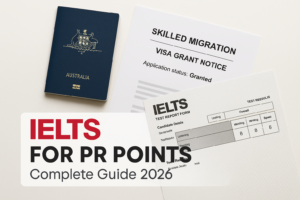
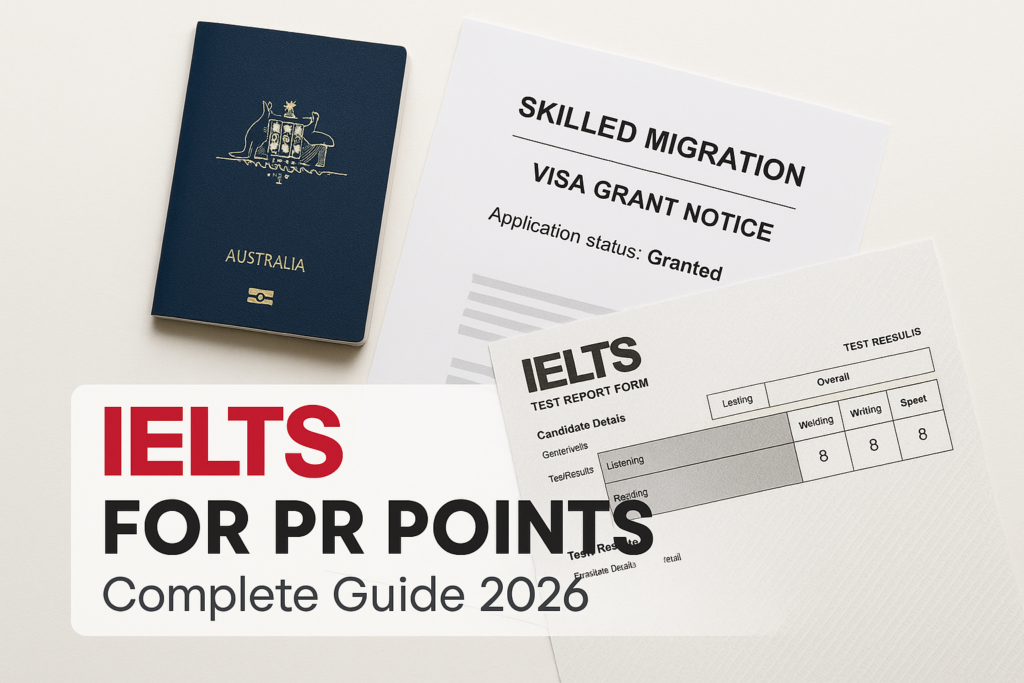
If you are applying for permanent residence in Australia through a points-tested visa — such as the Subclass 189 or 190 — your English proficiency score is one of the most direct ways to add points to your profile. The difference between Band 7 and Band 8 is not just a test result. It is the difference between 10 and 20 points in the SkillSelect system, which can determine whether you receive an invitation or wait indefinitely.
This guide covers exactly what IELTS scores you need, how the points are calculated, which visa pathways they apply to, and what a realistic preparation plan looks like. If you want to know where you stand right now, the IELTS Express Pre-Test gives you a personalised band prediction for just $4.99 — a useful starting point before committing to months of preparation.
How English Proficiency Points Work in the Australian Points System
Australia’s points-based migration system awards points across several categories including age, qualifications, work experience, and English language ability. English proficiency is scored as follows for most General Skilled Migration (GSM) visas:
- Competent English (Band 6.0 in each component) — 0 bonus points (but required to be eligible)
- Proficient English (Band 7.0 in each component) — 10 points
- Superior English (Band 8.0 in each component) — 20 points
The key word here is each component. You cannot average across Listening, Reading, Writing and Speaking. Every single section must meet the threshold. A Band 8 in three sections and a Band 7.5 in Writing means you qualify for Proficient — not Superior — English points.
This distinction matters enormously. For high-competition occupation ceilings, many applicants are scoring 85 to 90 points or more. Getting Superior English over Proficient is often the deciding factor that gets an invitation issued.
Which Visas Use the English Points System
The points-tested English thresholds apply to the following visa subclasses:
- Subclass 189 — Skilled Independent (no state sponsorship required)
- Subclass 190 — Skilled Nominated (state or territory nomination)
- Subclass 491 — Skilled Work Regional (Provisional)
For employer-sponsored visas such as the 482 or 186, you typically only need to demonstrate Competent English — the points scale does not apply. However, if you plan to transition to a permanent residence pathway later, achieving a higher band score now positions you better.
It is also worth noting that some state nomination streams impose their own English requirements on top of the federal threshold. Some states require Proficient English as a minimum condition for nomination — meaning the 10-point threshold is effectively your entry point, not a bonus target.
IELTS Score Requirements: A Practical Breakdown
Here is a clear summary of the IELTS scores you need for each English proficiency level under the Australian migration framework:
- Competent English: Minimum Band 6.0 in each of the four components (L, R, W, S)
- Proficient English: Minimum Band 7.0 in each component
- Superior English: Minimum Band 8.0 in each component
There is no overall band score shortcut here. The Department of Home Affairs assesses component-by-component. A candidate with an overall Band 8.0 who scored Band 6.5 in Writing would be assessed at Competent English — zero points — despite their headline score.
This is one of the most misunderstood aspects of the IELTS-for-PR process. Many applicants assume an overall band score is what is assessed. It is not. Component floors are what determine your points category.
For most test-takers, Writing and Speaking are the two components that sit slightly below target — especially when the goal is Superior English at Band 8.0. These are also the components most responsive to targeted preparation.
How to Decide Whether to Aim for Proficient or Superior English
The answer depends on your current points total and the Invitation to Apply (ITA) cut-offs for your occupation and visa subclass.
If your current profile sits at 75 to 79 points, reaching Proficient English (10 points) is likely enough to push you into a competitive range for many occupations. But if your occupation ceiling regularly clears 85 or 90 points, going for Superior English (20 points) is a strategic necessity — not a stretch goal.
Check the IELTS for Migration Australia complete guide for more context on how English scores interact with overall visa strategy. You can also access unlimited IELTS mock tests to assess which components need the most work before you re-sit.
A practical approach: use the immigration points estimator (available on the Department of Home Affairs website) to calculate your current score without English points, then add 10 and 20 points to see where each outcome leaves you relative to recent ITA rounds for your occupation.
Preparation Strategy for PR-Level IELTS Scores
Scoring Band 7.0 or Band 8.0 across all four components is a specific and demanding target. It requires more than general English improvement — it requires test-format fluency and section-specific strategies.
Listening
Listening is often the highest-scoring section for many candidates. At Band 8.0, you need to answer around 36 of 40 questions correctly. Key preparation habits include active listening with transcripts (not passive background audio), practising with authentic IELTS recordings at native speed, and reviewing every wrong answer to identify whether the error was vocabulary, distraction, or form-filling technique.
Reading
Reading Band 8.0 requires approximately 36 correct answers from 40. Time management is the primary barrier for most candidates — running out of time and leaving questions blank is the fastest way to drop below Band 8. Practise timed sections and learn skimming and scanning techniques rather than reading every word in full.
Writing
Writing is the most common bottleneck for candidates targeting Band 8.0. The four assessment criteria — Task Achievement, Coherence and Cohesion, Lexical Resource, and Grammatical Range and Accuracy — each contribute equally. A single weak criterion pulls the entire score down. Aim for a consistent 7.5 across criteria rather than 9.0 in one area and 6.5 in another. Practise under timed conditions and get specific feedback on your grammar and cohesion patterns. The IELTS Writing Task 2 Band Score Strategy goes deeper on how to structure high-scoring arguments.
Speaking
Speaking at Band 8.0 means demonstrating fluency, coherent extended responses, a wide range of vocabulary used accurately, and complex grammatical structures with only rare errors. Preparation should involve recorded self-practice and review — not just conversation — so you can hear your hesitations, fillers, and grammatical slips. The IELTS Speaking Test complete guide covers Part 2 and Part 3 techniques in detail.
How Long Does It Take to Reach Band 7 or Band 8?
There is no single answer, but some realistic benchmarks based on starting level:
- Starting at Band 6.0: Reaching Band 7.0 typically takes 3 to 6 months of structured preparation for most candidates. Some achieve it faster with intensive daily practice.
- Starting at Band 7.0: Reaching Band 8.0 in all components takes longer than most candidates expect — often 6 to 12 months. The gap between 7 and 8 is significant, especially in Writing and Speaking.
- Starting at Band 7.5 in most sections: A targeted 8 to 12 week push on weak components (usually Writing or Speaking) can close the gap for candidates who are borderline.
The timeline also depends on study intensity. Candidates studying 1 to 2 hours per day five days per week progress substantially faster than those cramming in bursts. Consistent exposure — especially to authentic test materials — is more effective than last-minute preparation.
Ready to find out your current IELTS band score?
Take the IELTS Express Pre-Test for just $4.99 and get your personalised band prediction with a 14-day improvement plan.
Frequently Asked Questions
Do I need IELTS Academic or IELTS General Training for a PR visa?
For most skilled migration visas (189, 190, 491), either IELTS Academic or IELTS General Training is accepted by the Department of Home Affairs. Both versions test the same Listening and Speaking components — the Reading and Writing sections differ in format but are assessed at the same band levels for migration purposes. Check the specific requirements for your occupation’s assessing body, as some (like Engineers Australia or AHPRA) have their own preferences.
How long is an IELTS result valid for a PR application?
IELTS results are valid for three years from the test date for migration purposes. If your result expires before you lodge your visa application, you will need to re-sit the test. Plan your preparation timeline with this in mind — especially if you are aiming to build your points profile over an extended period.
What happens if I meet the overall Band 8 but have one component below?
You will be assessed at the level of your lowest component. If your Listening, Reading and Speaking are all Band 8.0 but your Writing is Band 7.5, you qualify for Proficient English (10 points) — not Superior English (20 points). The component floor is not negotiable. You would need to re-sit and achieve Band 8.0 in Writing to unlock the higher points category.
Can I use OET or PTE instead of IELTS for PR points?
Yes. The Department of Home Affairs accepts multiple approved English language tests for skilled migration, including PTE Academic, TOEFL iBT, Cambridge English (C1 Advanced), and OET (for certain healthcare occupations). Each test has its own equivalent score thresholds for Competent, Proficient and Superior English. IELTS is the most widely recognised and tested by most assessing bodies, but your choice should be based on which test format suits your strengths.
Is it worth paying for IELTS coaching just to go from Band 7 to Band 8?
In the context of a PR application, yes — for most applicants it is. Ten additional migration points from reaching Superior English can be the difference between receiving an invitation within months and waiting years. When you consider the economic value of Australian permanent residence, the investment in quality IELTS preparation typically delivers a very high return. The key is structured, section-specific coaching rather than generic English improvement.