What Is the IELTS Exam and Why Does It Matter?
The IELTS exam is one of the most widely accepted English language proficiency tests in the world. Whether you are applying for a skilled migration visa, enrolling at a university, or registering with a professional body in Australia, your IELTS result will likely be part of the process.
More than 3.5 million people sit the test each year across 140 countries. For many of them, the score they receive determines whether they can move forward with their career, education, or migration plans.
This guide covers what the IELTS exam involves, how the scoring works, what to expect on test day, and how to prepare effectively. If you are planning to sit the test in 2026, this is a practical starting point.
IELTS Exam Format: Academic vs General Training
There are two versions of the IELTS test: Academic and General Training. Both assess the same four language skills (Listening, Reading, Writing, and Speaking), but the content differs in a few key areas.
Academic
The Academic version is designed for people applying to universities or professional registration bodies. The Reading and Writing sections use more formal, subject-specific material drawn from academic texts and reports.
General Training
The General Training version is aimed at people applying for work experience, training programmes, or migration. The Reading section uses everyday English sources such as advertisements, employee handbooks, and newspaper articles. The Writing tasks focus on practical communication.
Both versions share the same Listening and Speaking components. Your choice depends on where you are sending your results. Most Australian visa applications accept General Training, while universities and nursing boards typically require Academic.
Breaking Down the Four IELTS Test Sections
Listening (30 minutes)
You will hear four recordings played once each. These range from a simple conversation between two people to a short academic lecture. There are 40 questions in total, and you write your answers as you listen. You get 10 extra minutes at the end to transfer answers to the answer sheet.
The recordings use a variety of accents, including British, Australian, and North American. This catches some test takers off guard, so practising with different accents beforehand is worth the effort.
Reading (60 minutes)
The Reading section contains 40 questions spread across three long passages. For Academic, these are taken from books, journals, and magazines. For General Training, the first two sections use shorter, practical texts, and the third is a longer passage.
Time pressure is the biggest challenge here. Many candidates struggle to finish all three sections. Building reading speed through regular practice makes a real difference.
Writing (60 minutes)
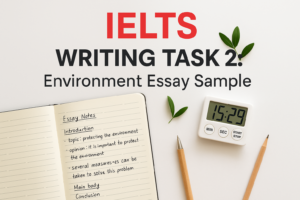
You complete two tasks. In Academic, Task 1 asks you to describe a graph, chart, or diagram in at least 150 words. Task 2 is an essay of at least 250 words on a given topic. In General Training, Task 1 is a letter (formal, semi-formal, or informal) and Task 2 is the same essay format.
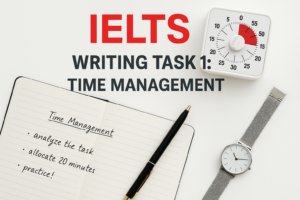
Task 2 carries twice the weight of Task 1 in the final Writing score. Many candidates spend too long on Task 1 and run out of time for the essay. Allocate roughly 20 minutes for Task 1 and 40 minutes for Task 2.
Speaking (11 to 14 minutes)
The Speaking test is a face-to-face interview with an examiner, divided into three parts. Part 1 covers familiar topics like your home, work, or studies. Part 2 gives you a topic card and one minute to prepare a short talk. Part 3 is a deeper discussion related to the Part 2 topic.
The entire interview is recorded. Examiners assess fluency, vocabulary, grammar, and pronunciation. Sounding natural matters more than sounding perfect. Rehearsed answers tend to score lower because they lack the spontaneity examiners are listening for.
How IELTS Exam Scoring Works
Each section is scored on a band scale from 0 to 9, in half-band increments (for example, 6.0, 6.5, 7.0). Your Overall Band Score is the average of the four section scores, rounded to the nearest half band.
Here is a quick reference for what the bands mean:
- Band 9: Expert user. Full command of the language.
- Band 7 to 8: Good to very good user. Handles complex language well with occasional errors.
- Band 5 to 6: Modest to competent user. Manages in most situations but makes noticeable mistakes.
- Band 4 and below: Limited user. Struggles in unfamiliar situations.
Most Australian skilled migration visas require a minimum of Band 6 or 7 across all four sections. Some professional bodies, such as the Nursing and Midwifery Board, require Band 7 in every component with no exceptions.
Computer-Delivered vs Paper-Based: Which Should You Choose?
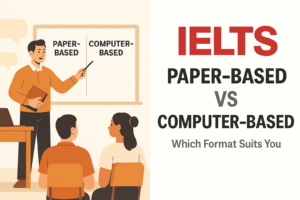
The IELTS English proficiency test is available in both paper and computer-delivered formats. The content and scoring are identical. The difference is practical.
Computer-delivered tests offer more session times and faster results (typically 3 to 5 days instead of 13). Typing the Writing section is easier for most people and allows quick editing. Paper-based tests suit candidates who prefer handwriting or find on-screen reading tiring.
One thing to note: the Listening section plays through headphones in computer-delivered tests, which many candidates find clearer. The Speaking test is always conducted in person regardless of format.
Preparing for the IELTS Exam: A Practical Approach
Effective IELTS preparation does not require expensive courses or months of study. What it does require is consistent, targeted practice. Here is a structured approach that works.
Step 1: Take a Diagnostic Test
Before you start studying, find out where you stand. A diagnostic test gives you a baseline score for each section so you can focus your preparation where it counts. The IELTS Express Pre Test is a quick way to identify your strengths and weaknesses before committing to a full study plan.
Step 2: Focus on Weak Areas
If your Reading score is strong but Writing pulls you down, spend more time on Writing. This sounds obvious, but many candidates practise what they are already good at because it feels more comfortable. Target the skills that will raise your overall band.
Step 3: Practise Under Timed Conditions
Doing practice questions without a timer builds knowledge but not exam readiness. Once you understand the question types, switch to timed practice. The time pressure in Reading and Writing catches unprepared candidates every time.
Step 4: Get Feedback on Writing and Speaking
These two sections are assessed by human examiners using specific criteria. Practising alone only gets you so far. Having a teacher or tutor review your writing and provide targeted feedback accelerates improvement far more than self-study alone.
Step 5: Use Full Practice Tests
In the final two weeks before your test, complete full IELTS mock tests under real conditions. Sit all four sections in one go. This builds stamina and helps you manage your energy across a three-hour test session.
Common Mistakes That Lower IELTS Scores
After working with hundreds of IELTS candidates, certain patterns come up repeatedly. Avoiding these can add half a band or more to your result.
- Not reading the instructions carefully. The Listening and Reading sections have specific instructions for each question type. Writing “TRUE” when the question asks for “YES” costs marks.
- Running out of time on Writing Task 2. This is the highest-weighted part of the Writing test. Spending 30 minutes on Task 1 leaves you scrambling.
- Memorising Speaking answers. Examiners are trained to spot rehearsed responses. They will redirect you with follow-up questions, and candidates who have memorised scripts often struggle to adapt.
- Ignoring spelling in Listening and Reading. Answers must be spelled correctly. If you write “goverment” instead of “government,” you lose the mark.
- Skipping the review. In computer-delivered tests, you can flag questions and return to them. Use the last few minutes to check flagged answers rather than staring at the clock.
IELTS Exam Costs and Booking in Australia
The standard IELTS test fee in Australia is around AUD $395 (as of early 2026). Prices may vary slightly between test centres. You can book through IDP or the British Council, both of which operate centres across major Australian cities.
Test dates are available most weeks, with computer-delivered sessions running almost daily in Sydney, Melbourne, Brisbane, and Perth. Paper-based tests are typically offered two to four times per month.
Results are valid for two years from the test date. If your visa or university application deadline is approaching, plan your test date with enough buffer for a potential retake.
IELTS vs PTE vs Other English Tests
IELTS is not the only English language assessment accepted in Australia. PTE Academic and the Cambridge C1 Advanced are also recognised for many visa subclasses and university admissions.
PTE Academic is fully computer-based and uses AI scoring, which means faster and more consistent results. Some candidates prefer it for Writing and Speaking because there is no human examiner, which reduces anxiety. Others find the microphone-based Speaking section awkward.
IELTS remains the most widely accepted test globally. If you are applying to institutions or bodies in multiple countries, IELTS gives you the broadest coverage. For Australian migration specifically, both IELTS and PTE are accepted equally by the Department of Home Affairs.
The right choice depends on your test-taking style. If you type quickly and prefer interacting with a screen, PTE may suit you. If you communicate better in conversation and prefer handwriting, IELTS is likely the stronger option. You can explore IELTS preparation resources on the IELTS Preparation: Complete Guide to help you decide on your study approach.
Frequently Asked Questions About the IELTS Exam
How long is the IELTS exam?
The total test time is approximately 2 hours and 45 minutes. Listening takes 30 minutes (plus 10 minutes transfer time for paper-based), Reading takes 60 minutes, Writing takes 60 minutes, and Speaking takes 11 to 14 minutes. The Speaking test may be scheduled on a different day.
How many times can I sit the IELTS exam?
There is no limit. You can retake the test as many times as you need. Each sitting is independent, and your previous results do not affect future scores. IELTS also offers One Skill Retake, which lets you resit a single section rather than the full test.
What score do I need for Australian migration?
It depends on your visa subclass. Most skilled migration visas require a minimum of Band 6 in each component for “competent English.” Higher scores (Band 7 or 8) earn additional points under the points-based system. Check the Department of Home Affairs website for your specific visa requirements.
Can I use a pen or pencil on the paper-based test?
You must use a pencil for the Listening and Reading answer sheets. For Writing, you can use either a pen or pencil, but pencil is recommended because it allows easier corrections.
When do I receive my IELTS results?
Computer-delivered test results are typically available online within 3 to 5 days. Paper-based results take approximately 13 calendar days. You can view your results through the IDP or British Council website using your test reference number.
Your Next Steps Toward a Strong IELTS Result
The IELTS exam is a straightforward test once you understand its structure and know what the examiners are looking for. The candidates who perform best are not necessarily the ones with the strongest English. They are the ones who prepared specifically for the test format and managed their time well on the day.
Start with a diagnostic assessment to understand your current level. Build a focused study plan that targets your weaker sections. Practise under timed conditions regularly. And give yourself enough time before your test date to make real progress, typically six to eight weeks of consistent preparation.
The score you need is achievable. It just takes the right approach.