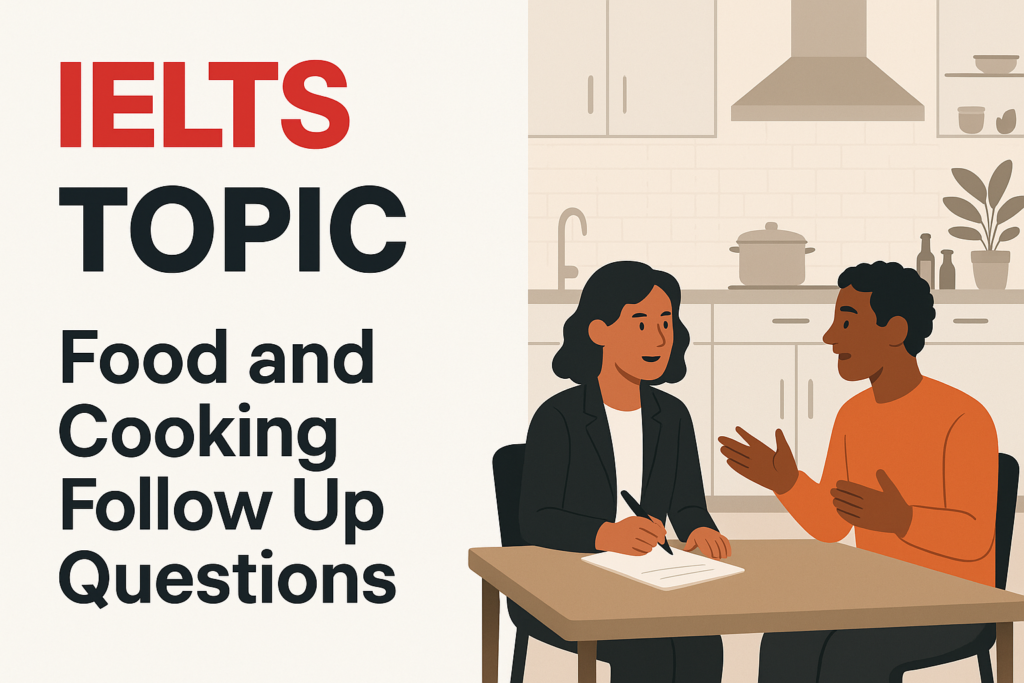
If you are preparing for IELTS Speaking Part 3 food and cooking follow up questions, remember that the examiner is not asking for a meal story. Part 3 is a wider discussion. You may need to explain why people cook and share meals, whether food culture helps families and local communities, how cooking has changed because of technology, or whether global food culture creates problems. Before you practise blindly, take the IELTS Express Pre-Test to check your current band level and get a clearer plan for your speaking improvement.
Food and cooking is a popular IELTS topic because it connects personal experience with society, culture, money, education, work, and the environment. A weak answer stays too simple: “Food and cooking is good because it is fun.” A stronger answer explains a reason, gives a realistic example, and adds a result. You do not need expert knowledge of food culture. You need organised ideas and natural English that can handle follow-up questions.
What food and cooking Questions In Part 3 Are Testing
Part 3 tests your ability to discuss ideas beyond your own life. If Part 2 asks you to describe a cooking class, Part 3 may ask whether people in your country cook more than before, whether modern food culture is always positive, or whether young people learn more from cooking at home than from videos. The topic becomes more abstract, so your answer needs more than a personal memory.
A useful response usually has four parts: a direct answer, a reason, an example, and a result. For example, if the examiner asks whether cooking is important for young people, you can say yes because it helps them understand different ways of living. Then you might mention learning recipes at home or helping family prepare meals. Finally, explain that this can make people more independent and culturally aware.
- Answer the exact question first.
- Move from personal experience to a wider point.
- Use realistic examples, not memorised speeches.
- Finish with a consequence, comparison, or judgement.
For the full test format, read the IELTS Speaking Test complete guide alongside this topic practice.
How To Build A Band 7 food and cooking Answer
A Band 7 style answer is usually clear rather than dramatic. It gives the examiner enough language to assess fluency, vocabulary, grammar, and coherence. The safest pattern is answer, explain, example, extend. This pattern helps you avoid short answers and keeps your response focused.
If the question is “Do you think global food culture is more common now than in the past?”, you might say yes, because cooking videos, recipes, and nutrition advice are easier to access online. Then explain that people can compare prices, compare recipes, watch demonstrations, and learn techniques from their phone. Add an example such as young adults learning quick meals online. Finally, say that cooking knowledge has become a normal part of life for many middle-income people, not only a luxury.
If you want to test this structure under pressure, use unlimited IELTS mock tests and record several Part 3 food and cooking answers in one sitting. You will quickly hear whether your ideas stay organised when the examiner changes the question.
Common IELTS Speaking Part 3 food and cooking Follow Up Questions
Use these questions to practise flexible answers. Do not memorise complete scripts. Prepare useful ideas for each theme so you can adapt naturally in the test.
- Why do people like trying different cuisines?
- Do people in your country cook more now than in the past?
- Is global food culture always a positive experience?
- What are the benefits of learning to cook for young people?
- How has technology changed the way people cook and choose food?
- Does food culture help or harm families and local communities?
- Should governments encourage domestic food culture?
- Is it better to cook alone or with other people?
- Why do some people prefer home-cooked food?
- Could online cooking content replace real cooking experience in the future?
Sample Answer: Why Do People Like Trying Different Foods?
I think people enjoy trying different foods because it gives them a break from normal routines and lets them experience something different. For example, someone who works in a busy city may enjoy visiting a family kitchen or local restaurant because the change of environment helps them relax. Cooking and eating can also be educational because people see different food, architecture, languages, and social habits. So, in my view, food and cooking is not only a daily routine. It can refresh people mentally and also broaden their understanding of culture and health.
This answer works because it does not stop at “food and cooking is enjoyable.” It explains why food and cooking feels valuable and gives examples that are easy to imagine. That is the kind of development Part 3 needs.
Sample Answer: Does Food Culture Help Local Communities?
Food culture can help families and local communities if it is managed well. It creates jobs in restaurants, markets, farms, delivery services, and cooking classes, and it can encourage governments to improve markets, food safety, training, and public facilities. For example, a local area with strong food traditions may benefit when local people and visitors spend money in local businesses. However, food culture can also create problems if food becomes too expensive or traditional dishes are turned into shallow trends. So I would say food culture is positive when local people actually share in the benefits and when the benefits are shared responsibly.
Notice the balanced ending. Many Part 3 questions about food and cooking invite both sides. You can give a clear opinion while still recognising the limits.
Sample Answer: Has Technology Changed food and cooking?
Technology has changed food and cooking in a major way. In the past, people often needed printed cookbooks, family recipes, and cooking schools. Now they can plan meals, check ingredients, check reviews, and learn cooking methods using one phone. This makes food and cooking more independent and convenient. At the same time, technology can make food and cooking less personal because people sometimes plan every detail and focus too much on trends, ratings, and short videos. Overall, I think technology has made food and cooking easier, but it has also changed the way people experience food.
This answer gives a clear view, adds contrast, and avoids extreme language. That is useful for technology questions because one-sided answers often sound too simple.
Vocabulary For food and cooking Discussion
Good vocabulary for this topic should be flexible. You do not need rare words. You need phrases that help you discuss reasons, impacts, comparisons, and changes clearly.
- broaden your horizons: learn more about the world and different ways of life.
- local economy: the businesses and jobs in a particular area.
- cultural exchange: people learning from each other’s customs and lifestyles.
- mass food culture: food habits or dishes becoming popular very quickly.
- effect on health, culture, and the environment: the effect food choices have on health, culture, and nature.
- domestic food culture: cooking and eating within your own country.
- cook independently: cook independently and choose meals without relying on takeaway.
Use vocabulary inside complete ideas. Instead of only saying “cultural exchange”, say: “Global food culture can create cultural exchange because people from different backgrounds learn about each other’s food, behaviour, and values.” Clear sentences score better than impressive phrases used awkwardly.
How To Extend Short food and cooking Answers
If your answer feels too short, add one useful layer. You can compare past and present, mention young people and older people, explain a benefit, describe a problem, or give a simple example. Food and cooking questions are easy to extend because they connect to time, money, technology, education, work, and the environment.
For example, if you say food culture creates jobs, extend the answer by explaining which jobs. Then add a result: more local families may earn stable income. If you say food culture harms the environment, give an example such as food waste, over-packaging, or pressure on small producers. Then explain why this matters for families, small businesses, and local residents.
- Compare home cooking and global food culture.
- Compare cooking at home and eating with family or friends.
- Mention cost, health, time, skill, or access.
- Explain how food and cooking affects health, culture, family life, jobs, or the environment.
If your answers are organised but still sound too basic, the IELTS Speaking Part 3 tips and strategies guide can help you build stronger discussion habits.
Common Mistakes With food and cooking Follow Up Questions
The first mistake is turning every answer into a personal food story. Personal examples are useful, but Part 3 asks for wider discussion. If the examiner asks whether food culture helps society, do not only describe your last meal. Use it briefly as an example, then explain the general point.
The second mistake is giving a list without development. Saying “cooking helps people save money, eat better, connect with family, and learn culture” is not enough. Choose one or two ideas and explain them properly. Development matters more than the number of points.
The third mistake is using extreme claims. Saying food culture is always good or always harmful is usually too simple. A stronger answer often explains that food culture has benefits, but the result depends on cost, planning, health, sustainability, and local control.
- Do not answer only from your personal experience.
- Do not list benefits without explaining them.
- Do not memorise full model answers.
- Do not ignore key words such as young people, government, technology, or environment.
Practice Method For This Topic
Practise in short sets. Choose five food and cooking questions and answer each for about one minute. Record yourself, then listen for three things: whether your first sentence answers the question, whether you gave a reason, and whether you added an example or result. This is more useful than reading many sample answers passively.
You can also group food and cooking questions by theme. One group can focus on food culture and communities. Another can focus on technology and food habits. A third can focus on health, culture, family, and personal development. Grouping questions helps you reuse ideas naturally without sounding memorised.
If you are preparing for a deadline or need structured feedback, review our IELTS preparation plans so your speaking practice is based on feedback, not guesswork.
Ready to find out your IELTS band score?
Take the IELTS Express Pre-Test for just $4.99 and get your personalised band prediction with a 14-day improvement plan.
FAQ: IELTS Speaking Part 3 food and cooking Follow Up Questions
How long should I answer food and cooking questions in Part 3?
Most strong answers are about four to six sentences. That is usually enough to give a direct answer, explain it, and add an example. If the examiner wants more detail, they will ask another follow-up question.
Can I talk about my own food and cooking experience?
Yes, but use personal experience as support for a wider idea. Part 3 is more general than Part 1, so your answer should not become only a story about one meal.
What vocabulary is useful for IELTS food and cooking topics?
Useful phrases include broaden your horizons, local economy, cultural exchange, mass food culture, effect on health, culture, and the environment, domestic food culture, and cook independently. Use them in natural sentences.
Should I give both sides in food and cooking answers?
Often, yes. Food and cooking topics commonly involve benefits and drawbacks. A balanced answer can sound more mature, as long as your final view is still clear.
Can online cooking content be a good IELTS example?
Yes. Recipe videos, online cooking classes, food blogs, and nutrition apps can all be useful examples when the question asks about technology or future food habits.
A Practical Final Takeaway
Food and cooking follow-up questions are familiar, but they still require real development in Part 3. A strong answer starts clearly, explains one main idea, gives a realistic example, and adds a result or comparison. This pattern can turn a short personal answer into a thoughtful discussion.
Your next step is active practice. Choose several questions from this guide, record your answers, and check whether each one moves beyond “cooking is fun.” If you can discuss food culture, technology, culture, money, young people, and the environment with clear examples, you will be much better prepared for the real IELTS Speaking discussion.