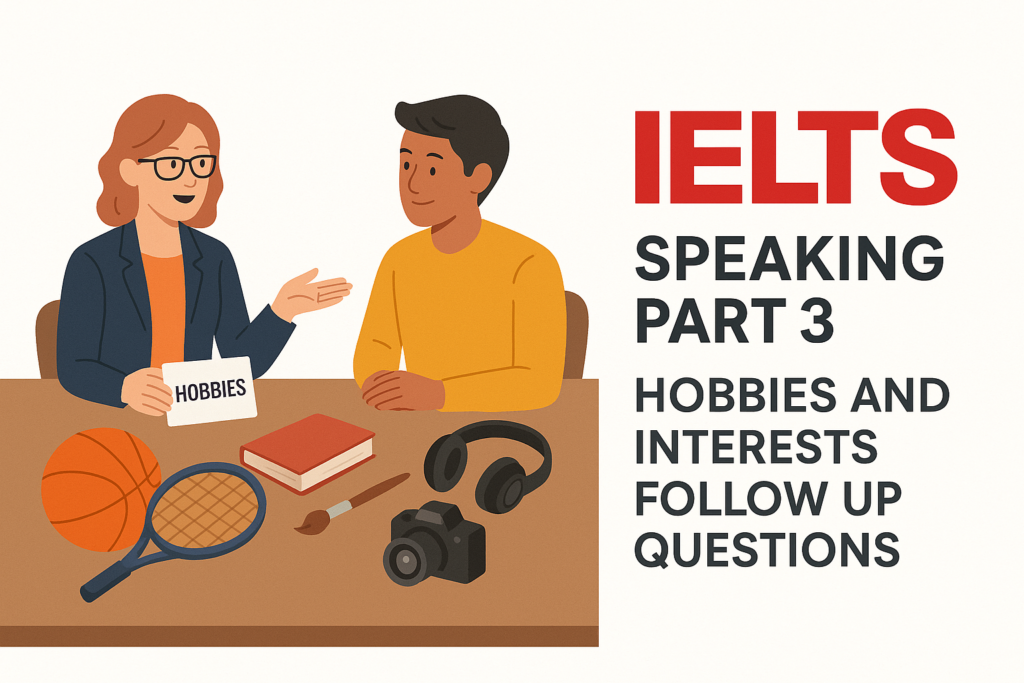
If you are practising IELTS Speaking Part 3 Hobbies And Interests follow up questions, the aim is not to memorise a long speech about your favourite free-time activity. Part 3 asks you to discuss the topic more widely. You may need to explain why people need hobbies, whether children should try different activities, how technology has changed leisure time, or why some interests become popular in society. Before you keep guessing whether your speaking is close to your target score, take the IELTS Express Pre-Test to check your current band level and get a clearer improvement plan.
Hobbies and interests are common because they connect to everyday life but still allow deeper discussion. A weak answer stays personal: “I like football because it is fun.” A stronger Part 3 answer moves from personal preference to reasons, examples, comparisons, and consequences. You do not need expert knowledge. You need organised thinking, natural vocabulary, and enough flexibility to keep speaking when the examiner asks a follow-up question.
What Part 3 Hobbies Questions Are Really Testing
IELTS Speaking Part 3 is a discussion. The examiner is listening for your ability to explain ideas beyond your own routine. If Part 2 asks you to describe a hobby, Part 3 may ask whether hobbies are important for mental health, whether young people have enough free time, or whether expensive hobbies are a problem. The topic becomes more abstract, so your answer needs more than a simple description.
A useful answer usually includes a direct view, one clear reason, a realistic example, and a short result. For example, if the examiner asks whether people should have hobbies, you can say yes, because hobbies give people a break from work or study. Then you might mention sport, music, reading, or gardening as examples. Finally, explain that this can reduce stress and make people more balanced.
- Answer the question directly before adding detail.
- Move from personal experience to a wider point.
- Use realistic examples rather than memorised stories.
- Finish with a consequence, comparison, or judgement.
If you want the wider speaking framework, read the IELTS Speaking Test complete guide alongside this topic practice.
How To Structure A Band 7 Hobbies Answer
A Band 7 style answer does not need to be dramatic. It needs to be developed. Many candidates give a correct first sentence, then stop too early. The safer structure is: answer, explain, example, extend. This gives the examiner enough language to assess fluency, vocabulary, grammar, and coherence.
For example, if the question is “Do you think hobbies are more important now than in the past?”, you could answer that they may be more important now because modern life is often mentally demanding. Then explain that many people spend long hours working or studying in front of screens. Add an example about someone using sport or music to disconnect from pressure. Finally, say that hobbies are not just entertainment; they can protect people’s wellbeing.
If you want to test whether this answer shape works under real timing, use unlimited IELTS mock tests and record several Part 3 answers in one sitting. You will quickly hear whether your structure stays clear when the questions change.
Common IELTS Speaking Part 3 Hobbies And Interests Follow Up Questions
Use these questions to practise flexible answers. Do not memorise complete responses. Instead, prepare two or three useful ideas for each theme so you can adapt naturally in the test.
- Why are hobbies important for people?
- Do children and adults usually enjoy different hobbies?
- Should parents encourage children to try many activities?
- Are some hobbies too expensive for ordinary people?
- How has technology changed the way people spend free time?
- Do people in your country have enough time for hobbies?
- Is it better to have an active hobby or a relaxing hobby?
- Why do some hobbies become fashionable?
- Can hobbies help people make friends?
- Should schools give students more time for creative activities?
Sample Answer: Why Are Hobbies Important?
I think hobbies are important because they give people a healthy break from their normal responsibilities. Many people spend most of the day working, studying, or dealing with family duties, so a hobby gives them a different kind of focus. For example, someone who plays sport after work may feel less stressed and more energetic, while someone who paints or plays music may feel more creative. Hobbies also help people build confidence because they can improve at something without the pressure of exams or deadlines. So, in my view, hobbies are not just a way to pass time. They can make daily life more balanced.
This answer works because it starts clearly, gives several examples, and explains why the examples matter. It also avoids sounding memorised. The language is natural, but the ideas are still developed enough for Part 3.
Sample Answer: Do Children Need Different Hobbies From Adults?
In many cases, yes, because children usually need hobbies that help them explore, move, and learn social skills. Activities such as team sports, drawing, dance, or simple music lessons can help them discover what they enjoy and how to cooperate with others. Adults may prefer hobbies that help them relax or manage stress, such as reading, gardening, gym training, or cooking. However, I do not think the difference is absolute. Some hobbies, like swimming or photography, can suit almost any age. The main point is that the activity should match the person’s needs, not just their age.
Notice the balanced ending. Part 3 often rewards answers that avoid extreme claims. You can say there is a difference, but still recognise exceptions.
Sample Answer: Has Technology Changed People’s Hobbies?
Technology has changed hobbies in a major way. On the positive side, it has made many interests easier to access. People can learn guitar from online videos, join fitness classes remotely, or share photography with a large audience. This can motivate people because they can see progress and connect with others who enjoy the same thing. On the negative side, technology can also make free time more passive. Some people spend hours scrolling or watching short videos instead of doing something active or creative. So I would say technology has expanded people’s choices, but it has also made self-discipline more important.
This answer gives both sides without becoming confused. That is useful for questions about technology, because a one-sided answer can sound too simple.
Vocabulary For Hobbies And Interests Discussion
Good vocabulary for this topic should be flexible. You do not need rare words. You need phrases that let you discuss leisure time, motivation, wellbeing, creativity, social life, and modern habits clearly.
- free-time activity: something people do outside work or study.
- mental wellbeing: a person’s emotional and psychological health.
- creative outlet: an activity that lets someone express ideas or feelings.
- social connection: contact and friendship with other people.
- screen-based entertainment: leisure activities that involve phones, computers, or television.
- work-life balance: the ability to manage work and personal life in a healthy way.
- personal development: improvement in skills, confidence, or discipline.
Use vocabulary inside complete ideas. Instead of only saying “mental wellbeing”, say: “Hobbies can support mental wellbeing because they give people a break from pressure and routine.” Clear sentences are more useful than impressive words that do not fit.
How To Extend Short Answers Naturally
If your Part 3 answers are too short, do not panic. Add one useful layer. You can give a reason, compare two groups, mention an example, or explain the result. Hobbies questions are especially good for this because they connect to age, lifestyle, money, education, technology, and health.
For example, if you say children should try different hobbies, extend the answer by explaining that this helps them discover their strengths. Then add an example: a child may not know they enjoy music, sport, or art until they try it. Finally, add a result: this can improve confidence and social skills. The answer becomes stronger without needing complicated vocabulary.
- Compare children and adults.
- Compare active hobbies and relaxing hobbies.
- Mention money, access, or time as a limitation.
- Explain how a hobby affects health, confidence, or friendships.
If your answers are organised but still feel too simple, the IELTS Speaking Part 3 tips and strategies guide can help you build stronger discussion habits.
Common Mistakes With Hobbies Follow Up Questions
The first mistake is staying in Part 1 mode. Part 1 is often personal and simple. Part 3 needs wider discussion. If the examiner asks whether hobbies are important for society, do not only say what you personally enjoy. Use your experience as an example, then move to a broader point.
The second mistake is listing too many hobbies without explaining any of them. A list such as football, reading, music, cooking, and gaming does not develop an answer. Choose one or two examples and explain why they matter.
The third mistake is using extreme language. Saying that technology has destroyed all hobbies or that expensive hobbies are always unfair is too strong unless you support it carefully. A more natural answer usually recognises both sides.
- Do not answer only with your favourite hobby.
- Do not list activities without explanation.
- Do not memorise full answers that may not match the question.
- Do not ignore words such as children, adults, society, or technology in the question.
Practice Method For This Topic
Practise in short sets. Choose five questions and answer each for about one minute. Record yourself, then listen for three things: whether your first sentence answers the question, whether you gave a reason, and whether you added an example or result. This is more useful than reading twenty sample answers passively.
You can also group questions by theme. One group can focus on children and education. Another can focus on adults and work-life balance. A third can focus on technology and modern leisure. Grouping questions helps you reuse ideas naturally without memorising whole scripts.
If you are preparing for a deadline or need structured feedback, review our IELTS preparation plans so your speaking practice is not just guesswork.
Ready to find out your IELTS band score?
Take the IELTS Express Pre-Test for just $4.99 and get your personalised band prediction with a 14-day improvement plan.
FAQ: IELTS Speaking Part 3 Hobbies And Interests Follow Up Questions
How long should I answer hobbies and interests Part 3 questions?
Most strong answers are about four to six sentences. That is usually enough to give a clear opinion, explain it, and add an example. If the examiner wants more detail, they will ask another question.
Can I use personal examples in IELTS Speaking Part 3?
Yes, but use them carefully. Part 3 is broader than Part 1, so a personal example should support a wider idea rather than replace it.
What vocabulary is useful for hobbies and interests?
Useful phrases include work-life balance, creative outlet, mental wellbeing, social connection, free-time activity, screen-based entertainment, and personal development. Use them in natural sentences.
Are technology hobbies good examples in IELTS Speaking?
Yes. Online learning, photography, gaming, fitness apps, and video editing can all be useful examples. Just make sure you explain the effect, not only the activity.
Should I memorise model answers for this topic?
No. Memorised answers often sound unnatural and may not fit the exact question. Learn answer shapes, useful vocabulary, and flexible examples instead.
A Practical Final Takeaway
Hobbies and interests questions are familiar, but they still need real development in Part 3. A strong answer starts clearly, explains one main idea, gives a realistic example, and adds a result or comparison. That simple pattern can lift your answer from short and personal to thoughtful and examiner-ready.
Your next step should be active practice. Choose several questions from this guide, record your answers, and check whether each one moves beyond “I like this because it is fun.” If you can explain why hobbies matter for people, children, adults, technology, health, and society, you will be much better prepared for the real discussion.