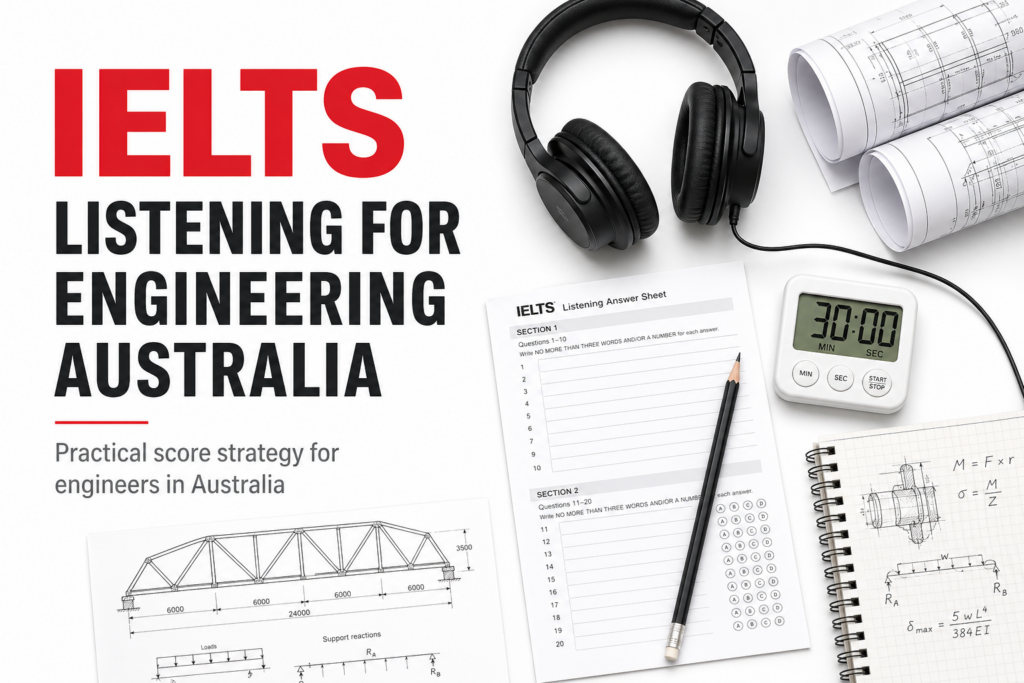
If you are searching for IELTS Listening for Engineering Australia, you probably do not need another vague reminder to “practise more”. You need a score strategy that fits the pressure engineers face when one section can delay registration, migration, or a job plan. Before you keep guessing whether Listening is already safe enough, take the IELTS Express Pre-Test to get a clearer sense of your current band and where your biggest risk sits.
For many engineers, Listening feels deceptively simple. The recordings sound manageable at first, but the marks disappear through small errors: a missed number, the wrong plural ending, a late correction from the speaker, or a moment of panic when an unfamiliar accent appears. That is why this section deserves a practical, system-based approach rather than casual repetition.
What IELTS Listening means for engineers in Australia
IELTS Listening matters because engineering pathways often depend on overall English competence, not just technical ability. Depending on your registration body, employer, visa pathway, or skills assessment route, your required English result may need to be strong across all four sections rather than rescued by one high score elsewhere.
That changes how you should think about preparation. If Listening is your strongest section, it can protect your overall result. If it is unstable, it can quietly become the section that keeps your file moving in circles. Engineers usually understand systems, margins, and failure points. Treat Listening the same way. The target is not “good enough most days”. The target is a repeatable result under timed pressure.
If you also need the wider pathway context, this IELTS for Engineering Australia complete guide helps explain how English results fit into the broader process.
Why engineers often lose marks in Listening even when their English is decent
A lot of engineers read technical material well and communicate effectively at work, yet still drop marks in IELTS Listening. The problem is usually not raw intelligence or even general language level. The problem is task behaviour.
Listening in IELTS rewards fast attention control. You have to predict what kind of answer is coming, follow signpost language, catch corrections, and write accurately while the recording keeps moving. Engineers who are used to careful review can find this frustrating because the test does not let you pause, rewind, or calmly inspect one sentence again.
Another issue is overconfidence with familiar topics. A candidate may think, “I understood the main idea,” but Listening questions are not marking the main idea alone. They are marking exact detail. One word can change the answer completely. A date instead of a day, a floor number instead of a room number, or a singular noun instead of a plural can cost the mark.
How the four Listening sections affect your score strategy
Engineers do better when they stop treating all four sections as one blur. Each section has a different rhythm. Section 1 usually feels more straightforward, but it punishes carelessness with names, numbers, addresses, and spelled information. Section 2 often sounds simple but hides traps in maps, directions, and changed plans. Sections 3 and 4 require more academic stamina, especially when speakers qualify ideas or move quickly between examples and conclusions.
Your preparation should reflect that difference. If you always score well early and collapse later, the issue is not general Listening weakness. It is a late-section control problem. If you miss easy details in Section 1, the issue may be answer-form accuracy, not comprehension. Once you label the pattern correctly, improvement becomes much faster.
A full IELTS Listening practice guide can help if you need broader section-by-section review alongside this engineering-specific approach.
IELTS Listening for Engineering Australia requires accuracy, not heroic guessing
When engineers are under time pressure, many fall into a dangerous habit: they infer an answer that sounds logical rather than writing the answer that was actually said. In normal professional life, inference is useful. In IELTS Listening, it can be a mark-killer.
For example, if a speaker says a workshop first started in Melbourne but is now held in Brisbane, many candidates still write Melbourne because they caught the first city and relaxed too early. IELTS does this constantly. The correct answer often arrives after the speaker revises, narrows, or contrasts an earlier point.
The fix is simple but not glamorous. Listen for change words such as actually, however, instead, the final choice was, we decided on, or it used to be. Those words tell you the answer may be moving. If your score is still inconsistent, it helps to access unlimited IELTS mock tests and review exactly where those late corrections caught you.
The most common Listening traps for engineering candidates
Some mistakes appear so often that they deserve blunt attention.
- Numbers and units: 15 and 50, 13 and 30, or metres and millimetres can blur when the recording moves quickly.
- Plural endings: writing tool instead of tools can lose the mark even when the idea is correct.
- Spelling errors: a near-miss spelling still counts as wrong if the answer is not accepted.
- Map and direction tasks: candidates understand the language but lose track of orientation halfway through.
- Distractor details: the speaker mentions one option, rejects it, then gives the real answer.
- Academic fatigue in Section 4: concentration slips because there is only one speaker and no pauses for rescue.
None of these problems are dramatic, but together they explain why a candidate who feels “pretty good at listening” can still miss the required band. Engineers usually improve fastest when they identify which trap type appears most often in their own papers and attack that first.
A practical note-taking method that works during the recording
You do not need elaborate shorthand. You need fast, readable note behaviour. During the short preview time before each section, scan the question set and predict the answer type. Is it likely to be a number, a place, a piece of equipment, a date, or an adjective? That quick prediction narrows your attention.
Then, while listening, keep your eye one question ahead when possible. If you stay frozen on the answer you just missed, the next answer usually disappears as well. This is where calm matters. One lost item does not justify losing three more.
A useful approach is:
- underline key nouns in the question before the recording starts
- circle instruction limits such as ONE WORD ONLY or NO MORE THAN TWO WORDS AND/OR A NUMBER
- write lightly first if you are unsure, then confirm during the remaining seconds before the next part
- move on immediately if a question is gone
This sounds basic, but strong Listening scores are often built on disciplined basics rather than fancy tricks.
How to train for Australian and international accents without overcomplicating it
Engineering candidates sometimes worry too much about accent variety. Accent exposure matters, but it should be targeted. IELTS may include Australian, British, New Zealand, or other standard English accents. The goal is not to master every accent in the world. The goal is to stay functional when pronunciation shifts slightly away from what you hear every day.
The smartest method is to use real IELTS-style recordings first, then supplement with short accent exposure from reliable English sources. Do not replace IELTS practice with random podcasts that have no question discipline. That often feels productive but does not build exam control.
If accent variation is a real weakness, spend part of each week transcribing thirty to sixty seconds of audio. This forces you to notice connected speech, dropped sounds, and number pronunciation. For engineers, that kind of deliberate practice is usually more effective than simply “listening more” in the background.
How many correct answers engineers usually need and why consistency matters more than one lucky test
Your exact target score depends on your required band, and those requirements can vary by pathway, so always confirm the current standard with the relevant authority. What matters for preparation is this: you should know your safe range, not just your best-ever result.
If your practice scores swing wildly, you do not yet have control. One paper at a high band does not mean Listening is solved. Engineers should think in terms of repeatability. Can you hit your target across multiple recent tests, including days when concentration is not perfect? If not, the section is still a risk variable.
This is why full-timed review matters. Use a small score log. Track raw marks, section drops, spelling losses, and instruction errors. Patterns show up quickly when you stop treating each paper as a separate emotional event.
A two-week Listening improvement plan for engineering candidates
If your test date is close, do not try to consume endless materials. Use a short cycle that combines timed practice, error review, and focused repair.
- Day 1: full Listening test under strict timing, then mark every wrong answer by trap type.
- Day 2: replay only the missed items, read the transcript, and note the exact clue that beat you.
- Day 3: do one Section 1 and one Section 2 set focusing on accuracy with forms, numbers, and spellings.
- Day 4: do one Section 3 or 4 set focusing on stamina and note prediction.
- Day 5: short dictation or transcription session for accent control.
- Day 6: second full test and compare with Day 1.
- Day 7: lighter review, correction log, and one focused weakness drill.
Then repeat the cycle with updated weaknesses. If your broader preparation still feels scattered, you can see our IELTS preparation plans and choose a more structured path rather than patching gaps at random.
When Listening is not your only weak section
Some engineers make the mistake of chasing Listening in isolation when the real issue is the full score profile. If Reading is also unstable, or if Writing is pulling down the overall result, your study plan needs balance. Listening can improve relatively quickly, but not if it takes all the time from sections that are in worse shape.
The better approach is to rank sections by risk. Which one is most likely to miss the required threshold? Which one can improve fastest with structured work? Where are you already stable enough that maintenance is enough? That kind of triage prevents the classic pre-test panic routine of doing whatever feels urgent on the day.
Ready to find out your IELTS band score?
Take the IELTS Express Pre-Test for just $4.99 and get your personalised band prediction with a 14-day improvement plan.
FAQ: IELTS Listening for Engineering Australia
Is IELTS Listening harder for engineers than for other candidates?
Not necessarily, but engineers often feel the pressure differently because English scores can affect registration, migration, or employment timelines. The section itself is the same, but the margin for error can feel smaller.
What is the biggest reason engineers lose marks in IELTS Listening?
The most common reason is not poor English. It is losing control of detail. Candidates hear the topic, assume the answer, and miss the corrected or more specific information that appears a moment later.
Should I focus more on Section 4 if I need a higher band?
You should focus on the section where your score drops most often. For many candidates that is Section 4 because concentration and note tracking become harder there, but some engineers actually lose more easy marks in Section 1 through spelling and number mistakes.
How can I improve IELTS Listening for Engineering Australia quickly?
The fastest safe improvement usually comes from reviewing mistakes by pattern, especially spelling, plurals, numbers, and distractors. Timed practice helps, but review is what turns effort into score protection.
Do I need engineering vocabulary for IELTS Listening?
No specialised engineering vocabulary list is required for the test. What matters more is accurate listening to common English used in forms, discussions, instructions, and academic explanations.
Your next move if Listening still feels unstable
IELTS Listening for Engineering Australia is usually won through control, not brilliance. Build a repeatable method, track your error patterns honestly, and treat detail mistakes as technical faults that can be fixed. Once Listening becomes consistent instead of hopeful, the whole exam plan gets calmer.
If you are close to your target, do not waste that position with casual practice. Test, review, correct, repeat. That is the boring part, and it is also the part that works.