If you are looking for an IELTS Speaking Part 2 Health And Fitness cue card sample, you probably do not want a robotic script that falls apart the moment the examiner asks a different follow-up. You want a natural answer, a simple structure, and enough language support to speak for the full two minutes without sounding forced. Before you guess where your speaking score stands, take the IELTS Express Pre-Test to get a clearer idea of your current band and what needs work.
In simple terms, a strong health and fitness cue card answer should sound personal, organised, and easy to follow. The examiner is not testing whether you are a fitness expert. The examiner is testing whether you can speak fluently, develop ideas clearly, and use vocabulary with control.
What this health and fitness cue card is really testing
Many candidates see a topic like health and fitness and panic because they think they need technical language about nutrition, exercise science, or medicine. That is not the real challenge. In IELTS Speaking Part 2, the topic is only a vehicle. Your score comes from fluency and coherence, lexical resource, grammar range and accuracy, and pronunciation.
That means a simple, believable story often works better than an overcomplicated answer. You might describe a time you joined a gym, started walking every morning, played a sport with friends, or changed your routine after a health scare. The key is to choose one idea you can explain comfortably. If you need a broader view of how this task fits into the full test, this IELTS Speaking Part 2 and Part 3 framework is a useful companion.
A common IELTS Speaking Part 2 Health And Fitness cue card prompt
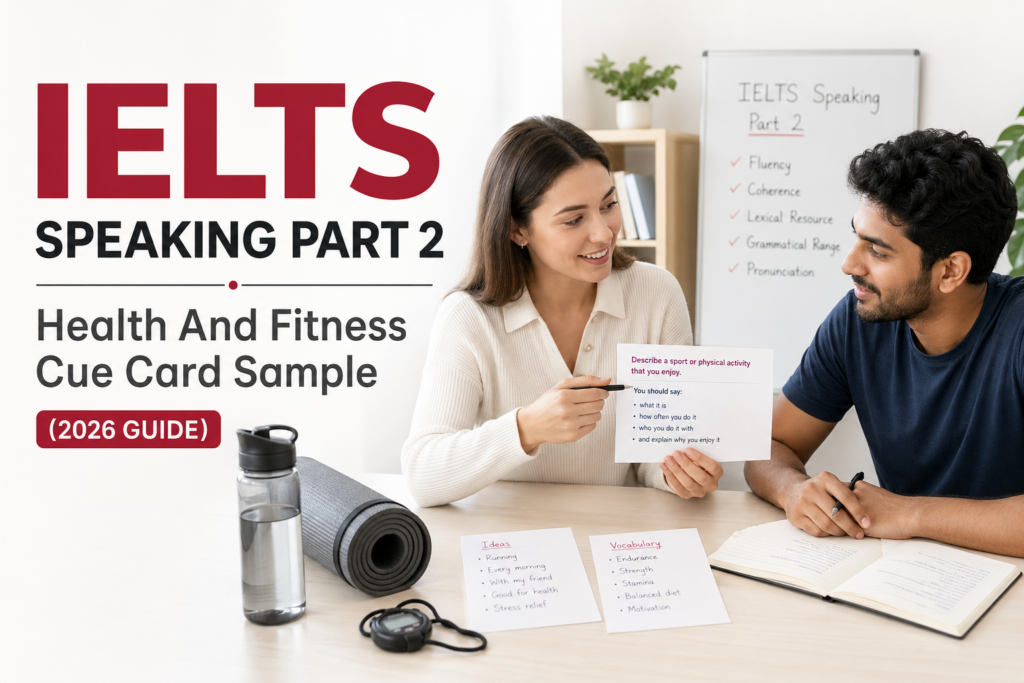
A typical cue card might say:
- Describe something you do to stay healthy or fit.
- You should say what it is.
- When you started doing it.
- Who you do it with, if anyone.
- And explain why it is important to you.
This type of prompt is manageable because it gives you a clear path. You do not need to invent a dramatic story. You only need one routine, one event, or one habit that you can describe with enough detail to keep speaking naturally.
Band-focused cue card sample answer
Here is a natural sample answer:
One thing I do to stay healthy is going for a brisk walk in the evening, usually for about forty minutes. I started doing this around two years ago when I realised I was spending too much time sitting at my desk and feeling tired most of the day.
At first, I only wanted some light exercise, so I chose walking because it was simple and did not require any expensive equipment. Over time, it became part of my routine. I normally go to a park near my home, and sometimes one of my friends joins me, but most of the time I walk alone because I enjoy the quiet time.
What I like about it is that it helps me in several ways. Physically, I feel more active and less stiff, especially after a long day of work or study. Mentally, it helps me clear my head and reduce stress. I have noticed that I sleep better on the days when I walk, and I also feel more focused the next morning.
I think it is important to me because it is one of the few healthy habits that I can maintain consistently. Some people start intense fitness programmes and stop after a few weeks, but walking feels realistic and sustainable for me. It may seem like a small habit, but it has made a big difference to my energy level and overall well-being.
This sample works because it is personal, easy to follow, and filled with specific detail. It does not sound memorised. It gives the examiner a clear timeline, a reason for starting, a description of the routine, and a thoughtful explanation of why it matters.
Why this sample answer works
The answer works well because it follows a simple speaking pattern. First, it introduces the habit clearly. Next, it explains when it started and why. Then it adds supporting detail about where, how often, and with whom the speaker does it. Finally, it explains the benefits and personal significance.
This structure helps fluency because you are not searching for your next idea every few seconds. You are simply moving through a sequence. That is often the difference between a smooth Part 2 answer and one that becomes repetitive after thirty seconds.
How to build your own answer without memorising
The safest approach is to prepare a framework, not a script. If you memorise full sentences, your delivery can sound stiff, and it becomes harder to adapt when the prompt changes slightly. A better method is to prepare short idea blocks.
For a health and fitness topic, your idea blocks could be:
- the activity or habit
- when and why you started
- where or how often you do it
- the physical and mental benefits
- why it matters in your life now
When you think in blocks, you sound more natural because you are speaking from meaning rather than reciting a memorised paragraph. That flexibility also helps when the examiner gives you one minute to prepare notes. You can quickly write one or two words under each block and use that as your roadmap.
Useful vocabulary for a health and fitness cue card
You do not need fancy language, but a few topic-relevant phrases can make your answer more precise. Try vocabulary like stay active, build stamina, improve my energy levels, relieve stress, maintain a routine, develop a healthy habit, and feel more refreshed.
You can also use natural linking phrases such as at first, over time, as a result, what I like most is, and the main reason is that. These small phrases help your answer move forward smoothly. They are often more valuable than one advanced word that you cannot control properly. If you are still building fluency for real test conditions, it can help to access unlimited IELTS mock tests so you can practise long-turn timing with feedback.
How to speak for the full two minutes
One of the biggest problems in Part 2 is finishing too early. Many candidates answer the bullet points, stop after fifty seconds, and feel the silence immediately. The solution is not to speak faster. The solution is to add safe detail.
For example, if you say you go jogging, you can extend the answer by explaining:
- why you chose jogging instead of another activity
- how often you do it
- how you felt when you first started
- what changed after a few months
- why you think you will continue doing it
That kind of expansion sounds natural because it stays connected to the main idea. In contrast, weak answers often repeat the same point using slightly different words.
Common mistakes with this topic
A common mistake is choosing an activity you cannot describe. Some candidates say they love yoga, swimming, or weight training, but then they do not have enough vocabulary or personal experience to continue naturally. Choose something simple and real, even if it seems ordinary. Walking, cycling, stretching, home workouts, and weekend sport can all work well.
Another mistake is becoming too general. Saying exercise is good for health is true, but it is not enough. The examiner needs detail. Explain when you started, what problem it solved, how often you do it, and what changed in your daily life.
A third mistake is forcing high-level vocabulary. If you try to use words you do not fully understand, the answer can become awkward. Clear language with good control usually scores better than ambitious language with visible errors.
How this topic can lead into Part 3
After your long turn, the examiner may ask broader questions about public health, lifestyle change, exercise habits, or whether modern life makes people less active. That is why this cue card is useful practice. It starts with a personal answer, but it can lead into wider discussion.
To prepare well, practise moving from your own experience to general ideas. For example, after describing your walking routine, you could discuss why city life reduces physical activity, why people struggle to keep healthy habits, or whether schools should do more to teach fitness. That transition matters because strong candidates adjust smoothly when the conversation becomes more abstract.
A simple note plan you can use in the exam
During your one-minute preparation time, do not try to write full sentences. Use a short note plan like this:
- activity: evening walk
- started: two years ago, too much sitting
- where: local park
- with who: sometimes friend, usually alone
- benefits: less stress, better sleep, more energy
- why important: easy to maintain
These notes are enough to guide a strong answer. They keep you organised without trapping you in memorised wording. That balance is exactly what you want in IELTS Speaking Part 2.
Ready to find out your IELTS band score?
Take the IELTS Express Pre-Test for just $4.99 and get your personalised band prediction with a 14-day improvement plan.
FAQ: IELTS Speaking Part 2 Health And Fitness cue card sample
Do I need to use advanced fitness vocabulary to get a high band?
No. You only need vocabulary you can use accurately. Simple phrases such as stay active, feel more energetic, and reduce stress are often enough when they are used naturally and supported with clear detail.
What if I do not have a real health or fitness routine?
You can still choose a small, believable habit, such as walking, stretching, or playing badminton with friends. The answer does not need to be impressive. It needs to sound natural and well organised.
How long should my sample answer be?
Your goal is to speak for close to two minutes. In practice, that usually means giving a clear main idea, adding several supporting details, and ending with why the activity matters to you personally.
Can I talk about mental health benefits as well as physical fitness?
Yes. In fact, that often improves the answer because it adds depth. You can explain that the activity helps you sleep better, feel calmer, or concentrate more easily.
Is it okay to adapt this IELTS Speaking Part 2 Health And Fitness cue card sample?
Yes, and you should. Use it as a model for structure and language, but replace the details with your own experience so the answer sounds authentic on test day.
Final thoughts on preparing this cue card
The best way to prepare for a health and fitness topic is to keep it simple. Pick one real habit, organise it into clear idea blocks, and practise speaking with enough detail to reach the full two minutes. Do not chase perfection. Chase clarity, control, and a steady pace.
If you can describe one realistic activity and explain why it matters to you, you already have the core of a strong Part 2 response. From there, practise timing, improve your vocabulary gradually, and keep your delivery natural. That is the kind of preparation that usually leads to a more confident performance on test day.