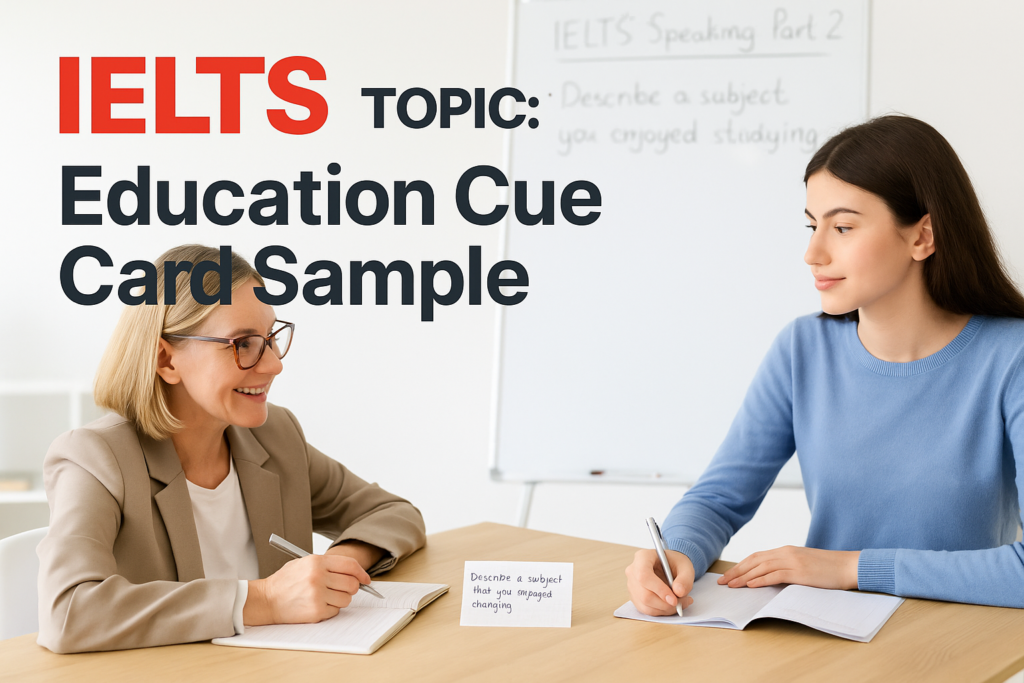
If you are looking for an IELTS Speaking Part 2 Education cue card sample, you probably want more than a memorised answer. You want to hear what a clear two-minute response sounds like, why it works, and how to build one yourself under pressure. Education is a common IELTS topic because it connects to school, teachers, learning habits, future plans, and social change. Before you assume your speaking level is already close to your target, take the IELTS Express Pre-Test to get a quick band prediction and a clearer starting point.
In simple terms, a strong education cue card answer should be personal, organised, and easy to follow. You do not need academic theory. You need one clear idea, supporting detail, and natural language that you can control for the full long turn.
What this education cue card is really testing
When the examiner gives you an education topic, the real test is not your opinion about schools or universities. The examiner is listening for fluency, coherence, vocabulary, grammar control, and pronunciation. The topic is only the vehicle. Your speaking control is what earns the band score.
This matters because many candidates overcomplicate education topics. They start talking like they are writing an essay, and the answer becomes stiff. Part 2 works better when you speak like a real person describing an experience, a teacher, a subject, or a learning moment that mattered to you.
If you need a wider view of how this task fits into the full interview, this IELTS Speaking Test complete guide gives useful context on scoring and question flow.
A common IELTS Speaking Part 2 education cue card prompt
A typical prompt might say:
- Describe a time when you learned something important.
- You should say what you learned, where you learned it, who helped you learn it, and explain why it was important to you.
Another version might ask you to describe a teacher, a useful lesson, a course, or a subject you enjoyed studying. The good news is that the same speaking method works across all of these. Choose one education-related experience that is easy for you to describe and expand.
The safest option is usually a real memory. It does not need to be dramatic. A calm, believable story is much easier to deliver well than an impressive story you barely know how to explain.
IELTS Speaking Part 2 education cue card sample answer
Here is a natural sample answer:
“I would like to talk about a time when I learned how to study more effectively, which was one of the most useful lessons I received during my final year of school. Before that, I used to spend many hours reading my notes again and again, but I often forgot the information quickly and felt stressed before exams.
I learned this new approach in a study skills session organised by one of my teachers. She explained that effective learning was not only about spending more time with books. It was also about using the right methods, such as active recall, short review sessions, and regular practice tests. At first, I was a bit doubtful because the method seemed too simple, but I decided to try it.
Over the next few weeks, I changed the way I studied. Instead of only reading, I started testing myself, making short summary notes, and reviewing the same material over several days. I noticed that I could remember information more clearly and I felt much calmer before assessments.
This lesson was important to me because it changed my attitude towards education. I realised that learning is not only about hard work. It is also about using smart strategies. Even now, I still use that approach when I prepare for exams or learn a new skill, so it had a long-term effect on me.”
That sample works because it is specific, organised, and easy to picture. It also gives the examiner enough language to assess fluency and grammar without sounding memorised.
Why this sample answer works well
A good IELTS Speaking Part 2 Education cue card sample usually does four things well. First, it answers every bullet point on the card. Second, it stays focused on one main experience. Third, it adds enough detail to fill the time naturally. Fourth, it includes a clear reason why the experience mattered.
Notice that the answer does not try to sound too formal. The vocabulary is useful but controlled. The speaker moves from background, to what happened, to why it mattered. That simple structure is exactly what many candidates need.
If you want to practise this under realistic pressure, record several Part 2 responses in one sitting and check whether your structure still holds up when you are tired or short on ideas.
A simple structure you can reuse for education topics
If you want to build your own answer, use this sequence:
- Opening: say what lesson, course, teacher, or educational experience you will describe
- Background: explain when and where it happened
- Main detail: describe what you learned or what happened
- Support: mention who helped you, what method was used, or what made the experience memorable
- Importance: explain why it mattered and what changed afterwards
This structure helps because it gives you a path. You do not need to invent a perfect speech. You only need to keep moving through the next part of the answer.
If your preparation still feels scattered, you can see our IELTS preparation plans and choose a more structured path instead of relying on random speaking practice.
Best education ideas to choose on test day
Some education topics are much easier to describe than others. Choose something familiar that gives you enough detail. Good options include:
- a teacher who changed the way you learned
- a subject that became easier after one useful lesson
- a study method that improved your results
- a course or workshop that taught you a practical skill
- a time when a class discussion changed your opinion
- a lesson from school, university, or online study that still helps you now
Try to avoid topics that are too broad, such as describing the whole education system in your country. Part 2 is easier when the answer is anchored in one event or one person. A small, clear story usually sounds stronger than a huge, abstract one.
Useful vocabulary for an education cue card
You do not need rare words. You need words that are accurate and easy to use while speaking. Helpful phrases include:
- study habits
- practical skill
- learning environment
- clear explanation
- build confidence
- improve my understanding
- helped me stay organised
- made a lasting impression on me
- changed the way I approached learning
The key is to use these naturally. It is much better to use one or two good phrases well than to force advanced vocabulary that sounds unnatural.
Common mistakes candidates make with education topics
The first mistake is becoming too general. Some candidates say education is important for success, but they never describe one real experience. That makes the answer thin and hard to follow.
The second mistake is trying to sound like an essay. Part 2 should sound organised, but it should still sound spoken. If every sentence feels too formal, the answer can become stiff.
The third mistake is ignoring the final bullet point. The card often asks why something was important. That part matters because it gives you a chance to add reflection, emotion, and consequence. Without it, the answer may feel unfinished.
The fourth mistake is running out of detail after thirty or forty seconds. That usually happens because the topic choice is too vague. A single clear memory gives you more material than a general opinion ever will.
How to use your one-minute preparation time well
In the one-minute planning stage, do not write full sentences. That usually wastes time. Instead, write five quick notes:
- what the lesson or experience was
- where it happened
- who was involved
- what you learned
- why it still matters
Those short notes are enough to keep you speaking for up to two minutes. The goal is not to memorise exact wording. The goal is to create a simple path so you do not freeze halfway through.
A useful trick is to think in scenes. Picture the classroom, the teacher, the moment of confusion, and the moment of understanding. Once the memory feels concrete, the language usually becomes easier too.
How to extend the answer if you finish too early
Many candidates have a decent answer but stop too soon. If that happens, add one more layer. You can mention what you thought before the experience, what changed afterwards, how the lesson affected your confidence, or how you still use that knowledge now.
For example, if you describe learning a better study method, you can extend by explaining how your exam results improved, how your stress level changed, or how you later shared the same method with a friend. These additions sound natural because they grow from the same story.
The best extensions do not feel like random extra facts. They feel like the next obvious part of the memory. That is why choosing a real example is so useful.
A short practice plan for education cue cards
If education topics feel weak for you, use a simple practice cycle:
- Day 1: choose one real educational experience and make a one-minute note plan
- Day 2: record a two-minute answer and listen for gaps or repetition
- Day 3: repeat the answer with stronger linking and clearer importance
- Day 4: switch to a different education topic but keep the same structure
- Day 5: do one full speaking mock and check whether your timing still feels controlled
This works because you are training the method, not memorising one script. Once the structure feels natural, you can adapt it to teachers, subjects, study skills, classroom memories, and many other education prompts.
Ready to find out your IELTS band score?
Take the IELTS Express Pre-Test for just $4.99 and get your personalised band prediction with a 14-day improvement plan.
Frequently Asked Questions
What is the best topic to choose for an IELTS Speaking Part 2 education cue card?
The best choice is usually a real educational experience that you can describe clearly, such as a helpful teacher, a useful lesson, or a study method that improved your results. Real memories are easier to extend naturally.
Do I need advanced vocabulary for an education cue card?
No. Clear and accurate vocabulary is more important than difficult words. The examiner wants a fluent, organised answer that sounds natural, not a formal lecture about education.
How long should I speak in IELTS Speaking Part 2?
You should try to keep speaking until the examiner stops you, usually close to two minutes. A good structure with background, main detail, and importance usually gives you enough content to do that comfortably.
Can I use a personal story for an education topic?
Yes. In fact, personal stories are often the safest option. They sound more natural, they are easier to remember, and they help you give specific detail instead of broad general statements.
How can I practise education cue card answers at home?
Use a timer, give yourself one minute to plan, then record a two-minute answer. Listen back and check whether your answer had a clear structure, enough detail, and a strong explanation of why the experience mattered.
Your next step with education cue cards
An IELTS Speaking Part 2 Education cue card sample is most useful when you treat it as a model for structure, not as a script to copy. Choose one real learning experience, organise it clearly, and make sure the answer explains why it mattered to you.
Once you can do that with calm detail, education topics become much less intimidating. And when the topic feels manageable, your fluency usually improves with it.